

211
contaminants with peroxides. Its main application is in reduction of contaminants
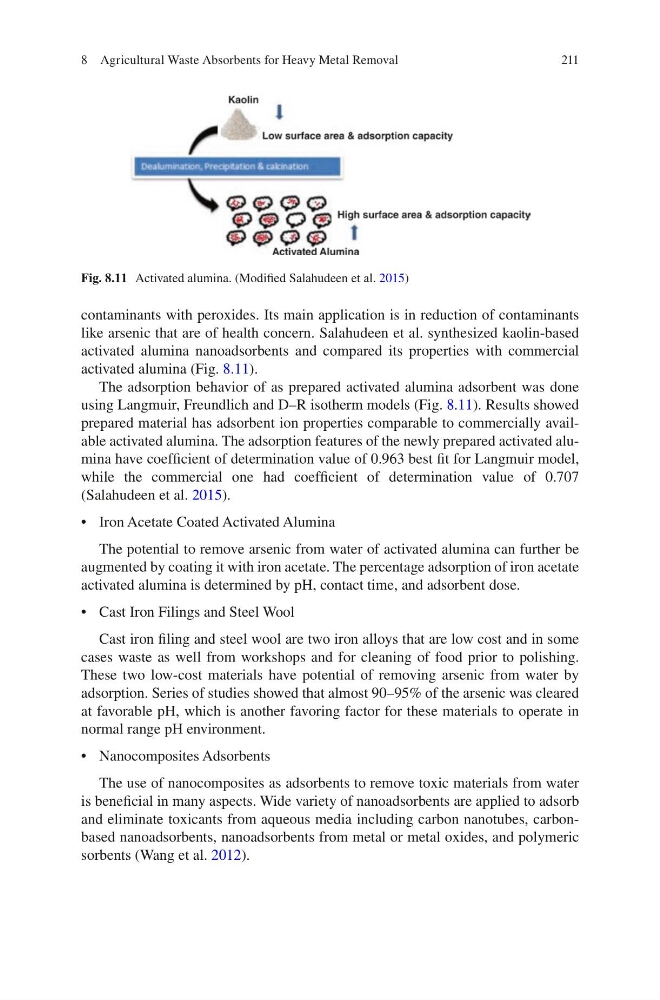
like arsenic that are of health concern. Salahudeen et al. synthesized kaolin-based
activated alumina nanoadsorbents and compared its properties with commercial
activated alumina (Fig. 8.11).
The adsorption behavior of as prepared activated alumina adsorbent was done
using Langmuir, Freundlich and D–R isotherm models (Fig. 8.11). Results showed
prepared material has adsorbent ion properties comparable to commercially available activated alumina. The adsorption features of the newly prepared activated alumina have coefficient of determination value of 0.963 best fit for Langmuir model,
while the commercial one had coefficient of determination value of 0.707
(Salahudeen et al. 2015).
• Iron Acetate Coated Activated Alumina
The potential to remove arsenic from water of activated alumina can further be
augmented by coating it with iron acetate. The percentage adsorption of iron acetate
activated alumina is determined by pH, contact time, and adsorbent dose.
• Cast Iron Filings and Steel Wool
Cast iron filing and steel wool are two iron alloys that are low cost and in some
cases waste as well from workshops and for cleaning of food prior to polishing.
These two low-cost materials have potential of removing arsenic from water by
adsorption. Series of studies showed that almost 90–95% of the arsenic was cleared
at favorable pH, which is another favoring factor for these materials to operate in
normal range pH environment.
• Nanocomposites Adsorbents
The use of nanocomposites as adsorbents to remove toxic materials from water
is beneficial in many aspects. Wide variety of nanoadsorbents are applied to adsorb
and eliminate toxicants from aqueous media including carbon nanotubes, carbonbased nanoadsorbents, nanoadsorbents from metal or metal oxides, and polymeric
sorbents (Wang et al. 2012).
Fig. 8.11 Activated alumina. (Modified Salahudeen et al. 2015)
8 Agricultural Waste Absorbents for Heavy Metal Removal
contaminants with peroxides. Its main application is in reduction of contaminants
like arsenic that are of health concern. Salahudeen et al. synthesized kaolin-based
activated alumina nanoadsorbents and compared its properties with commercial
activated alumina (Fig. 8.11).
The adsorption behavior of as prepared activated alumina adsorbent was done
using Langmuir, Freundlich and D–R isotherm models (Fig. 8.11). Results showed
prepared material has adsorbent ion properties comparable to commercially available activated alumina. The adsorption features of the newly prepared activated alumina have coefficient of determination value of 0.963 best fit for Langmuir model,
while the commercial one had coefficient of determination value of 0.707
(Salahudeen et al. 2015).
• Iron Acetate Coated Activated Alumina
The potential to remove arsenic from water of activated alumina can further be
augmented by coating it with iron acetate. The percentage adsorption of iron acetate
activated alumina is determined by pH, contact time, and adsorbent dose.
• Cast Iron Filings and Steel Wool
Cast iron filing and steel wool are two iron alloys that are low cost and in some
cases waste as well from workshops and for cleaning of food prior to polishing.
These two low-cost materials have potential of removing arsenic from water by
adsorption. Series of studies showed that almost 90–95% of the arsenic was cleared
at favorable pH, which is another favoring factor for these materials to operate in
normal range pH environment.
• Nanocomposites Adsorbents
The use of nanocomposites as adsorbents to remove toxic materials from water
is beneficial in many aspects. Wide variety of nanoadsorbents are applied to adsorb
and eliminate toxicants from aqueous media including carbon nanotubes, carbonbased nanoadsorbents, nanoadsorbents from metal or metal oxides, and polymeric
sorbents (Wang et al. 2012).
Fig. 8.11 Activated alumina. (Modified Salahudeen et al. 2015)
8 Agricultural Waste Absorbents for Heavy Metal Removal