

210
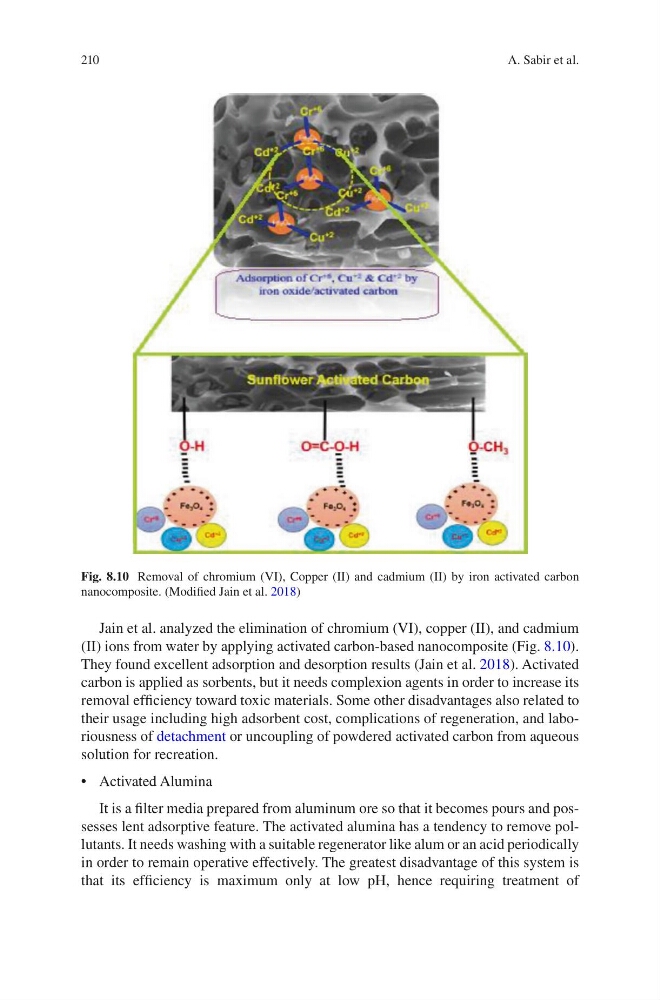
Jain et al. analyzed the elimination of chromium (VI), copper (II), and cadmium
(II) ions from water by applying activated carbon-based nanocomposite (Fig. 8.10).
They found excellent adsorption and desorption results (Jain et al. 2018). Activated
carbon is applied as sorbents, but it needs complexion agents in order to increase its
removal efficiency toward toxic materials. Some other disadvantages also related to
their usage including high adsorbent cost, complications of regeneration, and laboriousness of detachment or uncoupling of powdered activated carbon from aqueous
solution for recreation.
• Activated Alumina
It is a filter media prepared from aluminum ore so that it becomes pours and possesses lent adsorptive feature. The activated alumina has a tendency to remove pollutants. It needs washing with a suitable regenerator like alum or an acid periodically
in order to remain operative effectively. The greatest disadvantage of this system is
that its efficiency is maximum only at low pH, hence requiring treatment of
Fig. 8.10 Removal of chromium (VI), Copper (II) and cadmium (II) by iron activated carbon
nanocomposite. (Modified Jain et al. 2018)
A. Sabir et al.
Jain et al. analyzed the elimination of chromium (VI), copper (II), and cadmium
(II) ions from water by applying activated carbon-based nanocomposite (Fig. 8.10).
They found excellent adsorption and desorption results (Jain et al. 2018). Activated
carbon is applied as sorbents, but it needs complexion agents in order to increase its
removal efficiency toward toxic materials. Some other disadvantages also related to
their usage including high adsorbent cost, complications of regeneration, and laboriousness of detachment or uncoupling of powdered activated carbon from aqueous
solution for recreation.
• Activated Alumina
It is a filter media prepared from aluminum ore so that it becomes pours and possesses lent adsorptive feature. The activated alumina has a tendency to remove pollutants. It needs washing with a suitable regenerator like alum or an acid periodically
in order to remain operative effectively. The greatest disadvantage of this system is
that its efficiency is maximum only at low pH, hence requiring treatment of
Fig. 8.10 Removal of chromium (VI), Copper (II) and cadmium (II) by iron activated carbon
nanocomposite. (Modified Jain et al. 2018)
A. Sabir et al.