

199
is known to be a potential human cancer-causing metal and commutative toxicant
(Zhao et al. 2014), while mercury toxicity results in impairment of speech, mental
disturbance, and hearing and vision problems (Budnik and Casteleyn 2019).
Additionally, lead (Pb) and mercury (Hg) may result in autoimmunity development,
a disease in which immune system of a person tend to destroy its own cells, which
ultimately can cause joint-related illnesses, kidney damage, and ailment of the neurons and circulatory system. Higher quantities of lead and mercury may also result
in incurable brain impairments.
The source, toxicity, and chemistry of some heavy metals are discussed below.
8.2.1 Arsenic (As)
Arsenic is a tasteless and odorless element that occurs naturally. Arsenic occurs in
the aquatic environment in an inorganic form which comes from the disintegration
of solid compound including AsS 2 (realgar), As 2 O 5 (arsenolite), and As 2 O 3 (arsenic
anhydride) (Saint-Jacques et al. 2018). Arsenic may found in various valance states,
i.e., +1, +3, −3, and +5, and infrequently in elemental phase. It is found in
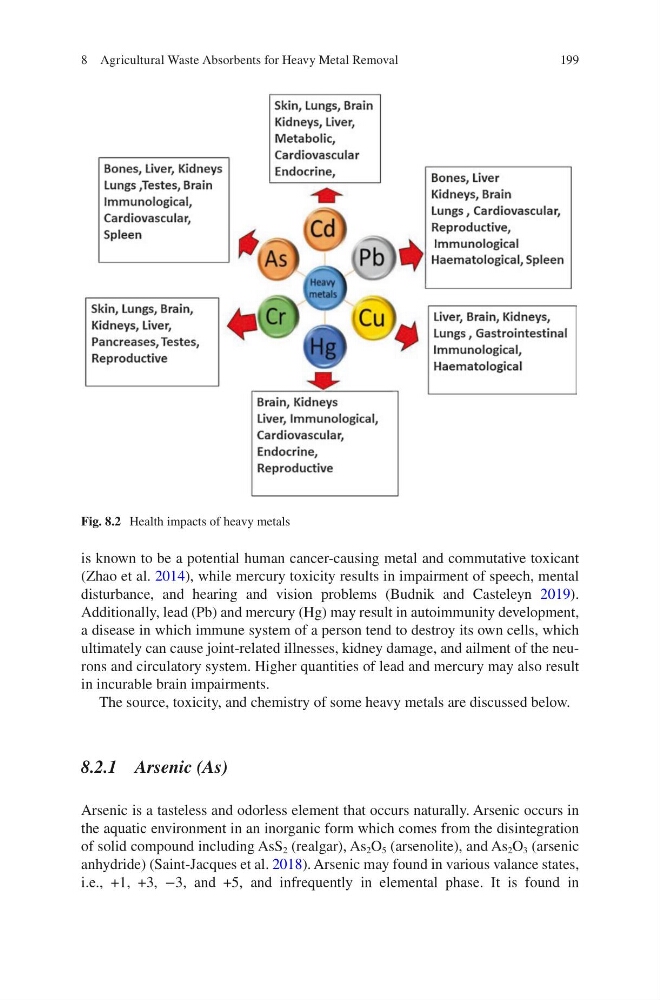
Fig. 8.2 Health impacts of heavy metals
8 Agricultural Waste Absorbents for Heavy Metal Removal
is known to be a potential human cancer-causing metal and commutative toxicant
(Zhao et al. 2014), while mercury toxicity results in impairment of speech, mental
disturbance, and hearing and vision problems (Budnik and Casteleyn 2019).
Additionally, lead (Pb) and mercury (Hg) may result in autoimmunity development,
a disease in which immune system of a person tend to destroy its own cells, which
ultimately can cause joint-related illnesses, kidney damage, and ailment of the neurons and circulatory system. Higher quantities of lead and mercury may also result
in incurable brain impairments.
The source, toxicity, and chemistry of some heavy metals are discussed below.
8.2.1 Arsenic (As)
Arsenic is a tasteless and odorless element that occurs naturally. Arsenic occurs in
the aquatic environment in an inorganic form which comes from the disintegration
of solid compound including AsS 2 (realgar), As 2 O 5 (arsenolite), and As 2 O 3 (arsenic
anhydride) (Saint-Jacques et al. 2018). Arsenic may found in various valance states,
i.e., +1, +3, −3, and +5, and infrequently in elemental phase. It is found in
Fig. 8.2 Health impacts of heavy metals
8 Agricultural Waste Absorbents for Heavy Metal Removal