

188
Ni Fe CN
Er
e
Er Ni Fe CN
III
II
1 5
6
3
1 3
1 5
6
1 3
.
/
.
/
( )
é ë
ù û +
+
( )
é ë
ù û
+
-
(7.4)
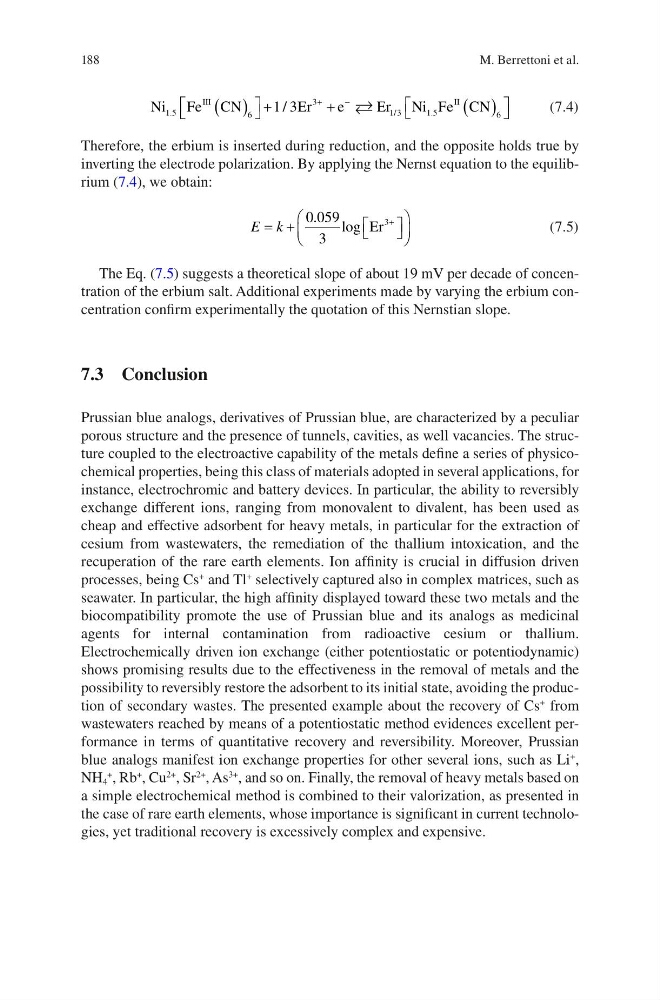
Therefore, the erbium is inserted during reduction, and the opposite holds true by
inverting the electrode polarization. By applying the Nernst equation to the equilibrium (7.4), we obtain:
E k
= +
é ë
ù û
æ
è
ç
ö
ø
÷
+
0 059
3
3
.
log Er
(7.5)
The Eq. (7.5) suggests a theoretical slope of about 19 mV per decade of concentration of the erbium salt. Additional experiments made by varying the erbium concentration confirm experimentally the quotation of this Nernstian slope.
7.3 Conclusion
Prussian blue analogs, derivatives of Prussian blue, are characterized by a peculiar
porous structure and the presence of tunnels, cavities, as well vacancies. The structure coupled to the electroactive capability of the metals define a series of physicochemical properties, being this class of materials adopted in several applications, for
instance, electrochromic and battery devices. In particular, the ability to reversibly
exchange different ions, ranging from monovalent to divalent, has been used as
cheap and effective adsorbent for heavy metals, in particular for the extraction of
cesium from wastewaters, the remediation of the thallium intoxication, and the
recuperation of the rare earth elements. Ion affinity is crucial in diffusion driven
processes, being Cs
+
and Tl
+
selectively captured also in complex matrices, such as
seawater. In particular, the high affinity displayed toward these two metals and the
biocompatibility promote the use of Prussian blue and its analogs as medicinal
agents for internal contamination from radioactive cesium or thallium.
Electrochemically driven ion exchange (either potentiostatic or potentiodynamic)
shows promising results due to the effectiveness in the removal of metals and the
possibility to reversibly restore the adsorbent to its initial state, avoiding the production of secondary wastes. The presented example about the recovery of Cs
+
from
wastewaters reached by means of a potentiostatic method evidences excellent performance in terms of quantitative recovery and reversibility. Moreover, Prussian
blue analogs manifest ion exchange properties for other several ions, such as Li
+
,
NH 4
+
, Rb
+
, Cu
2+
, Sr
2+
, As
3+
, and so on. Finally, the removal of heavy metals based on
a simple electrochemical method is combined to their valorization, as presented in
the case of rare earth elements, whose importance is significant in current technologies, yet traditional recovery is excessively complex and expensive.
M. Berrettoni et al.
Ni Fe CN
Er
e
Er Ni Fe CN
III
II
1 5
6
3
1 3
1 5
6
1 3
.
/
.
/
( )
é ë
ù û +
+
( )
é ë
ù û
+
-
(7.4)
Therefore, the erbium is inserted during reduction, and the opposite holds true by
inverting the electrode polarization. By applying the Nernst equation to the equilibrium (7.4), we obtain:
E k
= +
é ë
ù û
æ
è
ç
ö
ø
÷
+
0 059
3
3
.
log Er
(7.5)
The Eq. (7.5) suggests a theoretical slope of about 19 mV per decade of concentration of the erbium salt. Additional experiments made by varying the erbium concentration confirm experimentally the quotation of this Nernstian slope.
7.3 Conclusion
Prussian blue analogs, derivatives of Prussian blue, are characterized by a peculiar
porous structure and the presence of tunnels, cavities, as well vacancies. The structure coupled to the electroactive capability of the metals define a series of physicochemical properties, being this class of materials adopted in several applications, for
instance, electrochromic and battery devices. In particular, the ability to reversibly
exchange different ions, ranging from monovalent to divalent, has been used as
cheap and effective adsorbent for heavy metals, in particular for the extraction of
cesium from wastewaters, the remediation of the thallium intoxication, and the
recuperation of the rare earth elements. Ion affinity is crucial in diffusion driven
processes, being Cs
+
and Tl
+
selectively captured also in complex matrices, such as
seawater. In particular, the high affinity displayed toward these two metals and the
biocompatibility promote the use of Prussian blue and its analogs as medicinal
agents for internal contamination from radioactive cesium or thallium.
Electrochemically driven ion exchange (either potentiostatic or potentiodynamic)
shows promising results due to the effectiveness in the removal of metals and the
possibility to reversibly restore the adsorbent to its initial state, avoiding the production of secondary wastes. The presented example about the recovery of Cs
+
from
wastewaters reached by means of a potentiostatic method evidences excellent performance in terms of quantitative recovery and reversibility. Moreover, Prussian
blue analogs manifest ion exchange properties for other several ions, such as Li
+
,
NH 4
+
, Rb
+
, Cu
2+
, Sr
2+
, As
3+
, and so on. Finally, the removal of heavy metals based on
a simple electrochemical method is combined to their valorization, as presented in
the case of rare earth elements, whose importance is significant in current technologies, yet traditional recovery is excessively complex and expensive.
M. Berrettoni et al.