

187
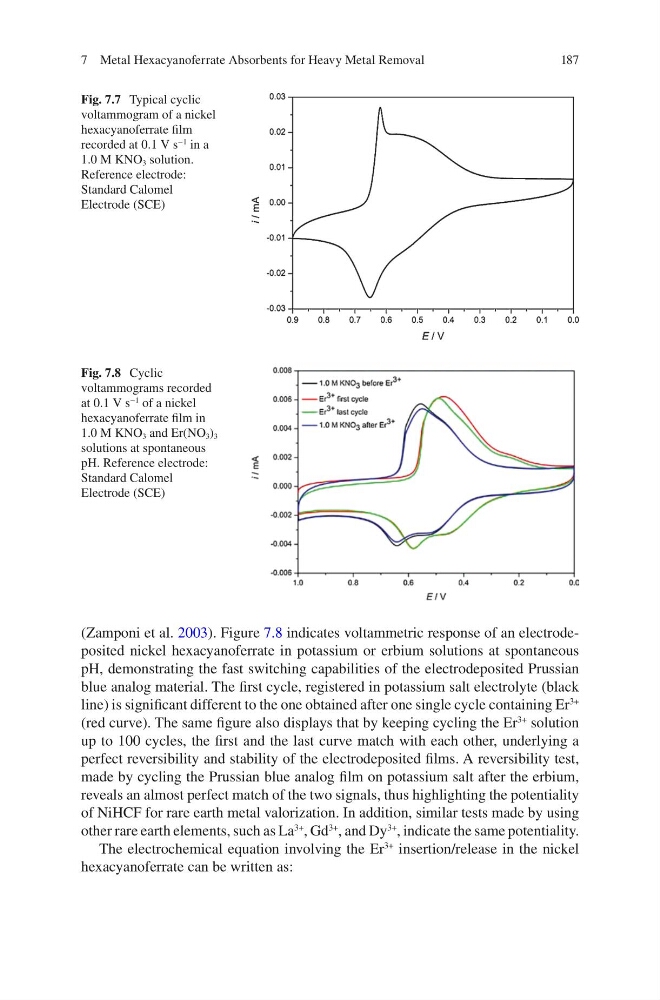
(Zamponi et al. 2003). Figure 7.8 indicates voltammetric response of an electrodeposited nickel hexacyanoferrate in potassium or erbium solutions at spontaneous
pH, demonstrating the fast switching capabilities of the electrodeposited Prussian
blue analog material. The first cycle, registered in potassium salt electrolyte (black
line) is significant different to the one obtained after one single cycle containing Er
3+
(red curve). The same figure also displays that by keeping cycling the Er
3+
solution
up to 100 cycles, the first and the last curve match with each other, underlying a
perfect reversibility and stability of the electrodeposited films. A reversibility test,
made by cycling the Prussian blue analog film on potassium salt after the erbium,
reveals an almost perfect match of the two signals, thus highlighting the potentiality
of NiHCF for rare earth metal valorization. In addition, similar tests made by using
other rare earth elements, such as La
3+
, Gd
3+
, and Dy
3+
, indicate the same potentiality.
The electrochemical equation involving the Er
3+
insertion/release in the nickel
hexacyanoferrate can be written as:
Fig. 7.7 Typical cyclic
voltammogram of a nickel
hexacyanoferrate film
recorded at 0.1 V s
−1 in a
1.0 M KNO 3 solution.
Reference electrode:
Standard Calomel
Electrode (SCE)
Fig. 7.8 Cyclic
voltammograms recorded
at 0.1 V s
−1 of a nickel
hexacyanoferrate film in
1.0 M KNO 3 and Er(NO 3 ) 3
solutions at spontaneous
pH. Reference electrode:
Standard Calomel
Electrode (SCE)
7 Metal Hexacyanoferrate Absorbents for Heavy Metal Removal
(Zamponi et al. 2003). Figure 7.8 indicates voltammetric response of an electrodeposited nickel hexacyanoferrate in potassium or erbium solutions at spontaneous
pH, demonstrating the fast switching capabilities of the electrodeposited Prussian
blue analog material. The first cycle, registered in potassium salt electrolyte (black
line) is significant different to the one obtained after one single cycle containing Er
3+
(red curve). The same figure also displays that by keeping cycling the Er
3+
solution
up to 100 cycles, the first and the last curve match with each other, underlying a
perfect reversibility and stability of the electrodeposited films. A reversibility test,
made by cycling the Prussian blue analog film on potassium salt after the erbium,
reveals an almost perfect match of the two signals, thus highlighting the potentiality
of NiHCF for rare earth metal valorization. In addition, similar tests made by using
other rare earth elements, such as La
3+
, Gd
3+
, and Dy
3+
, indicate the same potentiality.
The electrochemical equation involving the Er
3+
insertion/release in the nickel
hexacyanoferrate can be written as:
Fig. 7.7 Typical cyclic
voltammogram of a nickel
hexacyanoferrate film
recorded at 0.1 V s
−1 in a
1.0 M KNO 3 solution.
Reference electrode:
Standard Calomel
Electrode (SCE)
Fig. 7.8 Cyclic
voltammograms recorded
at 0.1 V s
−1 of a nickel
hexacyanoferrate film in
1.0 M KNO 3 and Er(NO 3 ) 3
solutions at spontaneous
pH. Reference electrode:
Standard Calomel
Electrode (SCE)
7 Metal Hexacyanoferrate Absorbents for Heavy Metal Removal