

6
1.3.2 Preparation of Activated Carbon
Three major steps are required in the preparation of AC, namely: (1) pretreatment,
(2) activation, and (3) carbonization as shown in Fig. 1.2. While activation involves
the use of reagents, carbonization (or pyrolysis) requires the application of heat
treatment to raise the carbon content of the precursors (González and Pliego-Cuervo
2013). Particle size is very important in material handling such as in mixing precursors with catalyst and impregnation reagents as well as in determining the textural
properties of the produced activated carbon (Auta and Hameed 2011; Gurten et al.
2012). Hence, unit operations including milling, grinding, and sieving are often
used to pretreat raw materials in order to achieve required particle sizes (Alslaibi
et al. 2013). The works of Şentorun-Shalaby et al. (2006) and Müller (2010) among
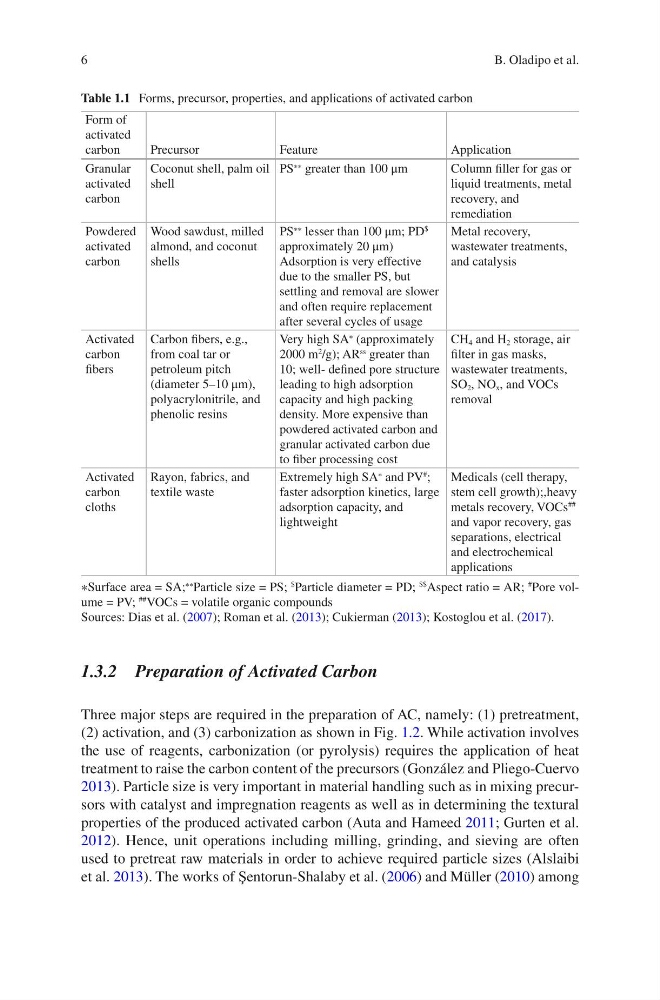
Table 1.1 Forms, precursor, properties, and applications of activated carbon
Form of
activated
carbon
Precursor
Feature
Application
Granular
activated
carbon
Coconut shell, palm oil
shell
PS
∗∗ greater than 100 μm
Column filler for gas or
liquid treatments, metal
recovery, and
remediation
Powdered
activated
carbon
Wood sawdust, milled
almond, and coconut
shells
PS
∗∗ lesser than 100 μm; PD
$
approximately 20 μm)
Adsorption is very effective
due to the smaller PS, but
settling and removal are slower
and often require replacement
after several cycles of usage
Metal recovery,
wastewater treatments,
and catalysis
Activated
carbon
fibers
Carbon fibers, e.g.,
from coal tar or
petroleum pitch
(diameter 5–10 μm),
polyacrylonitrile, and
phenolic resins
Very high SA
∗ (approximately
2000 m
2 /g); AR
ss greater than
10; well- defined pore structure
leading to high adsorption
capacity and high packing
density. More expensive than
powdered activated carbon and
granular activated carbon due
to fiber processing cost
CH 4 and H 2 storage, air
filter in gas masks,
wastewater treatments,
SO 2 , NO x , and VOCs
removal
Activated
carbon
cloths
Rayon, fabrics, and
textile waste
Extremely high SA
∗ and PV
#
;
faster adsorption kinetics, large
adsorption capacity, and
lightweight
Medicals (cell therapy,
stem cell growth);,heavy
metals recovery, VOCs
##
and vapor recovery, gas
separations, electrical
and electrochemical
applications
∗Surface area = SA;
∗∗ Particle size = PS;
$
Particle diameter = PD;
$$ Aspect ratio = AR;
#
Pore volume = PV;
##
VOCs = volatile organic compounds
Sources: Dias et al. (2007); Roman et al. (2013); Cukierman (2013); Kostoglou et al. (2017).
B. Oladipo et al.
1.3.2 Preparation of Activated Carbon
Three major steps are required in the preparation of AC, namely: (1) pretreatment,
(2) activation, and (3) carbonization as shown in Fig. 1.2. While activation involves
the use of reagents, carbonization (or pyrolysis) requires the application of heat
treatment to raise the carbon content of the precursors (González and Pliego-Cuervo
2013). Particle size is very important in material handling such as in mixing precursors with catalyst and impregnation reagents as well as in determining the textural
properties of the produced activated carbon (Auta and Hameed 2011; Gurten et al.
2012). Hence, unit operations including milling, grinding, and sieving are often
used to pretreat raw materials in order to achieve required particle sizes (Alslaibi
et al. 2013). The works of Şentorun-Shalaby et al. (2006) and Müller (2010) among
Table 1.1 Forms, precursor, properties, and applications of activated carbon
Form of
activated
carbon
Precursor
Feature
Application
Granular
activated
carbon
Coconut shell, palm oil
shell
PS
∗∗ greater than 100 μm
Column filler for gas or
liquid treatments, metal
recovery, and
remediation
Powdered
activated
carbon
Wood sawdust, milled
almond, and coconut
shells
PS
∗∗ lesser than 100 μm; PD
$
approximately 20 μm)
Adsorption is very effective
due to the smaller PS, but
settling and removal are slower
and often require replacement
after several cycles of usage
Metal recovery,
wastewater treatments,
and catalysis
Activated
carbon
fibers
Carbon fibers, e.g.,
from coal tar or
petroleum pitch
(diameter 5–10 μm),
polyacrylonitrile, and
phenolic resins
Very high SA
∗ (approximately
2000 m
2 /g); AR
ss greater than
10; well- defined pore structure
leading to high adsorption
capacity and high packing
density. More expensive than
powdered activated carbon and
granular activated carbon due
to fiber processing cost
CH 4 and H 2 storage, air
filter in gas masks,
wastewater treatments,
SO 2 , NO x , and VOCs
removal
Activated
carbon
cloths
Rayon, fabrics, and
textile waste
Extremely high SA
∗ and PV
#
;
faster adsorption kinetics, large
adsorption capacity, and
lightweight
Medicals (cell therapy,
stem cell growth);,heavy
metals recovery, VOCs
##
and vapor recovery, gas
separations, electrical
and electrochemical
applications
∗Surface area = SA;
∗∗ Particle size = PS;
$
Particle diameter = PD;
$$ Aspect ratio = AR;
#
Pore volume = PV;
##
VOCs = volatile organic compounds
Sources: Dias et al. (2007); Roman et al. (2013); Cukierman (2013); Kostoglou et al. (2017).
B. Oladipo et al.