

178
interstitial water that can hinder the cycle life of the electrode by saturating some
active sites (Itaya et al. 1984); (2) only the C-coordinated site of the CN ligand was
considered electroactive, making half of the vacant lattice spaces typically unused
(Yue et al. 2014). However, recent studies (Mullaliu et al. 2018a, b, 2019) made by
using the atomic sensitivity of X-ray absorption spectroscopy (XAS) demonstrated
that the copper or cobalt is electrochemically active in either copper or cobalt hexacyanoferrate electrode.
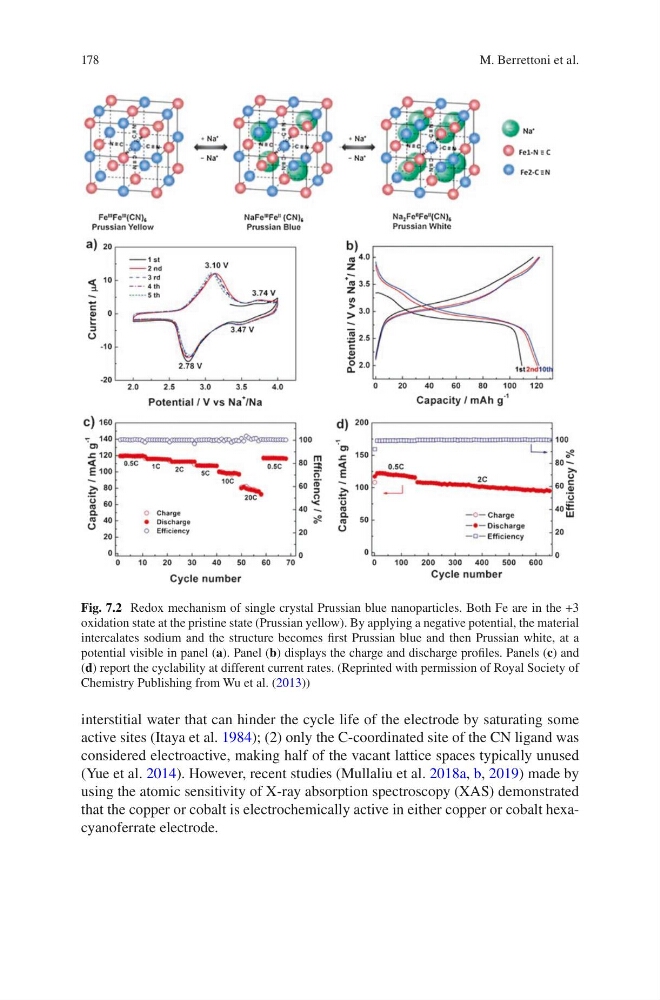
Fig. 7.2 Redox mechanism of single crystal Prussian blue nanoparticles. Both Fe are in the +3
oxidation state at the pristine state (Prussian yellow). By applying a negative potential, the material
intercalates sodium and the structure becomes first Prussian blue and then Prussian white, at a
potential visible in panel (a). Panel (b) displays the charge and discharge profiles. Panels (c) and
(d) report the cyclability at different current rates. (Reprinted with permission of Royal Society of
Chemistry Publishing from Wu et al. (2013))
M. Berrettoni et al.
interstitial water that can hinder the cycle life of the electrode by saturating some
active sites (Itaya et al. 1984); (2) only the C-coordinated site of the CN ligand was
considered electroactive, making half of the vacant lattice spaces typically unused
(Yue et al. 2014). However, recent studies (Mullaliu et al. 2018a, b, 2019) made by
using the atomic sensitivity of X-ray absorption spectroscopy (XAS) demonstrated
that the copper or cobalt is electrochemically active in either copper or cobalt hexacyanoferrate electrode.
Fig. 7.2 Redox mechanism of single crystal Prussian blue nanoparticles. Both Fe are in the +3
oxidation state at the pristine state (Prussian yellow). By applying a negative potential, the material
intercalates sodium and the structure becomes first Prussian blue and then Prussian white, at a
potential visible in panel (a). Panel (b) displays the charge and discharge profiles. Panels (c) and
(d) report the cyclability at different current rates. (Reprinted with permission of Royal Society of
Chemistry Publishing from Wu et al. (2013))
M. Berrettoni et al.