

177
(Qian et al. 2018). A significant result using a Prussian blue analog as an electrode
material for battery was suggested by Wessells et al. (2011), who showed interesting
performance of the copper analog in aqueous media, able to perform as many as
40,000 cycles. Furthermore, You et al. (2014) demonstrated the role of structural
defects on the electrode performance. Not only the most common ions such as lithium (Wessells et al. 2012; Mullaliu et al. 2019) and sodium (Moritomo et al. 2016;
Song et al. 2015) can be used for ion battery technology but also potassium
(Eftekhari 2004), the divalent calcium (Shiga et al. 2015), and magnesium (Chae
et al. 2017), as well as the trivalent aluminum (Liu et al. 2014). From a structural
perspective on the inserted cation occupancy, Ling et al. (2013) observed that large
cations prefer the body-centered site, whereas for small cations the face-centered
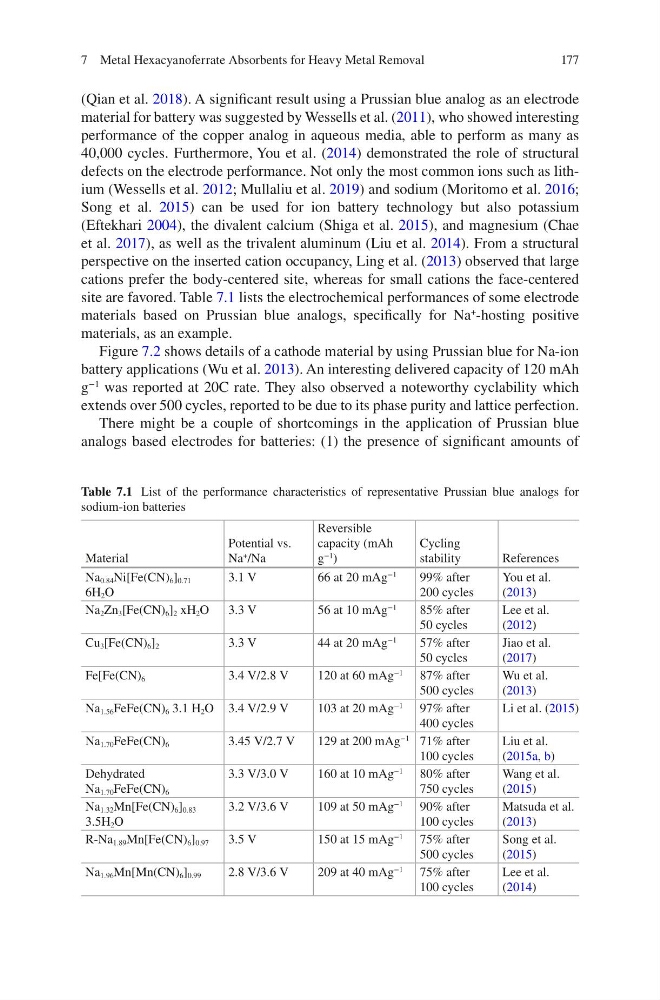
site are favored. Table 7.1 lists the electrochemical performances of some electrode
materials based on Prussian blue analogs, specifically for Na
+
-hosting positive
materials, as an example.
Figure 7.2 shows details of a cathode material by using Prussian blue for Na-ion
battery applications (Wu et al. 2013). An interesting delivered capacity of 120 mAh
g
−1
was reported at 20C rate. They also observed a noteworthy cyclability which
extends over 500 cycles, reported to be due to its phase purity and lattice perfection.
There might be a couple of shortcomings in the application of Prussian blue
analogs based electrodes for batteries: (1) the presence of significant amounts of
Table 7.1 List of the performance characteristics of representative Prussian blue analogs for
sodium-ion batteries
Material
Potential vs.
Na
+
/Na
Reversible
capacity (mAh
g
−1 )
Cycling
stability
References
Na 0.84 Ni[Fe(CN) 6 ] 0.71
6H 2 O
3.1 V
66 at 20 mAg
−1
99% after
200 cycles
You et al.
(2013)
Na 2 Zn 3 [Fe(CN) 6 ] 2 xH 2 O
3.3 V
56 at 10 mAg
−1
85% after
50 cycles
Lee et al.
(2012)
Cu 3 [Fe(CN) 6 ] 2
3.3 V
44 at 20 mAg
−1
57% after
50 cycles
Jiao et al.
(2017)
Fe[Fe(CN) 6
3.4 V/2.8 V
120 at 60 mAg
−1
87% after
500 cycles
Wu et al.
(2013)
Na 1.56 FeFe(CN) 6 3.1 H 2 O 3.4 V/2.9 V
103 at 20 mAg
−1
97% after
400 cycles
Li et al. (2015)
Na 1.70 FeFe(CN) 6
3.45 V/2.7 V
129 at 200 mAg
−1 71% after
100 cycles
Liu et al.
(2015a, b)
Dehydrated
Na 1.70 FeFe(CN) 6
3.3 V/3.0 V
160 at 10 mAg
−1
80% after
750 cycles
Wang et al.
(2015)
Na 1.32 Mn[Fe(CN) 6 ] 0.83
3.5H 2 O
3.2 V/3.6 V
109 at 50 mAg
−1
90% after
100 cycles
Matsuda et al.
(2013)
R-Na 1.89 Mn[Fe(CN) 6 ] 0.97
3.5 V
150 at 15 mAg
−1
75% after
500 cycles
Song et al.
(2015)
Na 1.96 Mn[Mn(CN) 6 ] 0.99
2.8 V/3.6 V
209 at 40 mAg
−1
75% after
100 cycles
Lee et al.
(2014)
7 Metal Hexacyanoferrate Absorbents for Heavy Metal Removal
(Qian et al. 2018). A significant result using a Prussian blue analog as an electrode
material for battery was suggested by Wessells et al. (2011), who showed interesting
performance of the copper analog in aqueous media, able to perform as many as
40,000 cycles. Furthermore, You et al. (2014) demonstrated the role of structural
defects on the electrode performance. Not only the most common ions such as lithium (Wessells et al. 2012; Mullaliu et al. 2019) and sodium (Moritomo et al. 2016;
Song et al. 2015) can be used for ion battery technology but also potassium
(Eftekhari 2004), the divalent calcium (Shiga et al. 2015), and magnesium (Chae
et al. 2017), as well as the trivalent aluminum (Liu et al. 2014). From a structural
perspective on the inserted cation occupancy, Ling et al. (2013) observed that large
cations prefer the body-centered site, whereas for small cations the face-centered
site are favored. Table 7.1 lists the electrochemical performances of some electrode
materials based on Prussian blue analogs, specifically for Na
+
-hosting positive
materials, as an example.
Figure 7.2 shows details of a cathode material by using Prussian blue for Na-ion
battery applications (Wu et al. 2013). An interesting delivered capacity of 120 mAh
g
−1
was reported at 20C rate. They also observed a noteworthy cyclability which
extends over 500 cycles, reported to be due to its phase purity and lattice perfection.
There might be a couple of shortcomings in the application of Prussian blue
analogs based electrodes for batteries: (1) the presence of significant amounts of
Table 7.1 List of the performance characteristics of representative Prussian blue analogs for
sodium-ion batteries
Material
Potential vs.
Na
+
/Na
Reversible
capacity (mAh
g
−1 )
Cycling
stability
References
Na 0.84 Ni[Fe(CN) 6 ] 0.71
6H 2 O
3.1 V
66 at 20 mAg
−1
99% after
200 cycles
You et al.
(2013)
Na 2 Zn 3 [Fe(CN) 6 ] 2 xH 2 O
3.3 V
56 at 10 mAg
−1
85% after
50 cycles
Lee et al.
(2012)
Cu 3 [Fe(CN) 6 ] 2
3.3 V
44 at 20 mAg
−1
57% after
50 cycles
Jiao et al.
(2017)
Fe[Fe(CN) 6
3.4 V/2.8 V
120 at 60 mAg
−1
87% after
500 cycles
Wu et al.
(2013)
Na 1.56 FeFe(CN) 6 3.1 H 2 O 3.4 V/2.9 V
103 at 20 mAg
−1
97% after
400 cycles
Li et al. (2015)
Na 1.70 FeFe(CN) 6
3.45 V/2.7 V
129 at 200 mAg
−1 71% after
100 cycles
Liu et al.
(2015a, b)
Dehydrated
Na 1.70 FeFe(CN) 6
3.3 V/3.0 V
160 at 10 mAg
−1
80% after
750 cycles
Wang et al.
(2015)
Na 1.32 Mn[Fe(CN) 6 ] 0.83
3.5H 2 O
3.2 V/3.6 V
109 at 50 mAg
−1
90% after
100 cycles
Matsuda et al.
(2013)
R-Na 1.89 Mn[Fe(CN) 6 ] 0.97
3.5 V
150 at 15 mAg
−1
75% after
500 cycles
Song et al.
(2015)
Na 1.96 Mn[Mn(CN) 6 ] 0.99
2.8 V/3.6 V
209 at 40 mAg
−1
75% after
100 cycles
Lee et al.
(2014)
7 Metal Hexacyanoferrate Absorbents for Heavy Metal Removal