

163


=
-
(
)q
t
k c q
q k q
ads
des
max
(6.11)
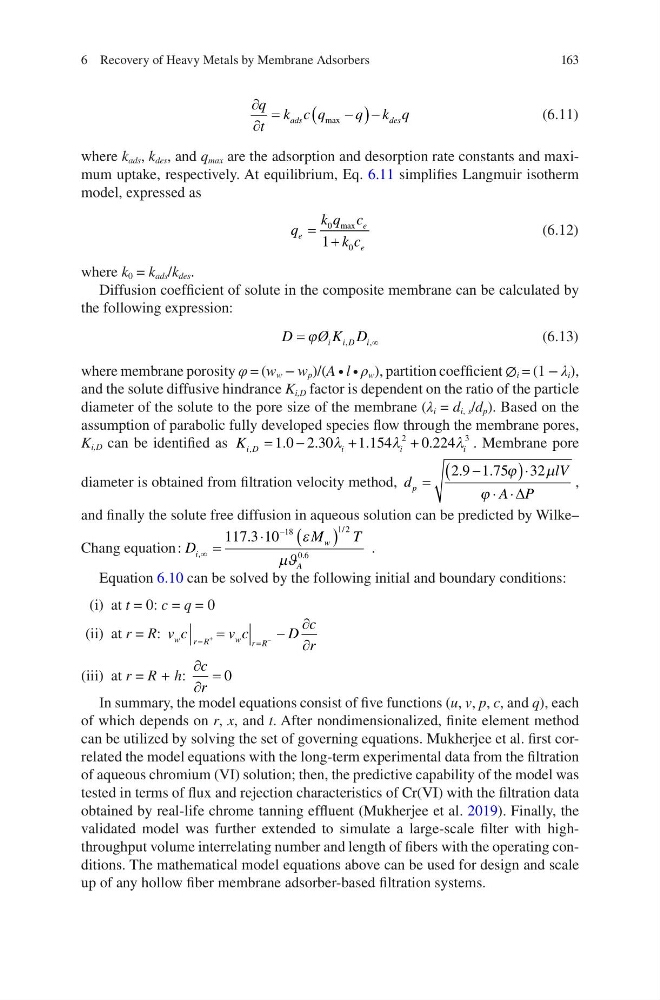
where k ads , k des , and q max are the adsorption and desorption rate constants and maximum uptake, respectively. At equilibrium, Eq. 6.11 simplifies Langmuir isotherm
model, expressed as
q
k q c
k c
e
e
e
= +
0
0
1
max
(6.12)
where k 0 = k ads /k des .
Diffusion coefficient of solute in the composite membrane can be calculated by
the following expression:
D
K D
i i D i
=
¥
jØ , ,
(6.13)
where membrane porosity φ = (w w − w p )/(A ∙ l ∙ ρ w ), partition coefficient ∅ i = (1 − λ i ),
and the solute diffusive hindrance K i,D factor is dependent on the ratio of the particle
diameter of the solute to the pore size of the membrane (λ i = d i, s /d p ). Based on the
assumption of parabolic fully developed species flow through the membrane pores,
K i,D can be identified as K i D
i
i
i
,
.
.
.
.
=
-
+
+
1 0 2 30
1154
0 224
2
3
l
l
l . Membrane pore
diameter is obtained from filtration velocity method, d
lV
A P
p =
-
(
)×
× ×
2 9 1 75 32
.
. j
m
j
D
,
and finally the solute free diffusion in aqueous solution can be predicted by Wilke–
Chang equation :
.
,
/
.
D
M
T
i
w
A
¥
-
=
×
(
)
117 3 10
18
1 2
0 6
e
mJ
.
Equation 6.10 can be solved by the following initial and boundary conditions:
(i) at t = 0: c = q = 0
(ii) at r = R: v c
v c
D
c
r
w
r R
w r R
=
=
+
-
=
-


(iii) at r = R + h:


=
c
r
0
In summary, the model equations consist of five functions (u, v, p, c, and q), each
of which depends on r, x, and t. After nondimensionalized, finite element method
can be utilized by solving the set of governing equations. Mukherjee et al. first correlated the model equations with the long-term experimental data from the filtration
of aqueous chromium (VI) solution; then, the predictive capability of the model was
tested in terms of flux and rejection characteristics of Cr(VI) with the filtration data
obtained by real-life chrome tanning effluent (Mukherjee et al. 2019). Finally, the
validated model was further extended to simulate a large-scale filter with highthroughput volume interrelating number and length of fibers with the operating conditions. The mathematical model equations above can be used for design and scale
up of any hollow fiber membrane adsorber-based filtration systems.
6 Recovery of Heavy Metals by Membrane Adsorbers


=
-
(
)q
t
k c q
q k q
ads
des
max
(6.11)
where k ads , k des , and q max are the adsorption and desorption rate constants and maximum uptake, respectively. At equilibrium, Eq. 6.11 simplifies Langmuir isotherm
model, expressed as
q
k q c
k c
e
e
e
= +
0
0
1
max
(6.12)
where k 0 = k ads /k des .
Diffusion coefficient of solute in the composite membrane can be calculated by
the following expression:
D
K D
i i D i
=
¥
jØ , ,
(6.13)
where membrane porosity φ = (w w − w p )/(A ∙ l ∙ ρ w ), partition coefficient ∅ i = (1 − λ i ),
and the solute diffusive hindrance K i,D factor is dependent on the ratio of the particle
diameter of the solute to the pore size of the membrane (λ i = d i, s /d p ). Based on the
assumption of parabolic fully developed species flow through the membrane pores,
K i,D can be identified as K i D
i
i
i
,
.
.
.
.
=
-
+
+
1 0 2 30
1154
0 224
2
3
l
l
l . Membrane pore
diameter is obtained from filtration velocity method, d
lV
A P
p =
-
(
)×
× ×
2 9 1 75 32
.
. j
m
j
D
,
and finally the solute free diffusion in aqueous solution can be predicted by Wilke–
Chang equation :
.
,
/
.
D
M
T
i
w
A
¥
-
=
×
(
)
117 3 10
18
1 2
0 6
e
mJ
.
Equation 6.10 can be solved by the following initial and boundary conditions:
(i) at t = 0: c = q = 0
(ii) at r = R: v c
v c
D
c
r
w
r R
w r R
=
=
+
-
=
-


(iii) at r = R + h:


=
c
r
0
In summary, the model equations consist of five functions (u, v, p, c, and q), each
of which depends on r, x, and t. After nondimensionalized, finite element method
can be utilized by solving the set of governing equations. Mukherjee et al. first correlated the model equations with the long-term experimental data from the filtration
of aqueous chromium (VI) solution; then, the predictive capability of the model was
tested in terms of flux and rejection characteristics of Cr(VI) with the filtration data
obtained by real-life chrome tanning effluent (Mukherjee et al. 2019). Finally, the
validated model was further extended to simulate a large-scale filter with highthroughput volume interrelating number and length of fibers with the operating conditions. The mathematical model equations above can be used for design and scale
up of any hollow fiber membrane adsorber-based filtration systems.
6 Recovery of Heavy Metals by Membrane Adsorbers