

162
(ii) at r = R, for all z: u = 0 and v = v w (x) (coupling with Darcy velocity in Domain 2)
(iii) x = 0 for all r (at the entrance of the channel): v = 0 and u = u 0
(iv) at z = L: p = p atm – it is necessary to solve p(r,x)
(v) initially, t = 0: u = v = 0
Mean velocity, u 0 , can be calculated by dividing volumetric flow rate, V, to the
cross-sectional area (A = n f πR
2
), where n f is fiber numbers in the module.
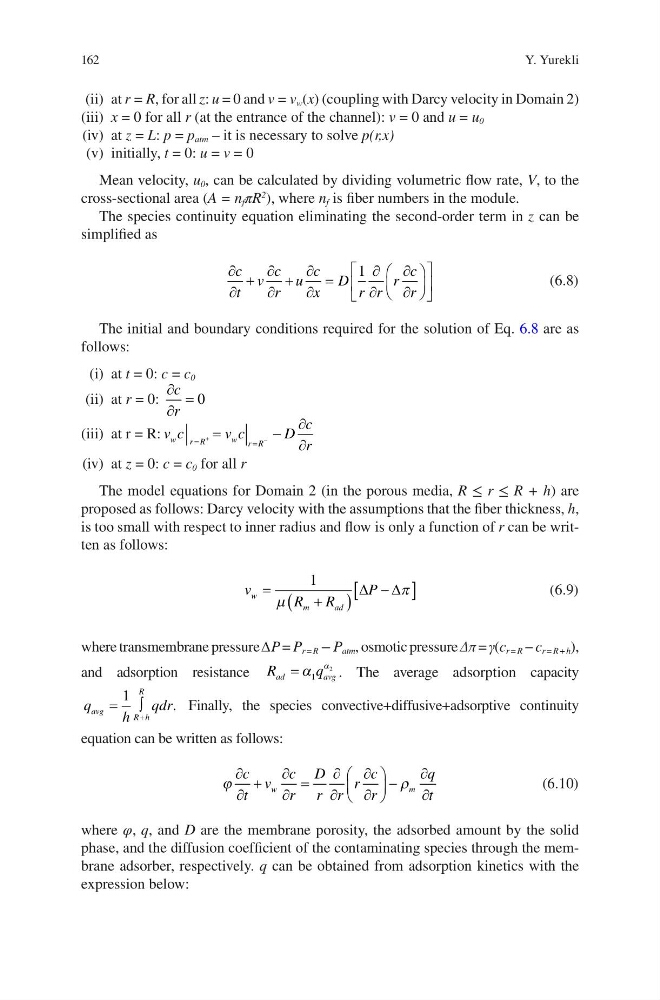
The species continuity equation eliminating the second-order term in z can be
simplified as


+


+


=


æ
è
ç
ö
ø
÷
é
ë
ê
ù
û
ú
c
t
v
c
r
u
c
x
D r r
r
c
r
1
(6.8)
The initial and boundary conditions required for the solution of Eq. 6.8 are as
follows:
(i) at t = 0: c = c 0
(ii) at r = 0:


=
c
r
0
(iii) at r = R: v c
v c
D
c
r
w
r R
w r R
=
=
+
-
=
-


(iv) at z = 0: c = c 0 for all r
The model equations for Domain 2 (in the porous media, R ≤ r ≤ R + h) are
proposed as follows: Darcy velocity with the assumptions that the fiber thickness, h,
is too small with respect to inner radius and flow is only a function of r can be written as follows:
v
R R
P
w
m
a d
=
+
(
)
-
[
]
1
m
p
D
D
(6.9)
where transmembrane pressure ∆P = P r = R − P atm , osmotic pressure ∆π = γ(c r = R − c r = R + h ),
and adsorption resistance R
q
ad
avg
= a
a
1
2 . The average adsorption capacity
q
h
qdr
avg
R h
R
= ò
+
1
. Finally, the species convective+diffusive+adsorptive continuity
equation can be written as follows:
j
r


+


=


æ
è
ç
ö
ø
÷ -


c
t
v
c
r
D
r r
r
c
r
q
t
w
m
(6.10)
where φ, q, and D are the membrane porosity, the adsorbed amount by the solid
phase, and the diffusion coefficient of the contaminating species through the membrane adsorber, respectively. q can be obtained from adsorption kinetics with the
expression below:
Y. Yurekli
(ii) at r = R, for all z: u = 0 and v = v w (x) (coupling with Darcy velocity in Domain 2)
(iii) x = 0 for all r (at the entrance of the channel): v = 0 and u = u 0
(iv) at z = L: p = p atm – it is necessary to solve p(r,x)
(v) initially, t = 0: u = v = 0
Mean velocity, u 0 , can be calculated by dividing volumetric flow rate, V, to the
cross-sectional area (A = n f πR
2
), where n f is fiber numbers in the module.
The species continuity equation eliminating the second-order term in z can be
simplified as


+


+


=


æ
è
ç
ö
ø
÷
é
ë
ê
ù
û
ú
c
t
v
c
r
u
c
x
D r r
r
c
r
1
(6.8)
The initial and boundary conditions required for the solution of Eq. 6.8 are as
follows:
(i) at t = 0: c = c 0
(ii) at r = 0:


=
c
r
0
(iii) at r = R: v c
v c
D
c
r
w
r R
w r R
=
=
+
-
=
-


(iv) at z = 0: c = c 0 for all r
The model equations for Domain 2 (in the porous media, R ≤ r ≤ R + h) are
proposed as follows: Darcy velocity with the assumptions that the fiber thickness, h,
is too small with respect to inner radius and flow is only a function of r can be written as follows:
v
R R
P
w
m
a d
=
+
(
)
-
[
]
1
m
p
D
D
(6.9)
where transmembrane pressure ∆P = P r = R − P atm , osmotic pressure ∆π = γ(c r = R − c r = R + h ),
and adsorption resistance R
q
ad
avg
= a
a
1
2 . The average adsorption capacity
q
h
qdr
avg
R h
R
= ò
+
1
. Finally, the species convective+diffusive+adsorptive continuity
equation can be written as follows:
j
r


+


=


æ
è
ç
ö
ø
÷ -


c
t
v
c
r
D
r r
r
c
r
q
t
w
m
(6.10)
where φ, q, and D are the membrane porosity, the adsorbed amount by the solid
phase, and the diffusion coefficient of the contaminating species through the membrane adsorber, respectively. q can be obtained from adsorption kinetics with the
expression below:
Y. Yurekli