

158
dynamic case, hydrous ferric oxide addition enhanced both water flux (629.3 L/
m
2
.h) and removal efficiency of Cr(VI) cations (75%). More importantly, the authors
remarked that the Cr(VI) concentration in permeate maintained below the maximum permissible limit up to 9 h of filtration. In another study, zirconia (ZrO 2 )
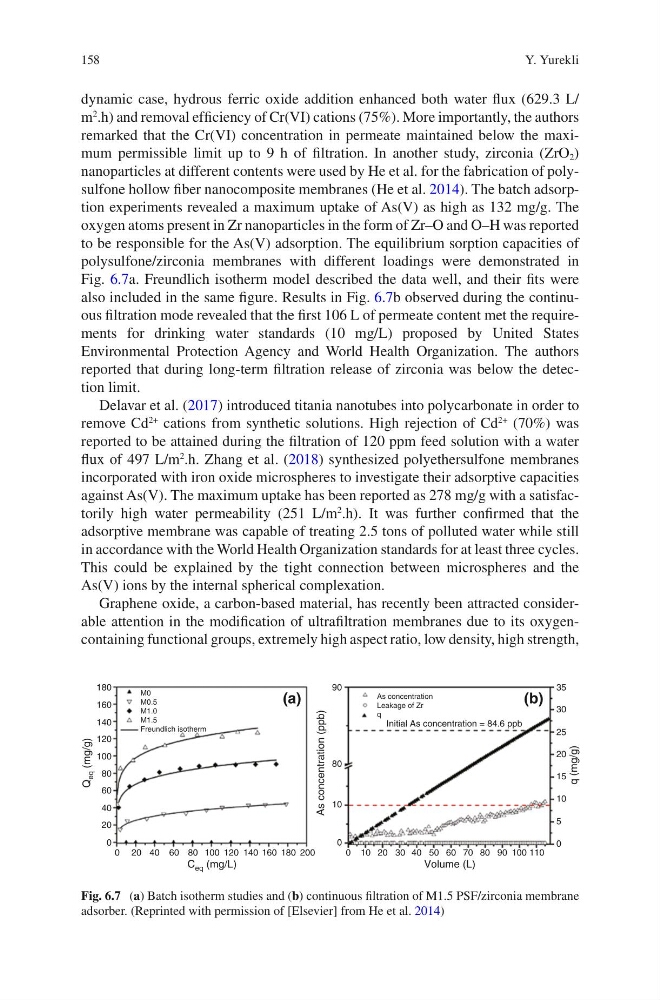
nanoparticles at different contents were used by He et al. for the fabrication of polysulfone hollow fiber nanocomposite membranes (He et al. 2014). The batch adsorption experiments revealed a maximum uptake of As(V) as high as 132 mg/g. The
oxygen atoms present in Zr nanoparticles in the form of Zr–O and O–H was reported
to be responsible for the As(V) adsorption. The equilibrium sorption capacities of
polysulfone/zirconia membranes with different loadings were demonstrated in
Fig. 6.7a. Freundlich isotherm model described the data well, and their fits were
also included in the same figure. Results in Fig. 6.7b observed during the continuous filtration mode revealed that the first 106 L of permeate content met the requirements for drinking water standards (10 mg/L) proposed by United States
Environmental Protection Agency and World Health Organization. The authors
reported that during long-term filtration release of zirconia was below the detection limit.
Delavar et al. (2017) introduced titania nanotubes into polycarbonate in order to
remove Cd
2+
cations from synthetic solutions. High rejection of Cd
2+
(70%) was
reported to be attained during the filtration of 120 ppm feed solution with a water
flux of 497 L/m
2
.h. Zhang et al. (2018) synthesized polyethersulfone membranes
incorporated with iron oxide microspheres to investigate their adsorptive capacities
against As(V). The maximum uptake has been reported as 278 mg/g with a satisfactorily high water permeability (251 L/m
2
.h). It was further confirmed that the
adsorptive membrane was capable of treating 2.5 tons of polluted water while still
in accordance with the World Health Organization standards for at least three cycles.
This could be explained by the tight connection between microspheres and the
As(V) ions by the internal spherical complexation.
Graphene oxide, a carbon-based material, has recently been attracted considerable attention in the modification of ultrafiltration membranes due to its oxygencontaining functional groups, extremely high aspect ratio, low density, high strength,
180
M0
M0.5
M1.0
M1.5
Freundlich isotherm
As concentration
Leakage of Zr
q
Initial As concentration = 84.6 ppb
90
35
(b)
(a)
30
25
20
15
10
5
0
80
10
0
160
140
120
100
80
60
40
20
0
0 20 40 60 80 100
C eq (mg/L)
Q
eq (mg/g)
As concentration (ppb)
Volume (L)
q (mg/g)
120 140 160 180 200
0 10 20 30 40 50 60 70 80 90 100 110
Fig. 6.7 (a) Batch isotherm studies and (b) continuous filtration of M1.5 PSF/zirconia membrane
adsorber. (Reprinted with permission of [Elsevier] from He et al. 2014)
Y. Yurekli
dynamic case, hydrous ferric oxide addition enhanced both water flux (629.3 L/
m
2
.h) and removal efficiency of Cr(VI) cations (75%). More importantly, the authors
remarked that the Cr(VI) concentration in permeate maintained below the maximum permissible limit up to 9 h of filtration. In another study, zirconia (ZrO 2 )
nanoparticles at different contents were used by He et al. for the fabrication of polysulfone hollow fiber nanocomposite membranes (He et al. 2014). The batch adsorption experiments revealed a maximum uptake of As(V) as high as 132 mg/g. The
oxygen atoms present in Zr nanoparticles in the form of Zr–O and O–H was reported
to be responsible for the As(V) adsorption. The equilibrium sorption capacities of
polysulfone/zirconia membranes with different loadings were demonstrated in
Fig. 6.7a. Freundlich isotherm model described the data well, and their fits were
also included in the same figure. Results in Fig. 6.7b observed during the continuous filtration mode revealed that the first 106 L of permeate content met the requirements for drinking water standards (10 mg/L) proposed by United States
Environmental Protection Agency and World Health Organization. The authors
reported that during long-term filtration release of zirconia was below the detection limit.
Delavar et al. (2017) introduced titania nanotubes into polycarbonate in order to
remove Cd
2+
cations from synthetic solutions. High rejection of Cd
2+
(70%) was
reported to be attained during the filtration of 120 ppm feed solution with a water
flux of 497 L/m
2
.h. Zhang et al. (2018) synthesized polyethersulfone membranes
incorporated with iron oxide microspheres to investigate their adsorptive capacities
against As(V). The maximum uptake has been reported as 278 mg/g with a satisfactorily high water permeability (251 L/m
2
.h). It was further confirmed that the
adsorptive membrane was capable of treating 2.5 tons of polluted water while still
in accordance with the World Health Organization standards for at least three cycles.
This could be explained by the tight connection between microspheres and the
As(V) ions by the internal spherical complexation.
Graphene oxide, a carbon-based material, has recently been attracted considerable attention in the modification of ultrafiltration membranes due to its oxygencontaining functional groups, extremely high aspect ratio, low density, high strength,
180
M0
M0.5
M1.0
M1.5
Freundlich isotherm
As concentration
Leakage of Zr
q
Initial As concentration = 84.6 ppb
90
35
(b)
(a)
30
25
20
15
10
5
0
80
10
0
160
140
120
100
80
60
40
20
0
0 20 40 60 80 100
C eq (mg/L)
Q
eq (mg/g)
As concentration (ppb)
Volume (L)
q (mg/g)
120 140 160 180 200
0 10 20 30 40 50 60 70 80 90 100 110
Fig. 6.7 (a) Batch isotherm studies and (b) continuous filtration of M1.5 PSF/zirconia membrane
adsorber. (Reprinted with permission of [Elsevier] from He et al. 2014)
Y. Yurekli