

157
polysulfone membrane had no contribution alone to adsorption, and the sorption
almost linearly increased with the addition of zeolite nanoparticles. High sorption
capacity reported as 682 and 122 mg/g for Pb
2+
and Ni
2+
cations, respectively, was
attained for the membrane adsorber at the end of 60 min of filtration, under 1 bar of
transmembrane pressure. In another study of Yurekli et al. (2017), the same membrane architecture was used in a cross-flow mode of filtration for the optimization
of the working conditions including transmembrane pressure, system temperature,
and filtration time. Reusability of the membrane adsorber was first determined in
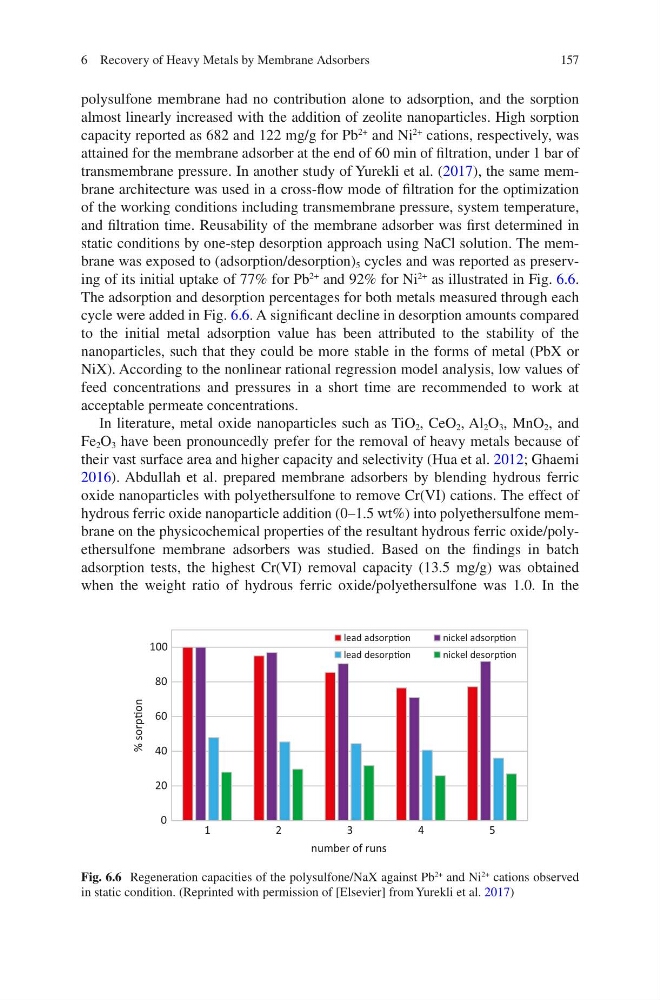
static conditions by one-step desorption approach using NaCl solution. The membrane was exposed to (adsorption/desorption) 5 cycles and was reported as preserving of its initial uptake of 77% for Pb
2+
and 92% for Ni
2+
as illustrated in Fig. 6.6.
The adsorption and desorption percentages for both metals measured through each
cycle were added in Fig. 6.6. A significant decline in desorption amounts compared
to the initial metal adsorption value has been attributed to the stability of the
nanoparticles, such that they could be more stable in the forms of metal (PbX or
NiX). According to the nonlinear rational regression model analysis, low values of
feed concentrations and pressures in a short time are recommended to work at
acceptable permeate concentrations.
In literature, metal oxide nanoparticles such as TiO 2 , CeO 2 , Al 2 O 3 , MnO 2 , and
Fe 2 O 3 have been pronouncedly prefer for the removal of heavy metals because of
their vast surface area and higher capacity and selectivity (Hua et al. 2012; Ghaemi
2016). Abdullah et al. prepared membrane adsorbers by blending hydrous ferric
oxide nanoparticles with polyethersulfone to remove Cr(VI) cations. The effect of
hydrous ferric oxide nanoparticle addition (0–1.5 wt%) into polyethersulfone membrane on the physicochemical properties of the resultant hydrous ferric oxide/polyethersulfone membrane adsorbers was studied. Based on the findings in batch
adsorption tests, the highest Cr(VI) removal capacity (13.5 mg/g) was obtained
when the weight ratio of hydrous ferric oxide/polyethersulfone was 1.0. In the
0
20
40
60
80
100
1
2
3
4
5
% sorpƟon
number of runs
lead adsorpƟon
nickel adsorpƟon
lead desorpƟon
nickel desorpƟon
Fig. 6.6 Regeneration capacities of the polysulfone/NaX against Pb
2+ and Ni
2+ cations observed
in static condition. (Reprinted with permission of [Elsevier] from Yurekli et al. 2017)
6 Recovery of Heavy Metals by Membrane Adsorbers
polysulfone membrane had no contribution alone to adsorption, and the sorption
almost linearly increased with the addition of zeolite nanoparticles. High sorption
capacity reported as 682 and 122 mg/g for Pb
2+
and Ni
2+
cations, respectively, was
attained for the membrane adsorber at the end of 60 min of filtration, under 1 bar of
transmembrane pressure. In another study of Yurekli et al. (2017), the same membrane architecture was used in a cross-flow mode of filtration for the optimization
of the working conditions including transmembrane pressure, system temperature,
and filtration time. Reusability of the membrane adsorber was first determined in
static conditions by one-step desorption approach using NaCl solution. The membrane was exposed to (adsorption/desorption) 5 cycles and was reported as preserving of its initial uptake of 77% for Pb
2+
and 92% for Ni
2+
as illustrated in Fig. 6.6.
The adsorption and desorption percentages for both metals measured through each
cycle were added in Fig. 6.6. A significant decline in desorption amounts compared
to the initial metal adsorption value has been attributed to the stability of the
nanoparticles, such that they could be more stable in the forms of metal (PbX or
NiX). According to the nonlinear rational regression model analysis, low values of
feed concentrations and pressures in a short time are recommended to work at
acceptable permeate concentrations.
In literature, metal oxide nanoparticles such as TiO 2 , CeO 2 , Al 2 O 3 , MnO 2 , and
Fe 2 O 3 have been pronouncedly prefer for the removal of heavy metals because of
their vast surface area and higher capacity and selectivity (Hua et al. 2012; Ghaemi
2016). Abdullah et al. prepared membrane adsorbers by blending hydrous ferric
oxide nanoparticles with polyethersulfone to remove Cr(VI) cations. The effect of
hydrous ferric oxide nanoparticle addition (0–1.5 wt%) into polyethersulfone membrane on the physicochemical properties of the resultant hydrous ferric oxide/polyethersulfone membrane adsorbers was studied. Based on the findings in batch
adsorption tests, the highest Cr(VI) removal capacity (13.5 mg/g) was obtained
when the weight ratio of hydrous ferric oxide/polyethersulfone was 1.0. In the
0
20
40
60
80
100
1
2
3
4
5
% sorpƟon
number of runs
lead adsorpƟon
nickel adsorpƟon
lead desorpƟon
nickel desorpƟon
Fig. 6.6 Regeneration capacities of the polysulfone/NaX against Pb
2+ and Ni
2+ cations observed
in static condition. (Reprinted with permission of [Elsevier] from Yurekli et al. 2017)
6 Recovery of Heavy Metals by Membrane Adsorbers