

155
foulant and the membrane surface (Zhou et al. 2014). This means hydrophobic foulants need more energy to approach the membrane surface.
Among diverse surface modification methods, nanoparticle-incorporated membrane offers an effective solution with their inherent properties. In literature, various
types of nanoparticles have been developed, characterized, and utilized in membrane materials. Besides hydrophilicity enhancement, TiO 2 , ZnO and Ag NPs (Luo
et al. 2005; Li et al. 2015; Zhu et al. 2010) provide antibacterial, SiO 2 NPs (Yin et al.
2012) electrical conductivity, carbon nanotubes such as single-walled carbon nanotubes and multi-walled carbon nanotubes (Mendez et al. 2017) and graphene oxide
(Hassan et al. 2014) new pathways, Fe and FeO NPs, respectively, (Homayoonfal
et al. 2015) catalytic and magnetic properties to membranes. Several studies have
shown that antibacterial properties of the membrane could appreciably assist to
improved antifouling capacity (Damodar et al. 2009; Sui et al. 2012; Yao et al.
2009). These antibacterial agents present on the membrane surface may prevent the
reproduction of bacteria and, in some conditions, destruct the bacteria cell wall
(Sawada et al. 2012). Another noteworthy of the inorganic nanoparticles is their
photocatalytic properties, which play important roles in degrading the foulants
when they are irradiated. This feature has been considered to be a reliable way to
minimize membrane fouling (Zhang et al. 2013a, b). Deposition of inorganic
nanoparticles on the membrane skin layer has been known to increase surface
roughness. In contrast to what is known for surface roughness, it is stated that
increase surface roughness could significantly enhance hydrophilicity and hence
lower the attractions at the membrane foulant interface (Lu et al. 2006). In addition,
removal of contaminants from the membrane surface has been reported to have
achieved easily in some studies, which can be attributed to the impacts of shear
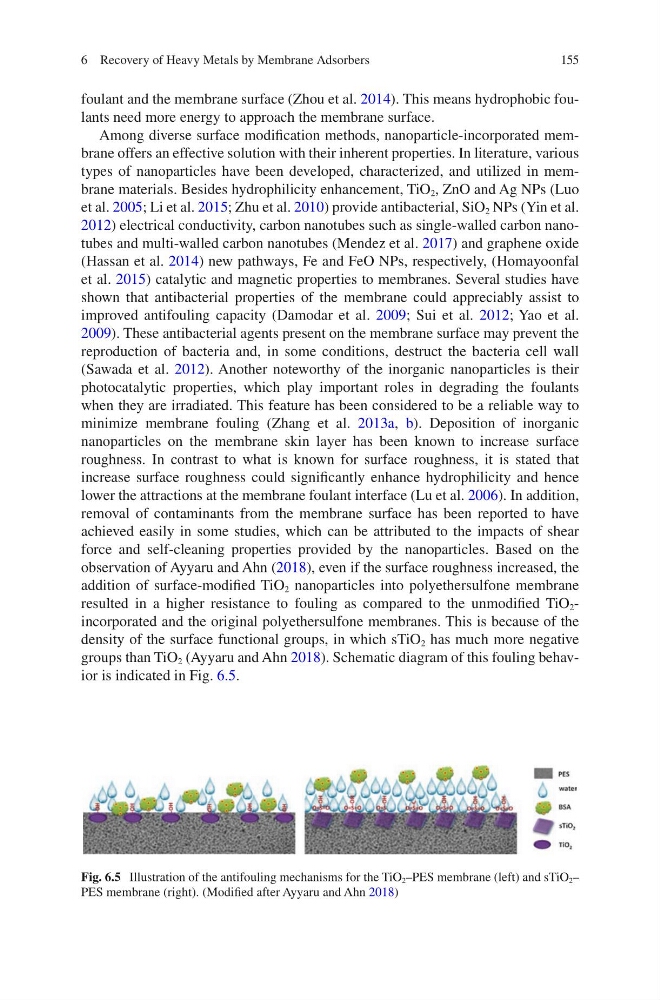
force and self-cleaning properties provided by the nanoparticles. Based on the
observation of Ayyaru and Ahn (2018), even if the surface roughness increased, the
addition of surface-modified TiO 2 nanoparticles into polyethersulfone membrane
resulted in a higher resistance to fouling as compared to the unmodified TiO 2 -
incorporated and the original polyethersulfone membranes. This is because of the
density of the surface functional groups, in which sTiO 2 has much more negative
groups than TiO 2 (Ayyaru and Ahn 2018). Schematic diagram of this fouling behavior is indicated in Fig. 6.5.
Fig. 6.5 Illustration of the antifouling mechanisms for the TiO 2 –PES membrane (left) and sTiO 2 –
PES membrane (right). (Modified after Ayyaru and Ahn 2018)
6 Recovery of Heavy Metals by Membrane Adsorbers
foulant and the membrane surface (Zhou et al. 2014). This means hydrophobic foulants need more energy to approach the membrane surface.
Among diverse surface modification methods, nanoparticle-incorporated membrane offers an effective solution with their inherent properties. In literature, various
types of nanoparticles have been developed, characterized, and utilized in membrane materials. Besides hydrophilicity enhancement, TiO 2 , ZnO and Ag NPs (Luo
et al. 2005; Li et al. 2015; Zhu et al. 2010) provide antibacterial, SiO 2 NPs (Yin et al.
2012) electrical conductivity, carbon nanotubes such as single-walled carbon nanotubes and multi-walled carbon nanotubes (Mendez et al. 2017) and graphene oxide
(Hassan et al. 2014) new pathways, Fe and FeO NPs, respectively, (Homayoonfal
et al. 2015) catalytic and magnetic properties to membranes. Several studies have
shown that antibacterial properties of the membrane could appreciably assist to
improved antifouling capacity (Damodar et al. 2009; Sui et al. 2012; Yao et al.
2009). These antibacterial agents present on the membrane surface may prevent the
reproduction of bacteria and, in some conditions, destruct the bacteria cell wall
(Sawada et al. 2012). Another noteworthy of the inorganic nanoparticles is their
photocatalytic properties, which play important roles in degrading the foulants
when they are irradiated. This feature has been considered to be a reliable way to
minimize membrane fouling (Zhang et al. 2013a, b). Deposition of inorganic
nanoparticles on the membrane skin layer has been known to increase surface
roughness. In contrast to what is known for surface roughness, it is stated that
increase surface roughness could significantly enhance hydrophilicity and hence
lower the attractions at the membrane foulant interface (Lu et al. 2006). In addition,
removal of contaminants from the membrane surface has been reported to have
achieved easily in some studies, which can be attributed to the impacts of shear
force and self-cleaning properties provided by the nanoparticles. Based on the
observation of Ayyaru and Ahn (2018), even if the surface roughness increased, the
addition of surface-modified TiO 2 nanoparticles into polyethersulfone membrane
resulted in a higher resistance to fouling as compared to the unmodified TiO 2 -
incorporated and the original polyethersulfone membranes. This is because of the
density of the surface functional groups, in which sTiO 2 has much more negative
groups than TiO 2 (Ayyaru and Ahn 2018). Schematic diagram of this fouling behavior is indicated in Fig. 6.5.
Fig. 6.5 Illustration of the antifouling mechanisms for the TiO 2 –PES membrane (left) and sTiO 2 –
PES membrane (right). (Modified after Ayyaru and Ahn 2018)
6 Recovery of Heavy Metals by Membrane Adsorbers