

154
flux recovery ratio (FRR(%)), reversible (R r (%)), irreversible (R ir (%)), and total
(R t (%)), fouling ratio can be calculated by the following equations to determine
antifouling capacity of the membrane (Xu et al. 2018):
FRR %
%
( ) = ´
J
J
wc
wv
100
(6.1)
R
J
J
J
r
wc
F
wv
%
%
( ) =
-
æ
è
ç
ö
ø
÷ ´100
(6.2)
R
J
J
ir
wc
wv
%
%
( ) = -
æ
è
ç
ö
ø
÷ ´
1
100
(6.3)
R
J
J
J
t
wv
F
wv
%
%
( ) =
-
æ
è
ç
ö
ø
÷ ´100
(6.4)
where J F is the flux of foulant.
One of the main reasons underlying membrane fouling is known as surface
roughness. The total local area present for the binding of a foulant species largely
increases with a high surface roughness that results in a consequent clogging of the
ridge and valley surface structure (Boussu et al. 2006). In addition, high surface
roughness protects the foulants from high shear and keeps them near the membrane
surface (Basri et al. 2011). Therefore, the membrane with antifouling capability
should exhibit a smooth surface. On the other hand, development of a hydrophilic
membrane has been commonly acknowledged as a more feasible and appropriate
way to address the fouling issue. Hydrophilic surfaces have high affinities to water
which might form a thicker layer impeding hydrophobic attractions between the
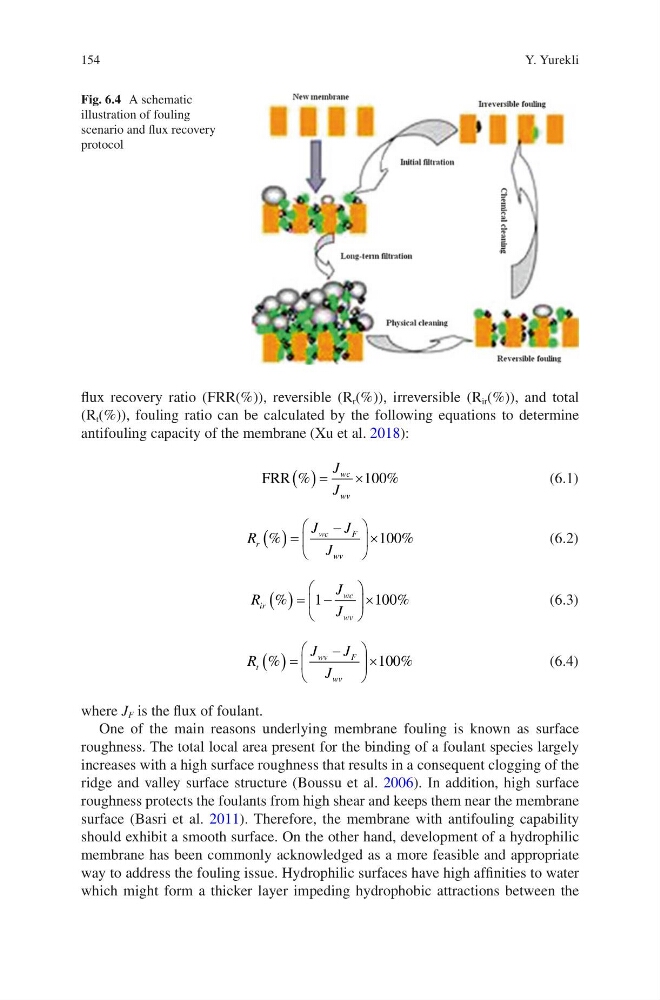
Fig. 6.4 A schematic
illustration of fouling
scenario and flux recovery
protocol
Y. Yurekli
flux recovery ratio (FRR(%)), reversible (R r (%)), irreversible (R ir (%)), and total
(R t (%)), fouling ratio can be calculated by the following equations to determine
antifouling capacity of the membrane (Xu et al. 2018):
FRR %
%
( ) = ´
J
J
wc
wv
100
(6.1)
R
J
J
J
r
wc
F
wv
%
%
( ) =
-
æ
è
ç
ö
ø
÷ ´100
(6.2)
R
J
J
ir
wc
wv
%
%
( ) = -
æ
è
ç
ö
ø
÷ ´
1
100
(6.3)
R
J
J
J
t
wv
F
wv
%
%
( ) =
-
æ
è
ç
ö
ø
÷ ´100
(6.4)
where J F is the flux of foulant.
One of the main reasons underlying membrane fouling is known as surface
roughness. The total local area present for the binding of a foulant species largely
increases with a high surface roughness that results in a consequent clogging of the
ridge and valley surface structure (Boussu et al. 2006). In addition, high surface
roughness protects the foulants from high shear and keeps them near the membrane
surface (Basri et al. 2011). Therefore, the membrane with antifouling capability
should exhibit a smooth surface. On the other hand, development of a hydrophilic
membrane has been commonly acknowledged as a more feasible and appropriate
way to address the fouling issue. Hydrophilic surfaces have high affinities to water
which might form a thicker layer impeding hydrophobic attractions between the
Fig. 6.4 A schematic
illustration of fouling
scenario and flux recovery
protocol
Y. Yurekli