

144
Keywords Heavy metals · Fouling resistance · Membrane adsorbers · Modelling ·
Phase inversion
6.1 Introduction
Water is the source of life. Although it has been constantly supplied by the Earth
since ancient times, a substantial decrease in water quality is faced across the globe
nowadays. Around 780 million people worldwide suffer from accessing drinking
water resources (WHO 2014). This water shortage problem has been caused by
rapid population growth and intense industrial activity that result in the contamination of wastewater with organic pollutants and a large numbers of heavy metals.
Heavy metals are toxic and carcinogenic and mostly found in poorly treated processed water of various industries including mining, plating, metal finishing, battery, paint, textile, leather, pesticide, and chemical (Jaishankar et al. 2014; Singh
et al. 2011). Their nonbiodegradability and strong affinities to anionic species cause
to continuously accumulate in the aquatic environment, hence, impairing the ecosystem health. Heavy metals intact for a long time in the environment ultimately
reach to animals and people via the food chain, drinking water, and air and accumulate in the body by air and water or directly through the skin (Jan et al. 2015;
Tchounwou et al. 2012; Mohammed et al. 2011). Due to severe health effects upon
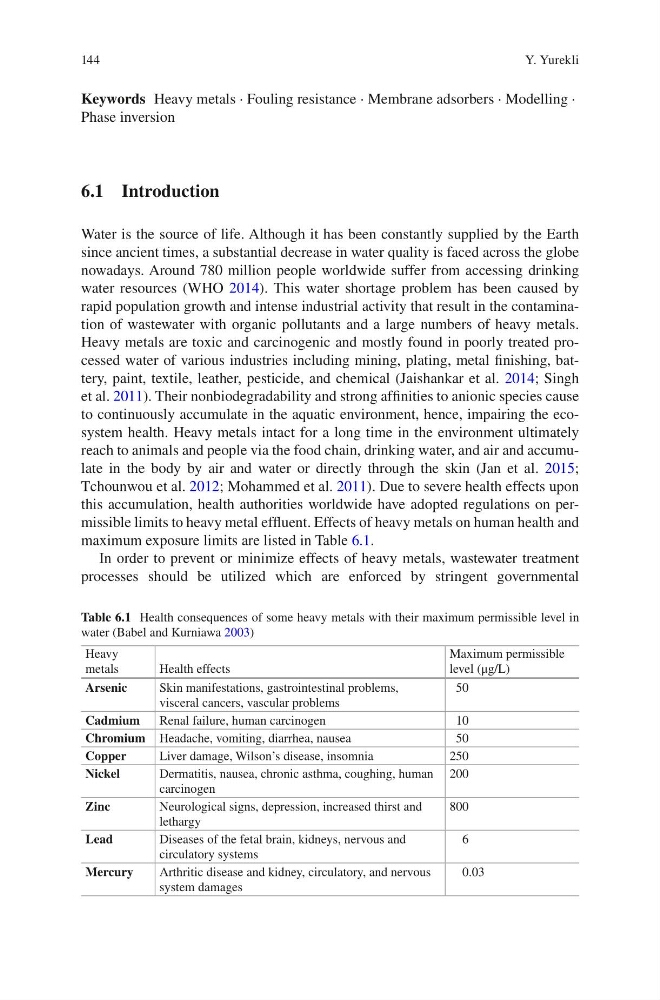
this accumulation, health authorities worldwide have adopted regulations on permissible limits to heavy metal effluent. Effects of heavy metals on human health and
maximum exposure limits are listed in Table 6.1.
In order to prevent or minimize effects of heavy metals, wastewater treatment
processes should be utilized which are enforced by stringent governmental
Table 6.1 Health consequences of some heavy metals with their maximum permissible level in
water (Babel and Kurniawa 2003)
Heavy
metals
Health effects
Maximum permissible
level (μg/L)
Arsenic
Skin manifestations, gastrointestinal problems,
visceral cancers, vascular problems
50
Cadmium
Renal failure, human carcinogen
10
Chromium Headache, vomiting, diarrhea, nausea
50
Copper
Liver damage, Wilson’s disease, insomnia
250
Nickel
Dermatitis, nausea, chronic asthma, coughing, human
carcinogen
200
Zinc
Neurological signs, depression, increased thirst and
lethargy
800
Lead
Diseases of the fetal brain, kidneys, nervous and
circulatory systems
6
Mercury
Arthritic disease and kidney, circulatory, and nervous
system damages
0.03
Y. Yurekli
Keywords Heavy metals · Fouling resistance · Membrane adsorbers · Modelling ·
Phase inversion
6.1 Introduction
Water is the source of life. Although it has been constantly supplied by the Earth
since ancient times, a substantial decrease in water quality is faced across the globe
nowadays. Around 780 million people worldwide suffer from accessing drinking
water resources (WHO 2014). This water shortage problem has been caused by
rapid population growth and intense industrial activity that result in the contamination of wastewater with organic pollutants and a large numbers of heavy metals.
Heavy metals are toxic and carcinogenic and mostly found in poorly treated processed water of various industries including mining, plating, metal finishing, battery, paint, textile, leather, pesticide, and chemical (Jaishankar et al. 2014; Singh
et al. 2011). Their nonbiodegradability and strong affinities to anionic species cause
to continuously accumulate in the aquatic environment, hence, impairing the ecosystem health. Heavy metals intact for a long time in the environment ultimately
reach to animals and people via the food chain, drinking water, and air and accumulate in the body by air and water or directly through the skin (Jan et al. 2015;
Tchounwou et al. 2012; Mohammed et al. 2011). Due to severe health effects upon
this accumulation, health authorities worldwide have adopted regulations on permissible limits to heavy metal effluent. Effects of heavy metals on human health and
maximum exposure limits are listed in Table 6.1.
In order to prevent or minimize effects of heavy metals, wastewater treatment
processes should be utilized which are enforced by stringent governmental
Table 6.1 Health consequences of some heavy metals with their maximum permissible level in
water (Babel and Kurniawa 2003)
Heavy
metals
Health effects
Maximum permissible
level (μg/L)
Arsenic
Skin manifestations, gastrointestinal problems,
visceral cancers, vascular problems
50
Cadmium
Renal failure, human carcinogen
10
Chromium Headache, vomiting, diarrhea, nausea
50
Copper
Liver damage, Wilson’s disease, insomnia
250
Nickel
Dermatitis, nausea, chronic asthma, coughing, human
carcinogen
200
Zinc
Neurological signs, depression, increased thirst and
lethargy
800
Lead
Diseases of the fetal brain, kidneys, nervous and
circulatory systems
6
Mercury
Arthritic disease and kidney, circulatory, and nervous
system damages
0.03
Y. Yurekli