

126
the adsorbent (Sharma and Bhattacharyya 2005). Sarin and Pant attempted activated
eucalyptus bark in column for chromium removal (Sarin and Pant 2006). Scientists
(Ozer and Pirincci 2006) were able to eliminate 82.8% lead by using sulfuric acidtreated wheat bran. Chen et al. observed a very good bed performance for removal
of Cr(VI) using modified corn slack (Chen et al. 2012). Other researchers (Martins
et al. 2013) used dried minced castor leaves for detoxification of Cd(II)- and Pb(II)laden water of Paraná River. The high nitrogen and sulfur content of the leaf favored
the adsorption process. Lopez et al. attempted plum (P. domestica L.) tree bark for
eradication of hexavalent and total chromium (Lopez-Nunez et al. 2014). NetzahuatlMunoz et al. attempted Cupressus lusitanica bark for Cr(VI) removal. It was endothermic reaction with metal uptake of 305.4 mg g
−1
(Netzahuatl-Munoz et al. 2015).
Another group of researchers (Martin-Lara et al. 2014) suggested a new treatment
method for real electroplating wastewater containing Cr(VI), Cu(II), and Ni(II) by
using olive stone, a biomaterial. Others (Nag et al. 2017, 2018a) effectively used
different leaves for Cr(VI) and Cd(II) removal. These green adsorbents were useful
for Cr(VI) and Cd(II) remotion in column also (Nag et al. 2015, 2018b). Das et al.
tried nut shells for Cr(VI) adsorption (Das et al. 2019). The performances of these
adsorbents are presented in Table 5.7.
5.5.6 Modified Cellulose
Cellulose was modified by several researchers, and the modified cellulose exhibited
better and promising performances in many cases as compared to the unmodified
one. It has high recycling ability and biodegradability. Navarro et al. modified
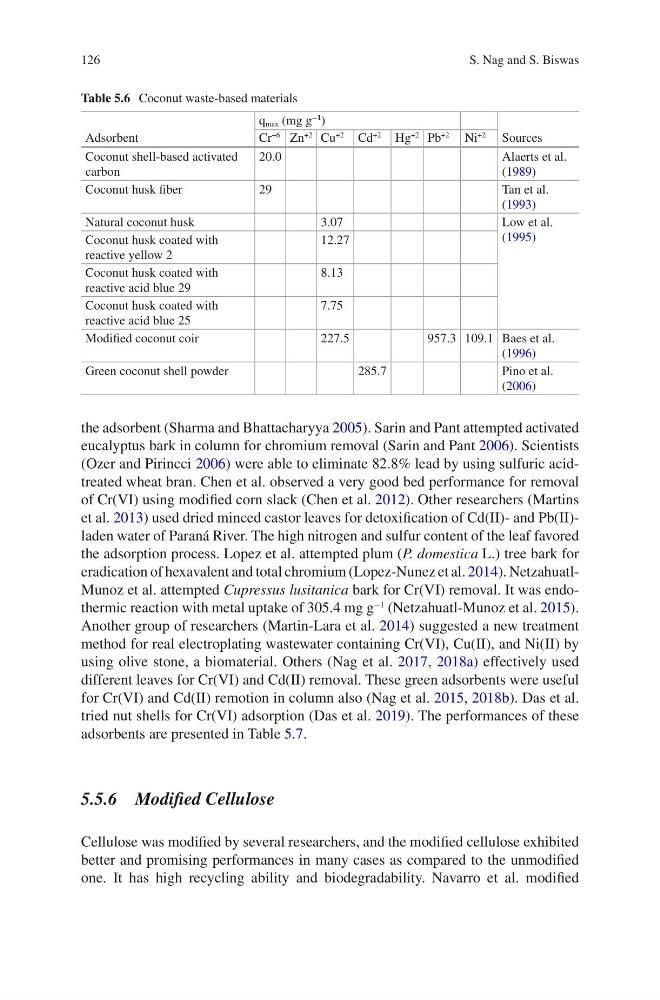
Table 5.6 Coconut waste-based materials
Adsorbent
q max (mg g
−1 )
Sources
Cr
+6 Zn
+2 Cu
+2
Cd
+2
Hg
+2 Pb
+2
Ni
+2
Coconut shell-based activated
carbon
20.0
Alaerts et al.
(1989)
Coconut husk fiber
29
Tan et al.
(1993)
Natural coconut husk
3.07
Low et al.
(1995)
Coconut husk coated with
reactive yellow 2
12.27
Coconut husk coated with
reactive acid blue 29
8.13
Coconut husk coated with
reactive acid blue 25
7.75
Modified coconut coir
227.5
957.3 109.1 Baes et al.
(1996)
Green coconut shell powder
285.7
Pino et al.
(2006)
S. Nag and S. Biswas
the adsorbent (Sharma and Bhattacharyya 2005). Sarin and Pant attempted activated
eucalyptus bark in column for chromium removal (Sarin and Pant 2006). Scientists
(Ozer and Pirincci 2006) were able to eliminate 82.8% lead by using sulfuric acidtreated wheat bran. Chen et al. observed a very good bed performance for removal
of Cr(VI) using modified corn slack (Chen et al. 2012). Other researchers (Martins
et al. 2013) used dried minced castor leaves for detoxification of Cd(II)- and Pb(II)laden water of Paraná River. The high nitrogen and sulfur content of the leaf favored
the adsorption process. Lopez et al. attempted plum (P. domestica L.) tree bark for
eradication of hexavalent and total chromium (Lopez-Nunez et al. 2014). NetzahuatlMunoz et al. attempted Cupressus lusitanica bark for Cr(VI) removal. It was endothermic reaction with metal uptake of 305.4 mg g
−1
(Netzahuatl-Munoz et al. 2015).
Another group of researchers (Martin-Lara et al. 2014) suggested a new treatment
method for real electroplating wastewater containing Cr(VI), Cu(II), and Ni(II) by
using olive stone, a biomaterial. Others (Nag et al. 2017, 2018a) effectively used
different leaves for Cr(VI) and Cd(II) removal. These green adsorbents were useful
for Cr(VI) and Cd(II) remotion in column also (Nag et al. 2015, 2018b). Das et al.
tried nut shells for Cr(VI) adsorption (Das et al. 2019). The performances of these
adsorbents are presented in Table 5.7.
5.5.6 Modified Cellulose
Cellulose was modified by several researchers, and the modified cellulose exhibited
better and promising performances in many cases as compared to the unmodified
one. It has high recycling ability and biodegradability. Navarro et al. modified
Table 5.6 Coconut waste-based materials
Adsorbent
q max (mg g
−1 )
Sources
Cr
+6 Zn
+2 Cu
+2
Cd
+2
Hg
+2 Pb
+2
Ni
+2
Coconut shell-based activated
carbon
20.0
Alaerts et al.
(1989)
Coconut husk fiber
29
Tan et al.
(1993)
Natural coconut husk
3.07
Low et al.
(1995)
Coconut husk coated with
reactive yellow 2
12.27
Coconut husk coated with
reactive acid blue 29
8.13
Coconut husk coated with
reactive acid blue 25
7.75
Modified coconut coir
227.5
957.3 109.1 Baes et al.
(1996)
Green coconut shell powder
285.7
Pino et al.
(2006)
S. Nag and S. Biswas