

120
or pseudo-second-order model (Lagergren 1898; Ho et al. 2000), demonstrated by
Eqs. 5.3 and 5.4.
log
l og
.
q q
q
k t
e
t
e
-
(
)=
-
1
2 303
(5.3)
t
q
k q
t
t
e
= +
1 1
2
(5.4)
In the above equations, q e indicates the equilibrium metal uptake and k 1 (min
−1
)
and k 2 (mg g
−1
min
−1
) are the pseudo-first- and pseudo-second-order rate constants.
The equilibrium models predicted by Langmuir (Langmuir 1918) and Freundlich
(Freundlich 1906) are commonly applied for representation of the equilibrium condition as given in Eqs. 5.5 and 5.6.
C
q
q b
C
q
e
e
e
=
+
1
max
m ax
(5.5)
log
log
log
q
K
n
C
e
f
e
=
+
1
(5.6)
C e signifies the adsorbate concentration (mg L
−1
) at equilibrium, q max is the maximum adsorption capacity, and b denotes the Langmuir constant (L mg
−1
). K f is the
Freundlich equilibrium constant (mg g
−1
(mg L)
-1/n
) and n is the intensity of adsorption. Numerical values of n > 1 indicate favorable adsorption (Erdem et al. 2004).
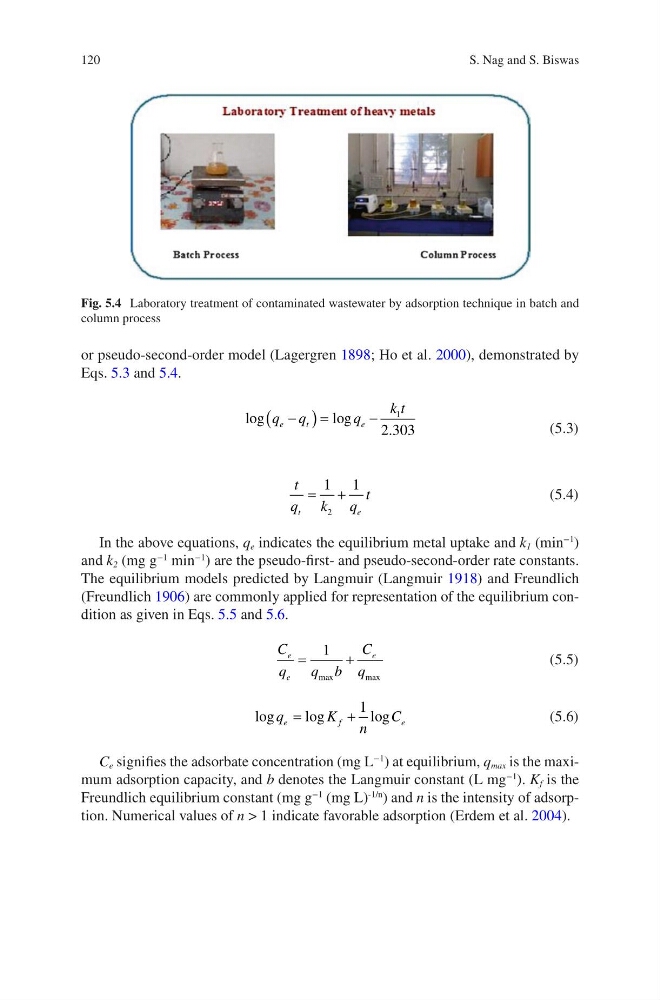
Fig. 5.4 Laboratory treatment of contaminated wastewater by adsorption technique in batch and
column process
S. Nag and S. Biswas
or pseudo-second-order model (Lagergren 1898; Ho et al. 2000), demonstrated by
Eqs. 5.3 and 5.4.
log
l og
.
q q
q
k t
e
t
e
-
(
)=
-
1
2 303
(5.3)
t
q
k q
t
t
e
= +
1 1
2
(5.4)
In the above equations, q e indicates the equilibrium metal uptake and k 1 (min
−1
)
and k 2 (mg g
−1
min
−1
) are the pseudo-first- and pseudo-second-order rate constants.
The equilibrium models predicted by Langmuir (Langmuir 1918) and Freundlich
(Freundlich 1906) are commonly applied for representation of the equilibrium condition as given in Eqs. 5.5 and 5.6.
C
q
q b
C
q
e
e
e
=
+
1
max
m ax
(5.5)
log
log
log
q
K
n
C
e
f
e
=
+
1
(5.6)
C e signifies the adsorbate concentration (mg L
−1
) at equilibrium, q max is the maximum adsorption capacity, and b denotes the Langmuir constant (L mg
−1
). K f is the
Freundlich equilibrium constant (mg g
−1
(mg L)
-1/n
) and n is the intensity of adsorption. Numerical values of n > 1 indicate favorable adsorption (Erdem et al. 2004).
Fig. 5.4 Laboratory treatment of contaminated wastewater by adsorption technique in batch and
column process
S. Nag and S. Biswas