

119
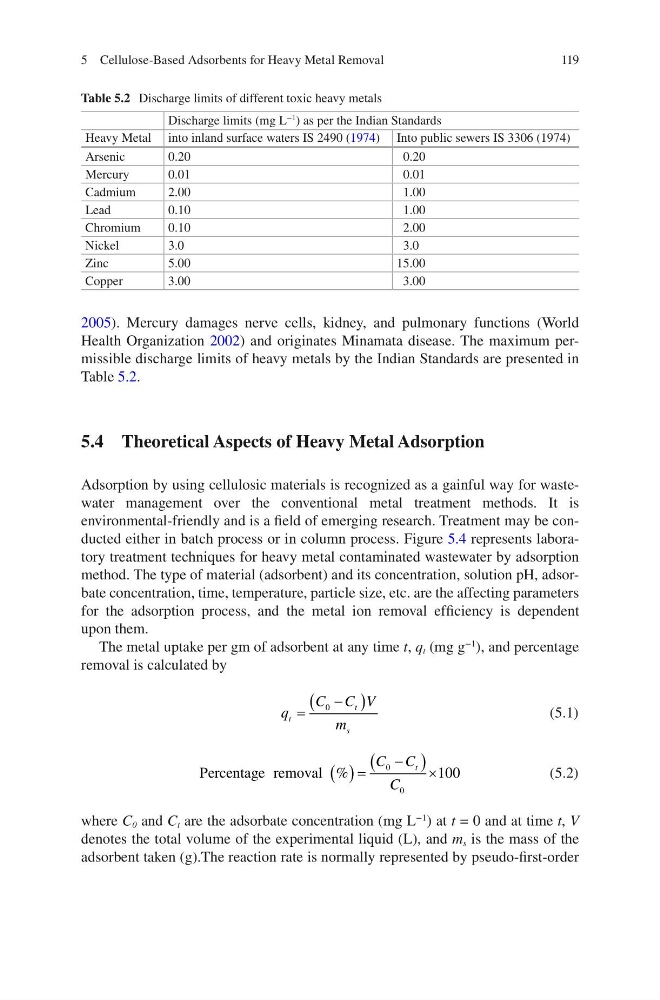
2005). Mercury damages nerve cells, kidney, and pulmonary functions (World
Health Organization 2002) and originates Minamata disease. The maximum permissible discharge limits of heavy metals by the Indian Standards are presented in
Table 5.2.
5.4 Theoretical Aspects of Heavy Metal Adsorption
Adsorption by using cellulosic materials is recognized as a gainful way for wastewater management over the conventional metal treatment methods. It is
environmental- friendly and is a field of emerging research. Treatment may be conducted either in batch process or in column process. Figure 5.4 represents laboratory treatment techniques for heavy metal contaminated wastewater by adsorption
method. The type of material (adsorbent) and its concentration, solution pH, adsorbate concentration, time, temperature, particle size, etc. are the affecting parameters
for the adsorption process, and the metal ion removal efficiency is dependent
upon them.
The metal uptake per gm of adsorbent at any time t, q t (mg g
−1
), and percentage
removal is calculated by
q
C C V
m
t
t
s
=
-
(
)
0
(5.1)
Percentage removal %
( ) =
-
(
) ´
C C
C
t
0
0
100
(5.2)
where C 0 and C t are the adsorbate concentration (mg L
−1
) at t = 0 and at time t, V
denotes the total volume of the experimental liquid (L), and m s is the mass of the
adsorbent taken (g).The reaction rate is normally represented by pseudo-first-order
Table 5.2 Discharge limits of different toxic heavy metals
Discharge limits (mg L
−1 ) as per the Indian Standards
Heavy Metal into inland surface waters IS 2490 (1974) Into public sewers IS 3306 (1974)
Arsenic
0.20
0.20
Mercury
0.01
0.01
Cadmium
2.00
1.00
Lead
0.10
1.00
Chromium
0.10
2.00
Nickel
3.0
3.0
Zinc
5.00
15.00
Copper
3.00
3.00
5 Cellulose-Based Adsorbents for Heavy Metal Removal
2005). Mercury damages nerve cells, kidney, and pulmonary functions (World
Health Organization 2002) and originates Minamata disease. The maximum permissible discharge limits of heavy metals by the Indian Standards are presented in
Table 5.2.
5.4 Theoretical Aspects of Heavy Metal Adsorption
Adsorption by using cellulosic materials is recognized as a gainful way for wastewater management over the conventional metal treatment methods. It is
environmental- friendly and is a field of emerging research. Treatment may be conducted either in batch process or in column process. Figure 5.4 represents laboratory treatment techniques for heavy metal contaminated wastewater by adsorption
method. The type of material (adsorbent) and its concentration, solution pH, adsorbate concentration, time, temperature, particle size, etc. are the affecting parameters
for the adsorption process, and the metal ion removal efficiency is dependent
upon them.
The metal uptake per gm of adsorbent at any time t, q t (mg g
−1
), and percentage
removal is calculated by
q
C C V
m
t
t
s
=
-
(
)
0
(5.1)
Percentage removal %
( ) =
-
(
) ´
C C
C
t
0
0
100
(5.2)
where C 0 and C t are the adsorbate concentration (mg L
−1
) at t = 0 and at time t, V
denotes the total volume of the experimental liquid (L), and m s is the mass of the
adsorbent taken (g).The reaction rate is normally represented by pseudo-first-order
Table 5.2 Discharge limits of different toxic heavy metals
Discharge limits (mg L
−1 ) as per the Indian Standards
Heavy Metal into inland surface waters IS 2490 (1974) Into public sewers IS 3306 (1974)
Arsenic
0.20
0.20
Mercury
0.01
0.01
Cadmium
2.00
1.00
Lead
0.10
1.00
Chromium
0.10
2.00
Nickel
3.0
3.0
Zinc
5.00
15.00
Copper
3.00
3.00
5 Cellulose-Based Adsorbents for Heavy Metal Removal