

117
acids or enzymes to remove the amorphous region leaving the crystalline form. The
process of depolymerization increases the surface area considerably making it more
suitable for the heavy metal adsorption. It does not dissolve in water and water binds
on its surface strongly (El-Naggar et al. 2017). Though three hydroxyl functional
groups are present, microcrystalline cellulose has weak binding forces for heavy
metals; however, it may be modified by alcohols for introduction of carboxylic
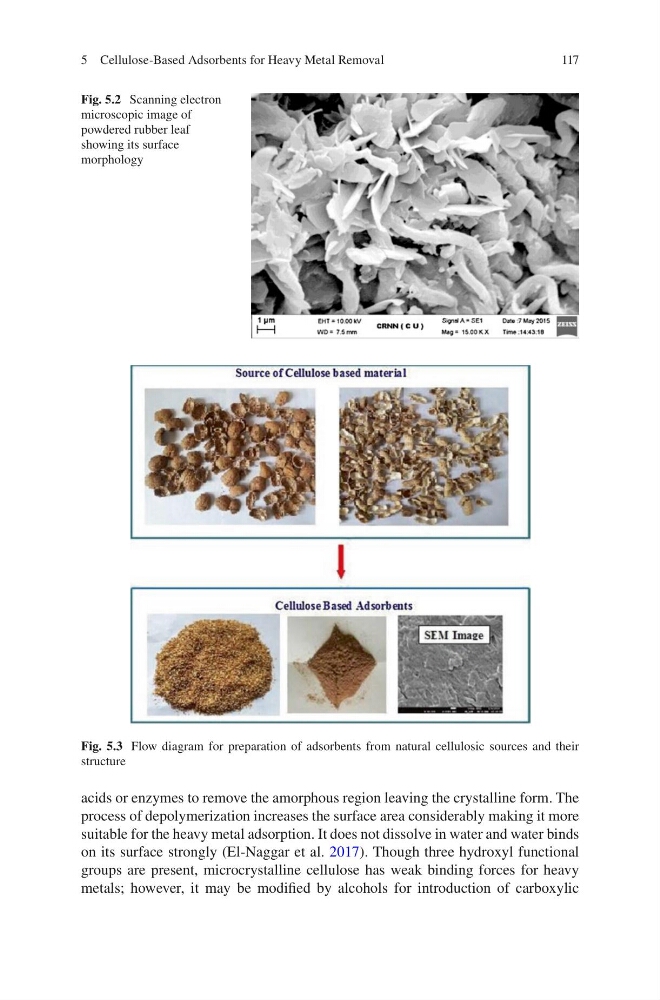
Fig. 5.2 Scanning electron
microscopic image of
powdered rubber leaf
showing its surface
morphology
Fig. 5.3 Flow diagram for preparation of adsorbents from natural cellulosic sources and their
structure
5 Cellulose-Based Adsorbents for Heavy Metal Removal
acids or enzymes to remove the amorphous region leaving the crystalline form. The
process of depolymerization increases the surface area considerably making it more
suitable for the heavy metal adsorption. It does not dissolve in water and water binds
on its surface strongly (El-Naggar et al. 2017). Though three hydroxyl functional
groups are present, microcrystalline cellulose has weak binding forces for heavy
metals; however, it may be modified by alcohols for introduction of carboxylic
Fig. 5.2 Scanning electron
microscopic image of
powdered rubber leaf
showing its surface
morphology
Fig. 5.3 Flow diagram for preparation of adsorbents from natural cellulosic sources and their
structure
5 Cellulose-Based Adsorbents for Heavy Metal Removal