

103
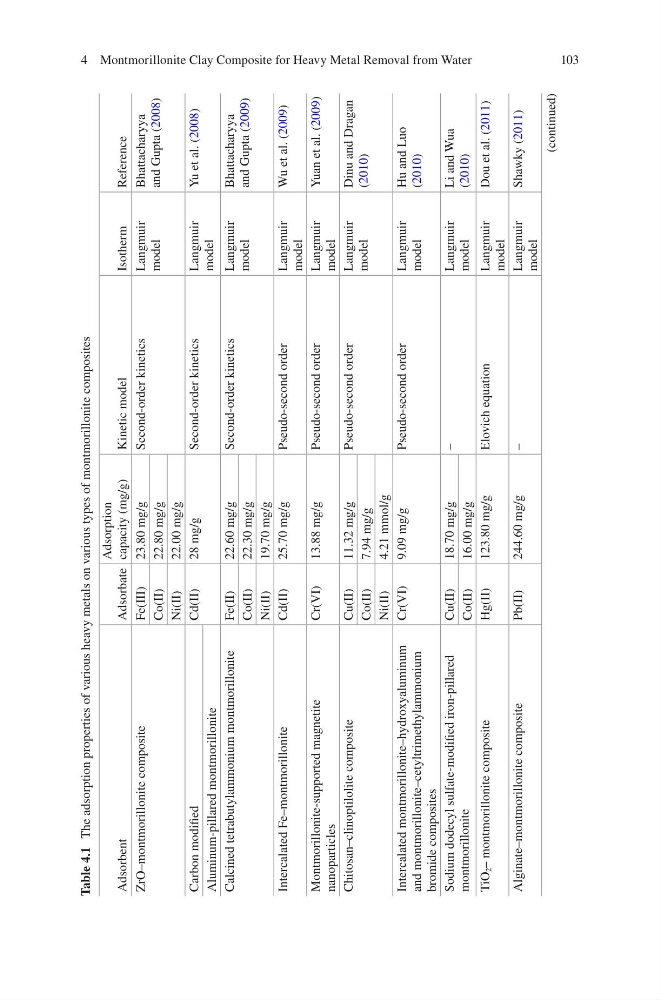
Table 4.1 The adsorption properties of various heavy metals on various types of montmorillonite composites
Adsorbent
Adsorbate
Adsorption
capacity (mg/g)
Kinetic model
Isotherm
Reference
ZrO–montmorillonite composite
Fe(III)
23.80 mg/g
Second-order kinetics
Langmuir
model
Bhattacharyya
and Gupta (2008)
Co(II)
22.80 mg/g
Ni(II)
22.00 mg/g
Carbon modified
Cd(II)
28 mg/g
Second-order kinetics
Langmuir
model
Yu et al. (2008)
Aluminum-pillared montmorillonite
Calcined tetrabutylammonium montmorillonite
Fe(II)
22.60 mg/g
Second-order kinetics
Langmuir
model
Bhattacharyya
and Gupta (2009)
Co(II)
22.30 mg/g
Ni(II)
19.70 mg/g
Intercalated Fe–montmorillonite
Cd(II)
25.70 mg/g
Pseudo-second order
Langmuir
model
Wu et al. (2009)
Montmorillonite-supported magnetite
nanoparticles
Cr(VI)
13.88 mg/g
Pseudo-second order
Langmuir
model
Yuan et al. (2009)
Chitosan–clinoptilolite composite
Cu(II)
11.32 mg/g
Pseudo-second order
Langmuir
model
Dinu and Dragan
(2010)
Co(II)
7.94 mg/g
Ni(II)
4.21 mmol/g
Intercalated montmorillonite–hydroxyaluminum
and montmorillonite–cetyltrimethylammonium
bromide composites
Cr(VI)
9.09 mg/g
Pseudo-second order
Langmuir
model
Hu and Luo
(2010)
Sodium dodecyl sulfate-modified iron-pillared
montmorillonite
Cu(II)
18.70 mg/g
–
Langmuir
model
Li and Wua
(2010)
Co(II)
16.00 mg/g
TiO
2 – montmorillonite composite
Hg(II)
123.80 mg/g
Elovich equation
Langmuir
model
Dou et al. (2011)
Alginate–montmorillonite composite
Pb(II)
244.60 mg/g
–
Langmuir
model
Shawky (2011)
(continued)
4 Montmorillonite Clay Composite for Heavy Metal Removal from Water
Table 4.1 The adsorption properties of various heavy metals on various types of montmorillonite composites
Adsorbent
Adsorbate
Adsorption
capacity (mg/g)
Kinetic model
Isotherm
Reference
ZrO–montmorillonite composite
Fe(III)
23.80 mg/g
Second-order kinetics
Langmuir
model
Bhattacharyya
and Gupta (2008)
Co(II)
22.80 mg/g
Ni(II)
22.00 mg/g
Carbon modified
Cd(II)
28 mg/g
Second-order kinetics
Langmuir
model
Yu et al. (2008)
Aluminum-pillared montmorillonite
Calcined tetrabutylammonium montmorillonite
Fe(II)
22.60 mg/g
Second-order kinetics
Langmuir
model
Bhattacharyya
and Gupta (2009)
Co(II)
22.30 mg/g
Ni(II)
19.70 mg/g
Intercalated Fe–montmorillonite
Cd(II)
25.70 mg/g
Pseudo-second order
Langmuir
model
Wu et al. (2009)
Montmorillonite-supported magnetite
nanoparticles
Cr(VI)
13.88 mg/g
Pseudo-second order
Langmuir
model
Yuan et al. (2009)
Chitosan–clinoptilolite composite
Cu(II)
11.32 mg/g
Pseudo-second order
Langmuir
model
Dinu and Dragan
(2010)
Co(II)
7.94 mg/g
Ni(II)
4.21 mmol/g
Intercalated montmorillonite–hydroxyaluminum
and montmorillonite–cetyltrimethylammonium
bromide composites
Cr(VI)
9.09 mg/g
Pseudo-second order
Langmuir
model
Hu and Luo
(2010)
Sodium dodecyl sulfate-modified iron-pillared
montmorillonite
Cu(II)
18.70 mg/g
–
Langmuir
model
Li and Wua
(2010)
Co(II)
16.00 mg/g
TiO
2 – montmorillonite composite
Hg(II)
123.80 mg/g
Elovich equation
Langmuir
model
Dou et al. (2011)
Alginate–montmorillonite composite
Pb(II)
244.60 mg/g
–
Langmuir
model
Shawky (2011)
(continued)
4 Montmorillonite Clay Composite for Heavy Metal Removal from Water