

120
Mécanique du point
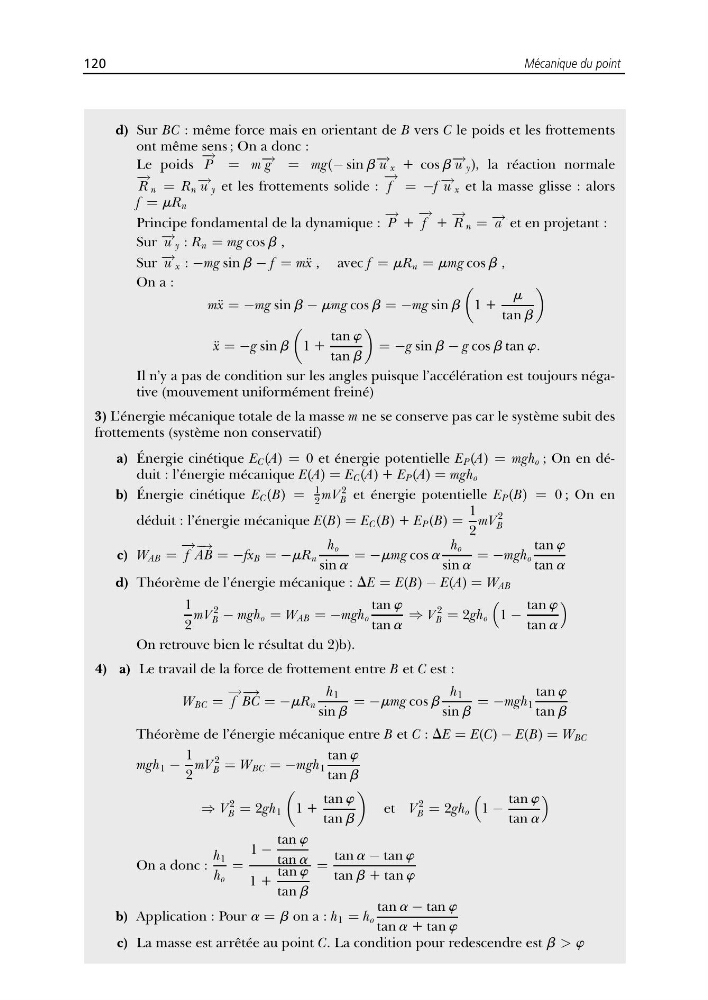
d) Sur BC : même force mais en orientant de B vers C le poids et les frottements
ont même sens ; On a donc :
Le poids
− →
P = m − → g = mg(− sin b − → u x + cos b − → u y ), la réaction normale
− →
R n = R n
− → u y et les frottements solide :
− →
f = −f − → u x et la masse glisse : alors
f = mR n
Principe fondamental de la dynamique :
− →
P +
− →
f +
− →
R n = − → a et en projetant :
Sur − → u y : R n = mg cos b ,
Sur − → u x : −mg sin b − f = m¨ x , avec f = mR n = mmg cos b ,
On a :
m¨ x = −mg sin b − mmg cos b = −mg sin b
1 +
m
tan b
¨ x = −g sin b
1 +
tan w
tan b
= −g sin b − g cos b tan w.
Il n’y a pas de condition sur les angles puisque l’accélération est toujours négative (mouvement uniformément freiné)
3) L’énergie mécanique totale de la masse m ne se conserve pas car le système subit des
frottements (système non conservatif)
a) Énergie cinétique E C (A) = 0 et énergie potentielle E P (A) = mgh o ; On en déduit : l’énergie mécanique E(A) = E C (A) + E P (A) = mgh o
b) Énergie cinétique E C (B) =
1
2
mV
2
B et énergie potentielle E P (B) = 0 ; On en
déduit : l’énergie mécanique E(B) = E C (B) + E P (B) =
1
2
mV
2
B
c) W AB =
− →
f
− →
AB = −fx B = −mR n
h o
sin a
= −mmg cos a
h o
sin a
= −mgh o
tan w
tan a
d) Théorème de l’énergie mécanique : DE = E(B) − E(A) = W AB
1
2
mV
2
B − mgh o = W AB = −mgh o
tan w
tan a
⇒ V
2
B = 2gh o
1 −
tan w
tan a
On retrouve bien le résultat du 2)b).
4) a) Le travail de la force de frottement entre B et C est :
W BC =
− →
f
− →
BC = −mR n
h 1
sin b
= −mmg cos b
h 1
sin b
= −mgh 1
tan w
tan b
Théorème de l’énergie mécanique entre B et C : DE = E(C) − E(B) = W BC
mgh 1 −
1
2
mV
2
B = W BC = −mgh 1
tan w
tan b
⇒ V
2
B = 2gh 1
1 +
tan w
tan b
et V
2
B = 2gh o
1 −
tan w
tan a
On a donc :
h 1
h o
=
1 −
tan w
tan a
1 +
tan w
tan b
=
tan a − tan w
tan b + tan w
b) Application : Pour a = b on a : h 1 = h o
tan a − tan w
tan a + tan w
c) La masse est arrêtée au point C. La condition pour redescendre est b > w
Mécanique du point
d) Sur BC : même force mais en orientant de B vers C le poids et les frottements
ont même sens ; On a donc :
Le poids
− →
P = m − → g = mg(− sin b − → u x + cos b − → u y ), la réaction normale
− →
R n = R n
− → u y et les frottements solide :
− →
f = −f − → u x et la masse glisse : alors
f = mR n
Principe fondamental de la dynamique :
− →
P +
− →
f +
− →
R n = − → a et en projetant :
Sur − → u y : R n = mg cos b ,
Sur − → u x : −mg sin b − f = m¨ x , avec f = mR n = mmg cos b ,
On a :
m¨ x = −mg sin b − mmg cos b = −mg sin b
1 +
m
tan b
¨ x = −g sin b
1 +
tan w
tan b
= −g sin b − g cos b tan w.
Il n’y a pas de condition sur les angles puisque l’accélération est toujours négative (mouvement uniformément freiné)
3) L’énergie mécanique totale de la masse m ne se conserve pas car le système subit des
frottements (système non conservatif)
a) Énergie cinétique E C (A) = 0 et énergie potentielle E P (A) = mgh o ; On en déduit : l’énergie mécanique E(A) = E C (A) + E P (A) = mgh o
b) Énergie cinétique E C (B) =
1
2
mV
2
B et énergie potentielle E P (B) = 0 ; On en
déduit : l’énergie mécanique E(B) = E C (B) + E P (B) =
1
2
mV
2
B
c) W AB =
− →
f
− →
AB = −fx B = −mR n
h o
sin a
= −mmg cos a
h o
sin a
= −mgh o
tan w
tan a
d) Théorème de l’énergie mécanique : DE = E(B) − E(A) = W AB
1
2
mV
2
B − mgh o = W AB = −mgh o
tan w
tan a
⇒ V
2
B = 2gh o
1 −
tan w
tan a
On retrouve bien le résultat du 2)b).
4) a) Le travail de la force de frottement entre B et C est :
W BC =
− →
f
− →
BC = −mR n
h 1
sin b
= −mmg cos b
h 1
sin b
= −mgh 1
tan w
tan b
Théorème de l’énergie mécanique entre B et C : DE = E(C) − E(B) = W BC
mgh 1 −
1
2
mV
2
B = W BC = −mgh 1
tan w
tan b
⇒ V
2
B = 2gh 1
1 +
tan w
tan b
et V
2
B = 2gh o
1 −
tan w
tan a
On a donc :
h 1
h o
=
1 −
tan w
tan a
1 +
tan w
tan b
=
tan a − tan w
tan b + tan w
b) Application : Pour a = b on a : h 1 = h o
tan a − tan w
tan a + tan w
c) La masse est arrêtée au point C. La condition pour redescendre est b > w