

4.5 Comparison with Other European
Projects
At this point, it also seems pertinent to compare
the current WH study with other permaculture
inspired WH projects like Holzer’s Krameterhof
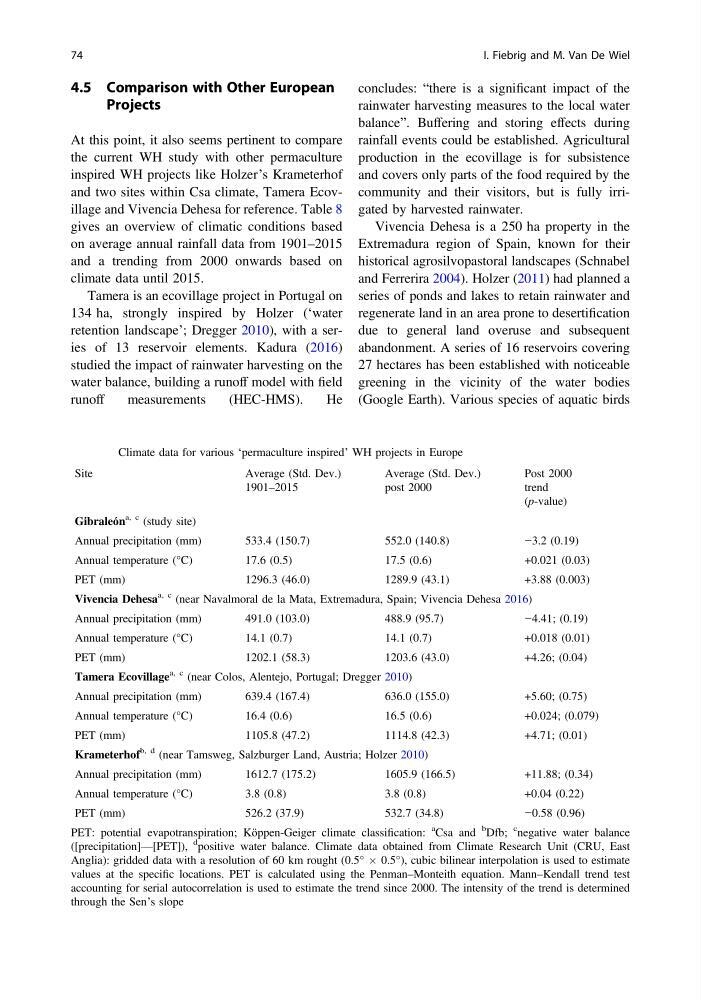
and two sites within Csa climate, Tamera Ecovillage and Vivencia Dehesa for reference. Table 8
gives an overview of climatic conditions based
on average annual rainfall data from 1901–2015
and a trending from 2000 onwards based on
climate data until 2015.
Tamera is an ecovillage project in Portugal on
134 ha, strongly inspired by Holzer (‘water
retention landscape’; Dregger 2010), with a series of 13 reservoir elements. Kadura (2016)
studied the impact of rainwater harvesting on the
water balance, building a runoff model with field
runoff
measurements
(HEC-HMS).
He
concludes: “there is a significant impact of the
rainwater harvesting measures to the local water
balance”. Buffering and storing effects during
rainfall events could be established. Agricultural
production in the ecovillage is for subsistence
and covers only parts of the food required by the
community and their visitors, but is fully irrigated by harvested rainwater.
Vivencia Dehesa is a 250 ha property in the
Extremadura region of Spain, known for their
historical agrosilvopastoral landscapes (Schnabel
and Ferrerira 2004). Holzer (2011) had planned a
series of ponds and lakes to retain rainwater and
regenerate land in an area prone to desertification
due to general land overuse and subsequent
abandonment. A series of 16 reservoirs covering
27 hectares has been established with noticeable
greening in the vicinity of the water bodies
(Google Earth). Various species of aquatic birds
Table 8 Climate data for various ‘permaculture inspired’ WH projects in Europe
Site
Average (Std. Dev.)
1901–2015
Average (Std. Dev.)
post 2000
Post 2000
trend
(p-value)
Gibraleón
a, c (study site)
Annual precipitation (mm)
533.4 (150.7)
552.0 (140.8)
−3.2 (0.19)
Annual temperature (°C)
17.6 (0.5)
17.5 (0.6)
+0.021 (0.03)
PET (mm)
1296.3 (46.0)
1289.9 (43.1)
+3.88 (0.003)
Vivencia Dehesa
a, c (near Navalmoral de la Mata, Extremadura, Spain; Vivencia Dehesa 2016)
Annual precipitation (mm)
491.0 (103.0)
488.9 (95.7)
−4.41; (0.19)
Annual temperature (°C)
14.1 (0.7)
14.1 (0.7)
+0.018 (0.01)
PET (mm)
1202.1 (58.3)
1203.6 (43.0)
+4.26; (0.04)
Tamera Ecovillage
a, c (near Colos, Alentejo, Portugal; Dregger 2010)
Annual precipitation (mm)
639.4 (167.4)
636.0 (155.0)
+5.60; (0.75)
Annual temperature (°C)
16.4 (0.6)
16.5 (0.6)
+0.024; (0.079)
PET (mm)
1105.8 (47.2)
1114.8 (42.3)
+4.71; (0.01)
Krameterhof
b, d (near Tamsweg, Salzburger Land, Austria; Holzer 2010)
Annual precipitation (mm)
1612.7 (175.2)
1605.9 (166.5)
+11.88; (0.34)
Annual temperature (°C)
3.8 (0.8)
3.8 (0.8)
+0.04 (0.22)
PET (mm)
526.2 (37.9)
532.7 (34.8)
−0.58 (0.96)
PET: potential evapotranspiration; Köppen-Geiger climate classification:
a Csa and
b
Dfb;
c negative water balance
([precipitation]—[PET]),
d
positive water balance. Climate data obtained from Climate Research Unit (CRU, East
Anglia): gridded data with a resolution of 60 km rought (0.5° Â 0.5°), cubic bilinear interpolation is used to estimate
values at the specific locations. PET is calculated using the Penman–Monteith equation. Mann–Kendall trend test
accounting for serial autocorrelation is used to estimate the trend since 2000. The intensity of the trend is determined
through the Sen’s slope
74
I. Fiebrig and M. Van De Wiel
Projects
At this point, it also seems pertinent to compare
the current WH study with other permaculture
inspired WH projects like Holzer’s Krameterhof
and two sites within Csa climate, Tamera Ecovillage and Vivencia Dehesa for reference. Table 8
gives an overview of climatic conditions based
on average annual rainfall data from 1901–2015
and a trending from 2000 onwards based on
climate data until 2015.
Tamera is an ecovillage project in Portugal on
134 ha, strongly inspired by Holzer (‘water
retention landscape’; Dregger 2010), with a series of 13 reservoir elements. Kadura (2016)
studied the impact of rainwater harvesting on the
water balance, building a runoff model with field
runoff
measurements
(HEC-HMS).
He
concludes: “there is a significant impact of the
rainwater harvesting measures to the local water
balance”. Buffering and storing effects during
rainfall events could be established. Agricultural
production in the ecovillage is for subsistence
and covers only parts of the food required by the
community and their visitors, but is fully irrigated by harvested rainwater.
Vivencia Dehesa is a 250 ha property in the
Extremadura region of Spain, known for their
historical agrosilvopastoral landscapes (Schnabel
and Ferrerira 2004). Holzer (2011) had planned a
series of ponds and lakes to retain rainwater and
regenerate land in an area prone to desertification
due to general land overuse and subsequent
abandonment. A series of 16 reservoirs covering
27 hectares has been established with noticeable
greening in the vicinity of the water bodies
(Google Earth). Various species of aquatic birds
Table 8 Climate data for various ‘permaculture inspired’ WH projects in Europe
Site
Average (Std. Dev.)
1901–2015
Average (Std. Dev.)
post 2000
Post 2000
trend
(p-value)
Gibraleón
a, c (study site)
Annual precipitation (mm)
533.4 (150.7)
552.0 (140.8)
−3.2 (0.19)
Annual temperature (°C)
17.6 (0.5)
17.5 (0.6)
+0.021 (0.03)
PET (mm)
1296.3 (46.0)
1289.9 (43.1)
+3.88 (0.003)
Vivencia Dehesa
a, c (near Navalmoral de la Mata, Extremadura, Spain; Vivencia Dehesa 2016)
Annual precipitation (mm)
491.0 (103.0)
488.9 (95.7)
−4.41; (0.19)
Annual temperature (°C)
14.1 (0.7)
14.1 (0.7)
+0.018 (0.01)
PET (mm)
1202.1 (58.3)
1203.6 (43.0)
+4.26; (0.04)
Tamera Ecovillage
a, c (near Colos, Alentejo, Portugal; Dregger 2010)
Annual precipitation (mm)
639.4 (167.4)
636.0 (155.0)
+5.60; (0.75)
Annual temperature (°C)
16.4 (0.6)
16.5 (0.6)
+0.024; (0.079)
PET (mm)
1105.8 (47.2)
1114.8 (42.3)
+4.71; (0.01)
Krameterhof
b, d (near Tamsweg, Salzburger Land, Austria; Holzer 2010)
Annual precipitation (mm)
1612.7 (175.2)
1605.9 (166.5)
+11.88; (0.34)
Annual temperature (°C)
3.8 (0.8)
3.8 (0.8)
+0.04 (0.22)
PET (mm)
526.2 (37.9)
532.7 (34.8)
−0.58 (0.96)
PET: potential evapotranspiration; Köppen-Geiger climate classification:
a Csa and
b
Dfb;
c negative water balance
([precipitation]—[PET]),
d
positive water balance. Climate data obtained from Climate Research Unit (CRU, East
Anglia): gridded data with a resolution of 60 km rought (0.5° Â 0.5°), cubic bilinear interpolation is used to estimate
values at the specific locations. PET is calculated using the Penman–Monteith equation. Mann–Kendall trend test
accounting for serial autocorrelation is used to estimate the trend since 2000. The intensity of the trend is determined
through the Sen’s slope
74
I. Fiebrig and M. Van De Wiel