

The water balance for a reservoir’s water
volume, V R , over an interval Dt is given by:
V R;t þ Dt ¼ V R;t þ DV R
with
DV R ¼ V sr À V e À V out þ V in À V w
where V sr is the influx from surface runoff, V e
denotes losses from the reservoir due to evaporation and reservoir seepage, V out is outflux
through overflow of the reservoir, V in is influx
from overflowing upstream reservoirs (i.e. where
reservoirs are connected, a cascading hydrological system is created), and V w denotes withdrawn
volume (e.g. for irrigation).
The surface runoff volume, V sr , contributing
to a reservoir over a given interval Dt is obtained
as:
V sr ¼ rA c Dt
where A c denotes the reservoir’s catchment area
and r is the surface run-off rate, which is calculated as a Hortonian infiltration-excess:
r ¼ f0p À i p ip [ i
where p denotes precipitation rate and i denotes
infiltration rate. Precipitation rate is temporally
variable and is provided as model input for each
time step. The infiltration rate is temporally
variable and depends on preceding rainfall. Here,
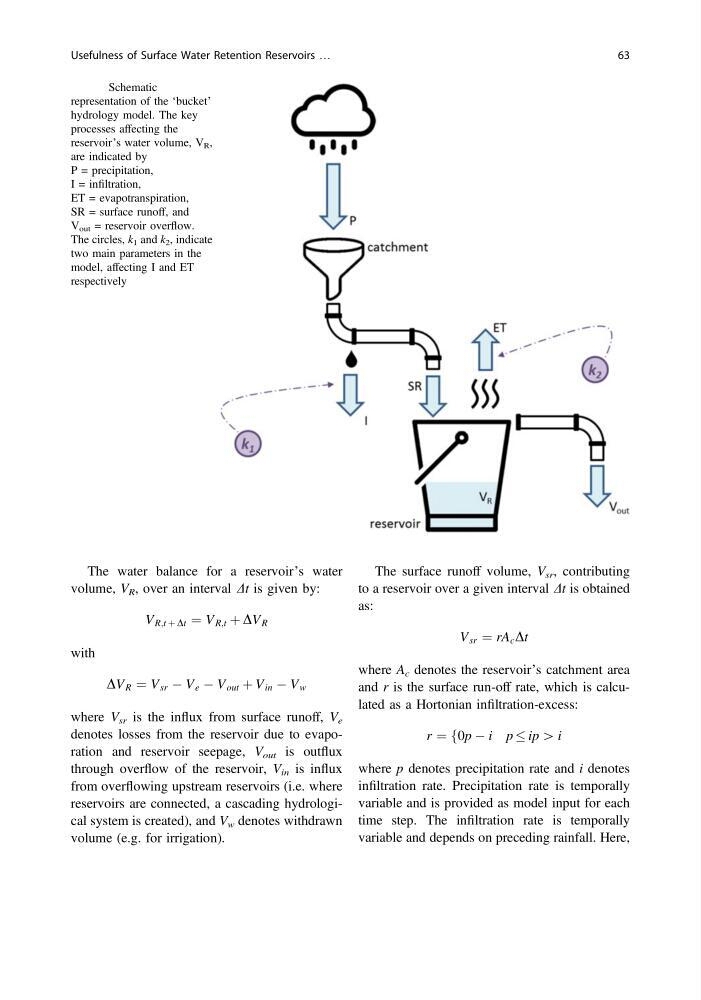
Fig. 2 Schematic
representation of the ‘bucket’
hydrology model. The key
processes affecting the
reservoir’s water volume, V R ,
are indicated by
P = precipitation,
I = infiltration,
ET = evapotranspiration,
SR = surface runoff, and
V out = reservoir overflow.
The circles, k 1 and k 2 , indicate
two main parameters in the
model, affecting I and ET
respectively
Usefulness of Surface Water Retention Reservoirs …
63
volume, V R , over an interval Dt is given by:
V R;t þ Dt ¼ V R;t þ DV R
with
DV R ¼ V sr À V e À V out þ V in À V w
where V sr is the influx from surface runoff, V e
denotes losses from the reservoir due to evaporation and reservoir seepage, V out is outflux
through overflow of the reservoir, V in is influx
from overflowing upstream reservoirs (i.e. where
reservoirs are connected, a cascading hydrological system is created), and V w denotes withdrawn
volume (e.g. for irrigation).
The surface runoff volume, V sr , contributing
to a reservoir over a given interval Dt is obtained
as:
V sr ¼ rA c Dt
where A c denotes the reservoir’s catchment area
and r is the surface run-off rate, which is calculated as a Hortonian infiltration-excess:
r ¼ f0p À i p ip [ i
where p denotes precipitation rate and i denotes
infiltration rate. Precipitation rate is temporally
variable and is provided as model input for each
time step. The infiltration rate is temporally
variable and depends on preceding rainfall. Here,
Fig. 2 Schematic
representation of the ‘bucket’
hydrology model. The key
processes affecting the
reservoir’s water volume, V R ,
are indicated by
P = precipitation,
I = infiltration,
ET = evapotranspiration,
SR = surface runoff, and
V out = reservoir overflow.
The circles, k 1 and k 2 , indicate
two main parameters in the
model, affecting I and ET
respectively
Usefulness of Surface Water Retention Reservoirs …
63