

(1) Wastewater treatment systems
Negative health effects can be alleviated by the
treatment of wastewater for the effective removal
of pathogens (FAO 1997). Sedimentation can be
effective in the removal of protozoa and helminths, with pathogen die-away during longterm storage (Lam et al. 2015). Wastewater
treatment systems are designed based on a set of
treatment principles and used for both domestic
and industrial wastewater. The CDD Society is
promoting Decentralized Wastewater Treatment
Systems (DEWATS) technology and has been
successful in applying the technology in India for
over 14 years with over 230 successfully
implemented projects across the country.
DEWATS is based on the treatment methods of
sedimentation, activated sludge treatment, and
aeration and filtration (Fig. 8).
DEWATS systems are effective, reliable, costefficient, and custom-made wastewater treatment
systems that are perfectly suited for small to
medium-sized systems at the community level
and for institutions like schools, hospitals, or
enterprises (Small and medium-sized enterprises). However, DEWATS solutions are not
intended to replace but rather to complement
centralized systems in applicable areas. At the
community level, DEWATS can be integrated
into a sanitation complex, which is operated on a
pay-and-use basis, creating income opportunities
for local people (community-based sanitation).
The technical options within DEWATS are based
on a modular and partly standardized design.
DEWATS is based on basic technical treatment
processes: mechanical treatment (sedimentation
and flotation) and biological (anaerobic and aerobic) treatment. These systems can be designed
based on needs and the most common DEWATS
modules are: septic tanks, biogas digesters,
anaerobic baffled reactors, anaerobic filters,
planted gravel filters, and (if needed) polishing
ponds.
DEWATS treatment methodology provides a
treatment efficiency that allows for the use of the
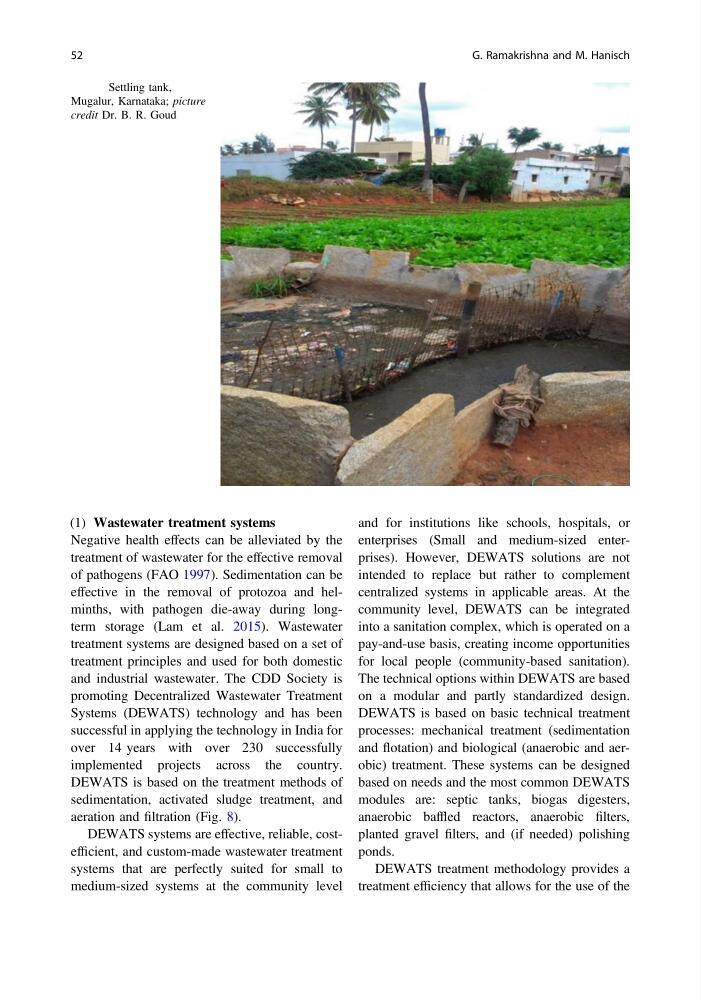
Fig. 7 Settling tank,
Mugalur, Karnataka; picture
credit Dr. B. R. Goud
52
G. Ramakrishna and M. Hanisch
Negative health effects can be alleviated by the
treatment of wastewater for the effective removal
of pathogens (FAO 1997). Sedimentation can be
effective in the removal of protozoa and helminths, with pathogen die-away during longterm storage (Lam et al. 2015). Wastewater
treatment systems are designed based on a set of
treatment principles and used for both domestic
and industrial wastewater. The CDD Society is
promoting Decentralized Wastewater Treatment
Systems (DEWATS) technology and has been
successful in applying the technology in India for
over 14 years with over 230 successfully
implemented projects across the country.
DEWATS is based on the treatment methods of
sedimentation, activated sludge treatment, and
aeration and filtration (Fig. 8).
DEWATS systems are effective, reliable, costefficient, and custom-made wastewater treatment
systems that are perfectly suited for small to
medium-sized systems at the community level
and for institutions like schools, hospitals, or
enterprises (Small and medium-sized enterprises). However, DEWATS solutions are not
intended to replace but rather to complement
centralized systems in applicable areas. At the
community level, DEWATS can be integrated
into a sanitation complex, which is operated on a
pay-and-use basis, creating income opportunities
for local people (community-based sanitation).
The technical options within DEWATS are based
on a modular and partly standardized design.
DEWATS is based on basic technical treatment
processes: mechanical treatment (sedimentation
and flotation) and biological (anaerobic and aerobic) treatment. These systems can be designed
based on needs and the most common DEWATS
modules are: septic tanks, biogas digesters,
anaerobic baffled reactors, anaerobic filters,
planted gravel filters, and (if needed) polishing
ponds.
DEWATS treatment methodology provides a
treatment efficiency that allows for the use of the
Fig. 7 Settling tank,
Mugalur, Karnataka; picture
credit Dr. B. R. Goud
52
G. Ramakrishna and M. Hanisch