

• Continuous bad odour was found and thus
chances of contamination through inhalation
(causing sickness to farmers) are high.
• 80% of farmers work without any safety
measures, which means they were directly
exposed to the wastewater.
• Non-judicious application of pesticides by
farmers. It was found that there was a high
dependence on manufacturers and private
agencies for chemical pest controls.
• No preliminary treatment of wastewater, direct
usage by pumping onto farmland (Fig. 6).
• The majority of the farmers were using
sprinklers for irrigation, which would increase
the risks through aerosol generation.
Field inspections related to operational issues
at the field level revealed the following:
• Chemical fertilizers applied to wastewaterirrigated fields resulted in the burning of crops
(withering and drying) because the high
nutrient content of previously added wastewater becomes toxic to plants following the
addition of fertilizers. The nutrients might be
in excess or deficient in wastewater as the
nutrient content of wastewater is unknown.
• Weeds are a major problem in wastewater
farming since agricultural runoff with seeds
and high nutrient content in wastewater
facilitate weed growth. Many farmers were
using weedicides to control weeds.
• There was clogging of drip irrigation pipes
and other plumbing devices became blocked
with algal growth when wastewater was
pumped through drip irrigation.
• Wastewater farming promoted the breeding of
mosquitoes in some of the fields. This can
result in mosquito-borne diseases in addition
to water-borne diseases, causing health issues
such as diarrhoea, enteric fever, hepatitis,
polio, and worm infestations.
0
5
10
15
20
25
30
Product Quality
Shelf life of product
irrigation water quality
Nutrient load
Product yield
Pesticide usage
Weeds in excess
Cost on pest & weed control
Dermatological issues
Sewage sickness
Gastrointestinal issues
Respiratory issues
Overall health impact
Odour presence
Mosquitoes and flies
Disease occurrence
Irrigation water availability
Potable water Quality
Willingness to switch to WW irrigation
Monitoring frequency
Awareness on treated WW
Economic loss due health cost
Soil Quality
Ground water quality
Control site
No. of positive opinions
No. of negative opinions
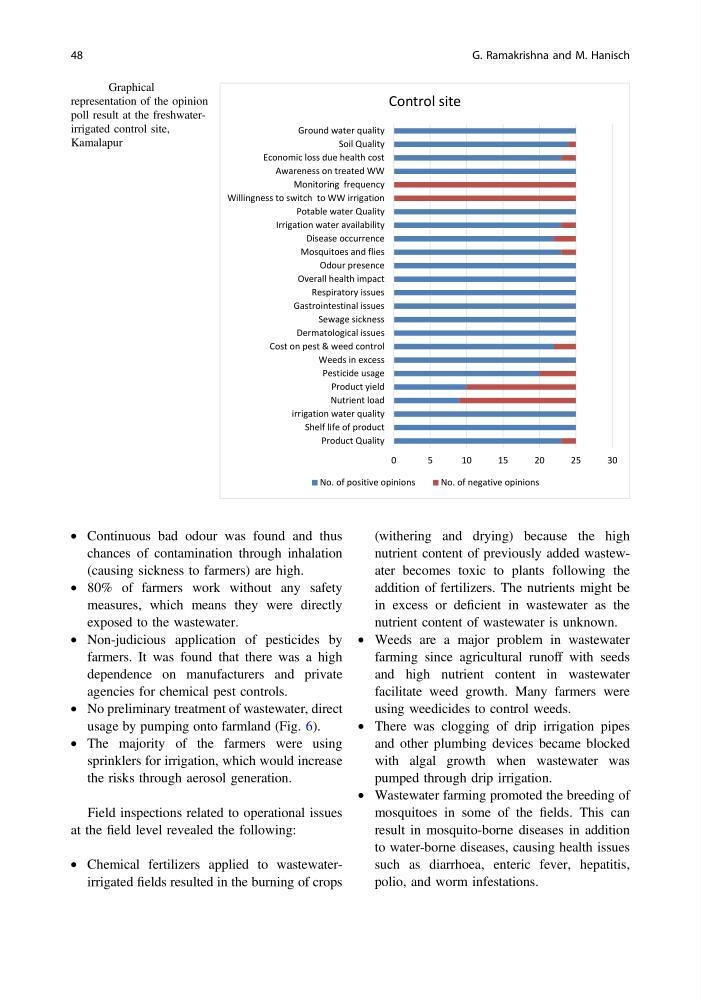
Fig. 5 Graphical
representation of the opinion
poll result at the freshwaterirrigated control site,
Kamalapur
48
G. Ramakrishna and M. Hanisch
chances of contamination through inhalation
(causing sickness to farmers) are high.
• 80% of farmers work without any safety
measures, which means they were directly
exposed to the wastewater.
• Non-judicious application of pesticides by
farmers. It was found that there was a high
dependence on manufacturers and private
agencies for chemical pest controls.
• No preliminary treatment of wastewater, direct
usage by pumping onto farmland (Fig. 6).
• The majority of the farmers were using
sprinklers for irrigation, which would increase
the risks through aerosol generation.
Field inspections related to operational issues
at the field level revealed the following:
• Chemical fertilizers applied to wastewaterirrigated fields resulted in the burning of crops
(withering and drying) because the high
nutrient content of previously added wastewater becomes toxic to plants following the
addition of fertilizers. The nutrients might be
in excess or deficient in wastewater as the
nutrient content of wastewater is unknown.
• Weeds are a major problem in wastewater
farming since agricultural runoff with seeds
and high nutrient content in wastewater
facilitate weed growth. Many farmers were
using weedicides to control weeds.
• There was clogging of drip irrigation pipes
and other plumbing devices became blocked
with algal growth when wastewater was
pumped through drip irrigation.
• Wastewater farming promoted the breeding of
mosquitoes in some of the fields. This can
result in mosquito-borne diseases in addition
to water-borne diseases, causing health issues
such as diarrhoea, enteric fever, hepatitis,
polio, and worm infestations.
0
5
10
15
20
25
30
Product Quality
Shelf life of product
irrigation water quality
Nutrient load
Product yield
Pesticide usage
Weeds in excess
Cost on pest & weed control
Dermatological issues
Sewage sickness
Gastrointestinal issues
Respiratory issues
Overall health impact
Odour presence
Mosquitoes and flies
Disease occurrence
Irrigation water availability
Potable water Quality
Willingness to switch to WW irrigation
Monitoring frequency
Awareness on treated WW
Economic loss due health cost
Soil Quality
Ground water quality
Control site
No. of positive opinions
No. of negative opinions
Fig. 5 Graphical
representation of the opinion
poll result at the freshwaterirrigated control site,
Kamalapur
48
G. Ramakrishna and M. Hanisch