

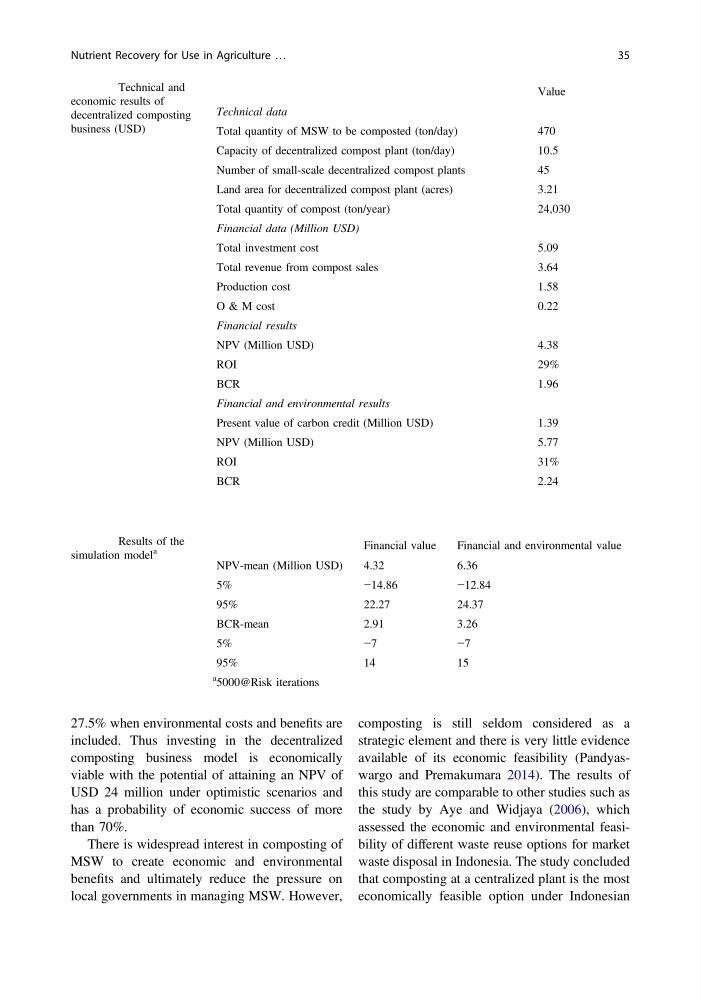
27.5% when environmental costs and benefits are
included. Thus investing in the decentralized
composting business model is economically
viable with the potential of attaining an NPV of
USD 24 million under optimistic scenarios and
has a probability of economic success of more
than 70%.
There is widespread interest in composting of
MSW to create economic and environmental
benefits and ultimately reduce the pressure on
local governments in managing MSW. However,
composting is still seldom considered as a
strategic element and there is very little evidence
available of its economic feasibility (Pandyaswargo and Premakumara 2014). The results of
this study are comparable to other studies such as
the study by Aye and Widjaya (2006), which
assessed the economic and environmental feasibility of different waste reuse options for market
waste disposal in Indonesia. The study concluded
that composting at a centralized plant is the most
economically feasible option under Indonesian
Table 5 Technical and
economic results of
decentralized composting
business (USD)
Value
Technical data
Total quantity of MSW to be composted (ton/day)
470
Capacity of decentralized compost plant (ton/day)
10.5
Number of small-scale decentralized compost plants
45
Land area for decentralized compost plant (acres)
3.21
Total quantity of compost (ton/year)
24,030
Financial data (Million USD)
Total investment cost
5.09
Total revenue from compost sales
3.64
Production cost
1.58
O & M cost
0.22
Financial results
NPV (Million USD)
4.38
ROI
29%
BCR
1.96
Financial and environmental results
Present value of carbon credit (Million USD)
1.39
NPV (Million USD)
5.77
ROI
31%
BCR
2.24
Table 6 Results of the
simulation model
a
Financial value
Financial and environmental value
NPV-mean (Million USD)
4.32
6.36
5%
−14.86
−12.84
95%
22.27
24.37
BCR-mean
2.91
3.26
5%
−7
−7
95%
14
15
a 5000@Risk iterations
Nutrient Recovery for Use in Agriculture …
35
included. Thus investing in the decentralized
composting business model is economically
viable with the potential of attaining an NPV of
USD 24 million under optimistic scenarios and
has a probability of economic success of more
than 70%.
There is widespread interest in composting of
MSW to create economic and environmental
benefits and ultimately reduce the pressure on
local governments in managing MSW. However,
composting is still seldom considered as a
strategic element and there is very little evidence
available of its economic feasibility (Pandyaswargo and Premakumara 2014). The results of
this study are comparable to other studies such as
the study by Aye and Widjaya (2006), which
assessed the economic and environmental feasibility of different waste reuse options for market
waste disposal in Indonesia. The study concluded
that composting at a centralized plant is the most
economically feasible option under Indonesian
Table 5 Technical and
economic results of
decentralized composting
business (USD)
Value
Technical data
Total quantity of MSW to be composted (ton/day)
470
Capacity of decentralized compost plant (ton/day)
10.5
Number of small-scale decentralized compost plants
45
Land area for decentralized compost plant (acres)
3.21
Total quantity of compost (ton/year)
24,030
Financial data (Million USD)
Total investment cost
5.09
Total revenue from compost sales
3.64
Production cost
1.58
O & M cost
0.22
Financial results
NPV (Million USD)
4.38
ROI
29%
BCR
1.96
Financial and environmental results
Present value of carbon credit (Million USD)
1.39
NPV (Million USD)
5.77
ROI
31%
BCR
2.24
Table 6 Results of the
simulation model
a
Financial value
Financial and environmental value
NPV-mean (Million USD)
4.32
6.36
5%
−14.86
−12.84
95%
22.27
24.37
BCR-mean
2.91
3.26
5%
−7
−7
95%
14
15
a 5000@Risk iterations
Nutrient Recovery for Use in Agriculture …
35