

strategic objectives and the SDGs. These
products of the working process were examined to check whether they correspond to the
LAG 21 NRW approach and previously
defined objectives.
– Structured interviews with project team
members have been conducted to capture a
comprehensive view of the project processes
in the specific municipalities. They first took
place after the second meeting of the steering
committees and contained questions about,
e.g.,
• Cooperation of the steering committee
members
• Quality of working results
• Intensity of participation of different actor
groups
c
– Standardized surveys of the municipal project
coordination and their proxies were implemented with an online survey tool twice
(n = 20/18). While the first survey was conducted after the second meeting of the steering
committees, the second occurred after the
developed target system was adopted by the
committee members (last meeting of the
steering committee). The following issues
were queried in both surveys to enable a
comparison:
• Satisfaction with the achieved results
• Impacts of the project in the municipalities
• Challenges and requirements regarding
their role as project coordinators and the
work of the steering committee
• Satisfaction with advisory service of the
LAG 21 NRW
– A standardized survey of all steering committee members was implemented after the
last meetings (n = 197). Here, the survey also
contained the following content:
• Satisfaction with the achieved results
• Impacts of the project in the municipalities
• Challenges and requirements regarding the
work of the steering committee
• Satisfaction with advisory services of the
LAG 21 NRW
– Impressions of local working processes were
guaranteed through participatory observation.
For this purpose, two steering committee
meetings were observed for every main
working step of the committees.
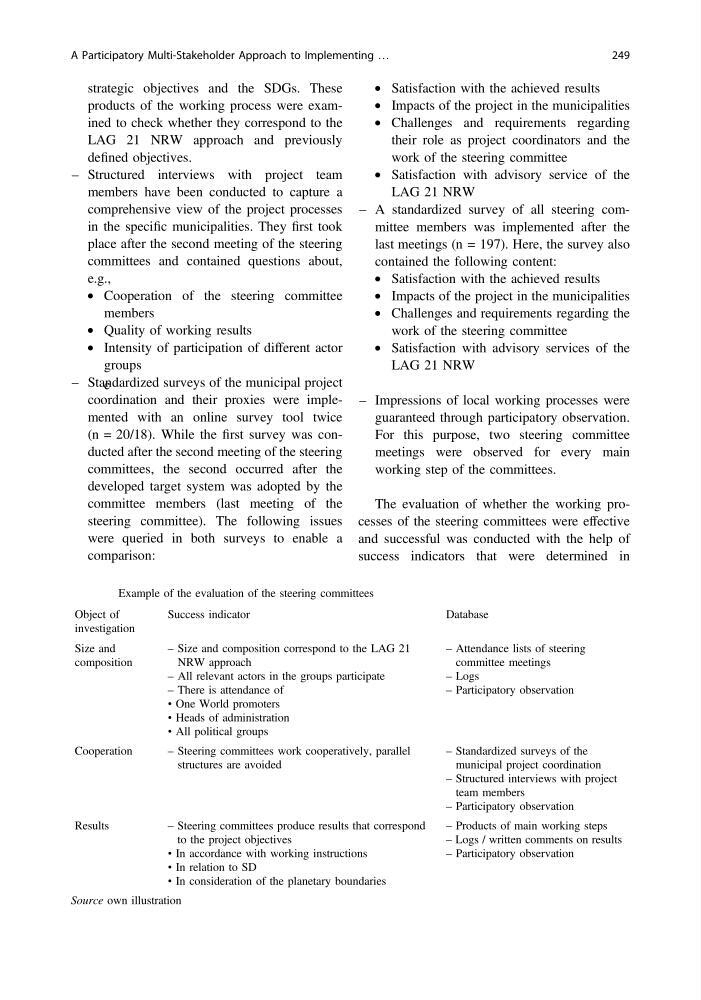
The evaluation of whether the working processes of the steering committees were effective
and successful was conducted with the help of
success indicators that were determined in
Table 1 Example of the evaluation of the steering committees
Object of
investigation
Success indicator
Database
Size and
composition
– Size and composition correspond to the LAG 21
NRW approach
– All relevant actors in the groups participate
– There is attendance of
• One World promoters
• Heads of administration
• All political groups
– Attendance lists of steering
committee meetings
– Logs
– Participatory observation
Cooperation
– Steering committees work cooperatively, parallel
structures are avoided
– Standardized surveys of the
municipal project coordination
– Structured interviews with project
team members
– Participatory observation
Results
– Steering committees produce results that correspond
to the project objectives
• In accordance with working instructions
• In relation to SD
• In consideration of the planetary boundaries
– Products of main working steps
– Logs / written comments on results
– Participatory observation
Source own illustration
A Participatory Multi-Stakeholder Approach to Implementing …
249
products of the working process were examined to check whether they correspond to the
LAG 21 NRW approach and previously
defined objectives.
– Structured interviews with project team
members have been conducted to capture a
comprehensive view of the project processes
in the specific municipalities. They first took
place after the second meeting of the steering
committees and contained questions about,
e.g.,
• Cooperation of the steering committee
members
• Quality of working results
• Intensity of participation of different actor
groups
c
– Standardized surveys of the municipal project
coordination and their proxies were implemented with an online survey tool twice
(n = 20/18). While the first survey was conducted after the second meeting of the steering
committees, the second occurred after the
developed target system was adopted by the
committee members (last meeting of the
steering committee). The following issues
were queried in both surveys to enable a
comparison:
• Satisfaction with the achieved results
• Impacts of the project in the municipalities
• Challenges and requirements regarding
their role as project coordinators and the
work of the steering committee
• Satisfaction with advisory service of the
LAG 21 NRW
– A standardized survey of all steering committee members was implemented after the
last meetings (n = 197). Here, the survey also
contained the following content:
• Satisfaction with the achieved results
• Impacts of the project in the municipalities
• Challenges and requirements regarding the
work of the steering committee
• Satisfaction with advisory services of the
LAG 21 NRW
– Impressions of local working processes were
guaranteed through participatory observation.
For this purpose, two steering committee
meetings were observed for every main
working step of the committees.
The evaluation of whether the working processes of the steering committees were effective
and successful was conducted with the help of
success indicators that were determined in
Table 1 Example of the evaluation of the steering committees
Object of
investigation
Success indicator
Database
Size and
composition
– Size and composition correspond to the LAG 21
NRW approach
– All relevant actors in the groups participate
– There is attendance of
• One World promoters
• Heads of administration
• All political groups
– Attendance lists of steering
committee meetings
– Logs
– Participatory observation
Cooperation
– Steering committees work cooperatively, parallel
structures are avoided
– Standardized surveys of the
municipal project coordination
– Structured interviews with project
team members
– Participatory observation
Results
– Steering committees produce results that correspond
to the project objectives
• In accordance with working instructions
• In relation to SD
• In consideration of the planetary boundaries
– Products of main working steps
– Logs / written comments on results
– Participatory observation
Source own illustration
A Participatory Multi-Stakeholder Approach to Implementing …
249