

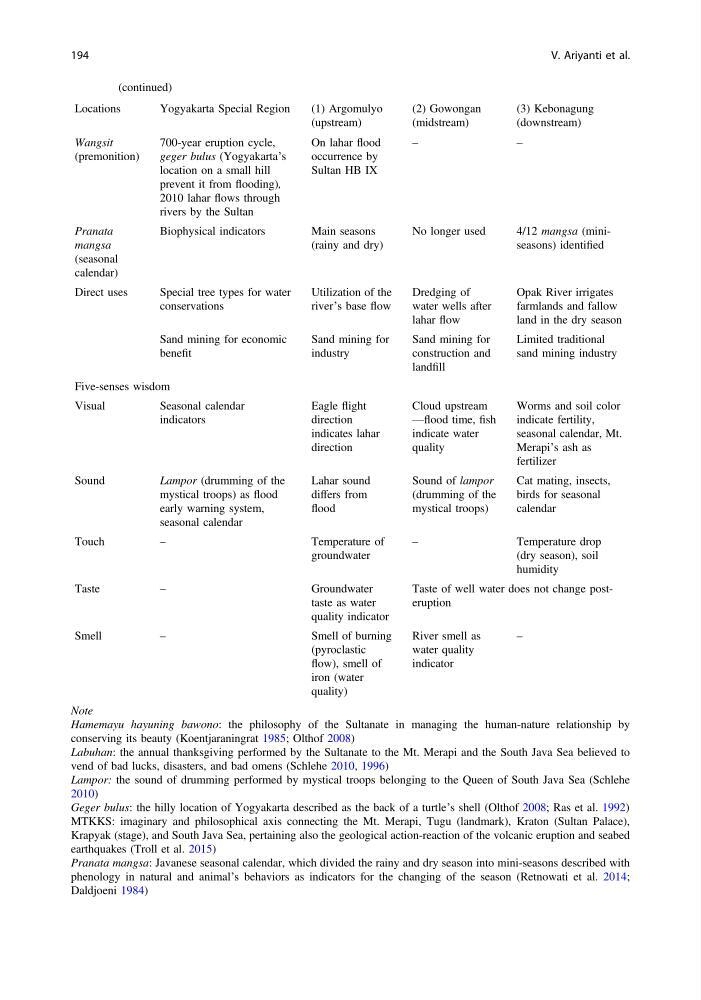
Table 1 (continued)
Locations
Yogyakarta Special Region
(1) Argomulyo
(upstream)
(2) Gowongan
(midstream)
(3) Kebonagung
(downstream)
Wangsit
(premonition)
700-year eruption cycle,
geger bulus (Yogyakarta’s
location on a small hill
prevent it from flooding),
2010 lahar flows through
rivers by the Sultan
On lahar flood
occurrence by
Sultan HB IX
–
–
Pranata
mangsa
(seasonal
calendar)
Biophysical indicators
Main seasons
(rainy and dry)
No longer used
4/12 mangsa (miniseasons) identified
Direct uses
Special tree types for water
conservations
Utilization of the
river’s base flow
Dredging of
water wells after
lahar flow
Opak River irrigates
farmlands and fallow
land in the dry season
Sand mining for economic
benefit
Sand mining for
industry
Sand mining for
construction and
landfill
Limited traditional
sand mining industry
Five-senses wisdom
Visual
Seasonal calendar
indicators
Eagle flight
direction
indicates lahar
direction
Cloud upstream
—flood time, fish
indicate water
quality
Worms and soil color
indicate fertility,
seasonal calendar, Mt.
Merapi’s ash as
fertilizer
Sound
Lampor (drumming of the
mystical troops) as flood
early warning system,
seasonal calendar
Lahar sound
differs from
flood
Sound of lampor
(drumming of the
mystical troops)
Cat mating, insects,
birds for seasonal
calendar
Touch
–
Temperature of
groundwater
–
Temperature drop
(dry season), soil
humidity
Taste
–
Groundwater
taste as water
quality indicator
Taste of well water does not change posteruption
Smell
–
Smell of burning
(pyroclastic
flow), smell of
iron (water
quality)
River smell as
water quality
indicator
–
Note
Hamemayu hayuning bawono: the philosophy of the Sultanate in managing the human-nature relationship by
conserving its beauty (Koentjaraningrat 1985; Olthof 2008)
Labuhan: the annual thanksgiving performed by the Sultanate to the Mt. Merapi and the South Java Sea believed to
vend of bad lucks, disasters, and bad omens (Schlehe 2010, 1996)
Lampor: the sound of drumming performed by mystical troops belonging to the Queen of South Java Sea (Schlehe
2010)
Geger bulus: the hilly location of Yogyakarta described as the back of a turtle’s shell (Olthof 2008; Ras et al. 1992)
MTKKS: imaginary and philosophical axis connecting the Mt. Merapi, Tugu (landmark), Kraton (Sultan Palace),
Krapyak (stage), and South Java Sea, pertaining also the geological action-reaction of the volcanic eruption and seabed
earthquakes (Troll et al. 2015)
Pranata mangsa: Javanese seasonal calendar, which divided the rainy and dry season into mini-seasons described with
phenology in natural and animal’s behaviors as indicators for the changing of the season (Retnowati et al. 2014;
Daldjoeni 1984)
194
V. Ariyanti et al.
Locations
Yogyakarta Special Region
(1) Argomulyo
(upstream)
(2) Gowongan
(midstream)
(3) Kebonagung
(downstream)
Wangsit
(premonition)
700-year eruption cycle,
geger bulus (Yogyakarta’s
location on a small hill
prevent it from flooding),
2010 lahar flows through
rivers by the Sultan
On lahar flood
occurrence by
Sultan HB IX
–
–
Pranata
mangsa
(seasonal
calendar)
Biophysical indicators
Main seasons
(rainy and dry)
No longer used
4/12 mangsa (miniseasons) identified
Direct uses
Special tree types for water
conservations
Utilization of the
river’s base flow
Dredging of
water wells after
lahar flow
Opak River irrigates
farmlands and fallow
land in the dry season
Sand mining for economic
benefit
Sand mining for
industry
Sand mining for
construction and
landfill
Limited traditional
sand mining industry
Five-senses wisdom
Visual
Seasonal calendar
indicators
Eagle flight
direction
indicates lahar
direction
Cloud upstream
—flood time, fish
indicate water
quality
Worms and soil color
indicate fertility,
seasonal calendar, Mt.
Merapi’s ash as
fertilizer
Sound
Lampor (drumming of the
mystical troops) as flood
early warning system,
seasonal calendar
Lahar sound
differs from
flood
Sound of lampor
(drumming of the
mystical troops)
Cat mating, insects,
birds for seasonal
calendar
Touch
–
Temperature of
groundwater
–
Temperature drop
(dry season), soil
humidity
Taste
–
Groundwater
taste as water
quality indicator
Taste of well water does not change posteruption
Smell
–
Smell of burning
(pyroclastic
flow), smell of
iron (water
quality)
River smell as
water quality
indicator
–
Note
Hamemayu hayuning bawono: the philosophy of the Sultanate in managing the human-nature relationship by
conserving its beauty (Koentjaraningrat 1985; Olthof 2008)
Labuhan: the annual thanksgiving performed by the Sultanate to the Mt. Merapi and the South Java Sea believed to
vend of bad lucks, disasters, and bad omens (Schlehe 2010, 1996)
Lampor: the sound of drumming performed by mystical troops belonging to the Queen of South Java Sea (Schlehe
2010)
Geger bulus: the hilly location of Yogyakarta described as the back of a turtle’s shell (Olthof 2008; Ras et al. 1992)
MTKKS: imaginary and philosophical axis connecting the Mt. Merapi, Tugu (landmark), Kraton (Sultan Palace),
Krapyak (stage), and South Java Sea, pertaining also the geological action-reaction of the volcanic eruption and seabed
earthquakes (Troll et al. 2015)
Pranata mangsa: Javanese seasonal calendar, which divided the rainy and dry season into mini-seasons described with
phenology in natural and animal’s behaviors as indicators for the changing of the season (Retnowati et al. 2014;
Daldjoeni 1984)
194
V. Ariyanti et al.