

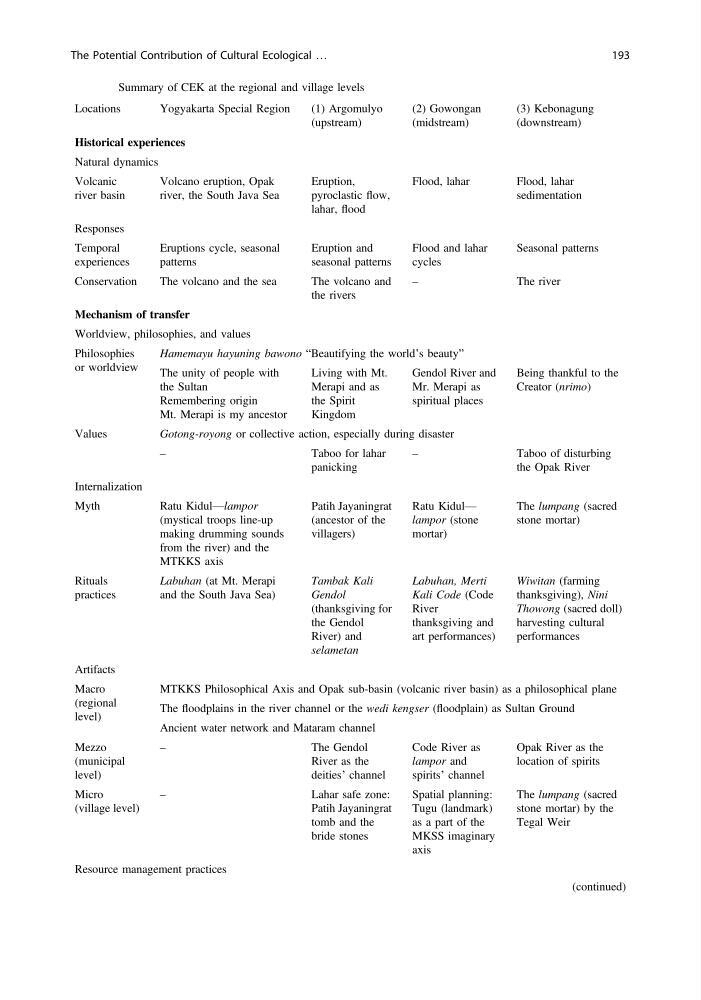
Table 1 Summary of CEK at the regional and village levels
Locations
Yogyakarta Special Region
(1) Argomulyo
(upstream)
(2) Gowongan
(midstream)
(3) Kebonagung
(downstream)
Historical experiences
Natural dynamics
Volcanic
river basin
Volcano eruption, Opak
river, the South Java Sea
Eruption,
pyroclastic flow,
lahar, flood
Flood, lahar
Flood, lahar
sedimentation
Responses
Temporal
experiences
Eruptions cycle, seasonal
patterns
Eruption and
seasonal patterns
Flood and lahar
cycles
Seasonal patterns
Conservation
The volcano and the sea
The volcano and
the rivers
–
The river
Mechanism of transfer
Worldview, philosophies, and values
Philosophies
or worldview
Hamemayu hayuning bawono “Beautifying the world’s beauty”
The unity of people with
the Sultan
Remembering origin
Mt. Merapi is my ancestor
Living with Mt.
Merapi and as
the Spirit
Kingdom
Gendol River and
Mr. Merapi as
spiritual places
Being thankful to the
Creator (nrimo)
Values
Gotong-royong or collective action, especially during disaster
–
Taboo for lahar
panicking
–
Taboo of disturbing
the Opak River
Internalization
Myth
Ratu Kidul—lampor
(mystical troops line-up
making drumming sounds
from the river) and the
MTKKS axis
Patih Jayaningrat
(ancestor of the
villagers)
Ratu Kidul—
lampor (stone
mortar)
The lumpang (sacred
stone mortar)
Rituals
practices
Labuhan (at Mt. Merapi
and the South Java Sea)
Tambak Kali
Gendol
(thanksgiving for
the Gendol
River) and
selametan
Labuhan, Merti
Kali Code (Code
River
thanksgiving and
art performances)
Wiwitan (farming
thanksgiving), Nini
Thowong (sacred doll)
harvesting cultural
performances
Artifacts
Macro
(regional
level)
MTKKS Philosophical Axis and Opak sub-basin (volcanic river basin) as a philosophical plane
The floodplains in the river channel or the wedi kengser (floodplain) as Sultan Ground
Ancient water network and Mataram channel
Mezzo
(municipal
level)
–
The Gendol
River as the
deities’ channel
Code River as
lampor and
spirits’ channel
Opak River as the
location of spirits
Micro
(village level)
–
Lahar safe zone:
Patih Jayaningrat
tomb and the
bride stones
Spatial planning:
Tugu (landmark)
as a part of the
MKSS imaginary
axis
The lumpang (sacred
stone mortar) by the
Tegal Weir
Resource management practices
(continued)
The Potential Contribution of Cultural Ecological …
193
Locations
Yogyakarta Special Region
(1) Argomulyo
(upstream)
(2) Gowongan
(midstream)
(3) Kebonagung
(downstream)
Historical experiences
Natural dynamics
Volcanic
river basin
Volcano eruption, Opak
river, the South Java Sea
Eruption,
pyroclastic flow,
lahar, flood
Flood, lahar
Flood, lahar
sedimentation
Responses
Temporal
experiences
Eruptions cycle, seasonal
patterns
Eruption and
seasonal patterns
Flood and lahar
cycles
Seasonal patterns
Conservation
The volcano and the sea
The volcano and
the rivers
–
The river
Mechanism of transfer
Worldview, philosophies, and values
Philosophies
or worldview
Hamemayu hayuning bawono “Beautifying the world’s beauty”
The unity of people with
the Sultan
Remembering origin
Mt. Merapi is my ancestor
Living with Mt.
Merapi and as
the Spirit
Kingdom
Gendol River and
Mr. Merapi as
spiritual places
Being thankful to the
Creator (nrimo)
Values
Gotong-royong or collective action, especially during disaster
–
Taboo for lahar
panicking
–
Taboo of disturbing
the Opak River
Internalization
Myth
Ratu Kidul—lampor
(mystical troops line-up
making drumming sounds
from the river) and the
MTKKS axis
Patih Jayaningrat
(ancestor of the
villagers)
Ratu Kidul—
lampor (stone
mortar)
The lumpang (sacred
stone mortar)
Rituals
practices
Labuhan (at Mt. Merapi
and the South Java Sea)
Tambak Kali
Gendol
(thanksgiving for
the Gendol
River) and
selametan
Labuhan, Merti
Kali Code (Code
River
thanksgiving and
art performances)
Wiwitan (farming
thanksgiving), Nini
Thowong (sacred doll)
harvesting cultural
performances
Artifacts
Macro
(regional
level)
MTKKS Philosophical Axis and Opak sub-basin (volcanic river basin) as a philosophical plane
The floodplains in the river channel or the wedi kengser (floodplain) as Sultan Ground
Ancient water network and Mataram channel
Mezzo
(municipal
level)
–
The Gendol
River as the
deities’ channel
Code River as
lampor and
spirits’ channel
Opak River as the
location of spirits
Micro
(village level)
–
Lahar safe zone:
Patih Jayaningrat
tomb and the
bride stones
Spatial planning:
Tugu (landmark)
as a part of the
MKSS imaginary
axis
The lumpang (sacred
stone mortar) by the
Tegal Weir
Resource management practices
(continued)
The Potential Contribution of Cultural Ecological …
193