

of September in most parts of the region. The
mean annual rainfall is about 650 mm and the
mean monthly temperature during the growing
season is 20 °C. The main soil types are Cambisols on undulating plains and rolling land,
Lithosols on hilly and steep to very steep land,
and Vertisols on flat and plateau landforms
(Tesfahunegn and Vlek 2013). The vegetation is
sparse as a result of centuries of overexploitation
and consists of shrubs and small trees with little
economic value. The farming system is principally a mixed crop-livestock system, but farmers’
livelihood mainly depends on crop cultivation
(Tesfahunegn and Vlek 2013).
The watersheds in the Tigray region of
northern Ethiopia were selected for this study
because of severe degradation in the region due
to long-cultivation and high population pressure.
To reduce such challenges, various different
watershed management interventions have been
introduced since the 1990s. Thus, in this study,
the impacts, and challenges, and opportunities of
the implemented watershed management
intervention were assessed from a nexus perspective, with the intention of identifying relevant lessons and experiences to find alternative
solutions.
In this study, a range of different approaches
was used to collect and organize the information.
This included the researchers’ personal experiences (field observations, research, and teaching)
and literature review (published and unpublished
sources). Data on the impacts of watershed
management interventions as a nexus approach
were organized using the “before” and “after”
intervention implementation (Table 1), based on
different survey tools (interviews, observations,
transect walks, group discussions, and key
informants’ interviews).
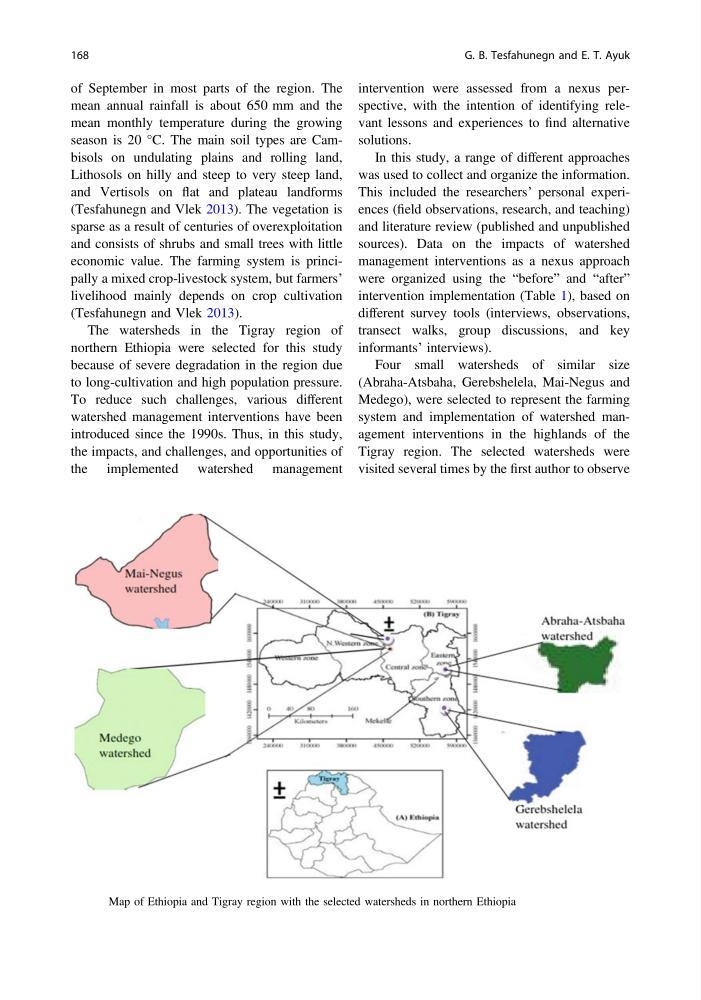
Four small watersheds of similar size
(Abraha-Atsbaha, Gerebshelela, Mai-Negus and
Medego), were selected to represent the farming
system and implementation of watershed management interventions in the highlands of the
Tigray region. The selected watersheds were
visited several times by the first author to observe
Fig. 1 Map of Ethiopia and Tigray region with the selected watersheds in northern Ethiopia
168
G. B. Tesfahunegn and E. T. Ayuk
mean annual rainfall is about 650 mm and the
mean monthly temperature during the growing
season is 20 °C. The main soil types are Cambisols on undulating plains and rolling land,
Lithosols on hilly and steep to very steep land,
and Vertisols on flat and plateau landforms
(Tesfahunegn and Vlek 2013). The vegetation is
sparse as a result of centuries of overexploitation
and consists of shrubs and small trees with little
economic value. The farming system is principally a mixed crop-livestock system, but farmers’
livelihood mainly depends on crop cultivation
(Tesfahunegn and Vlek 2013).
The watersheds in the Tigray region of
northern Ethiopia were selected for this study
because of severe degradation in the region due
to long-cultivation and high population pressure.
To reduce such challenges, various different
watershed management interventions have been
introduced since the 1990s. Thus, in this study,
the impacts, and challenges, and opportunities of
the implemented watershed management
intervention were assessed from a nexus perspective, with the intention of identifying relevant lessons and experiences to find alternative
solutions.
In this study, a range of different approaches
was used to collect and organize the information.
This included the researchers’ personal experiences (field observations, research, and teaching)
and literature review (published and unpublished
sources). Data on the impacts of watershed
management interventions as a nexus approach
were organized using the “before” and “after”
intervention implementation (Table 1), based on
different survey tools (interviews, observations,
transect walks, group discussions, and key
informants’ interviews).
Four small watersheds of similar size
(Abraha-Atsbaha, Gerebshelela, Mai-Negus and
Medego), were selected to represent the farming
system and implementation of watershed management interventions in the highlands of the
Tigray region. The selected watersheds were
visited several times by the first author to observe
Fig. 1 Map of Ethiopia and Tigray region with the selected watersheds in northern Ethiopia
168
G. B. Tesfahunegn and E. T. Ayuk