

4 Agricultural and Economic Tools
Although the agricultural contribution to the
GDP of Mendoza remains below 10%, the sector
becomes economically relevant when the multiplicative effects are considered. Since our focus
is on grape production, we review the fiscal
policies and economic tools employed in different sectors to improve the economic performance
of vineyards over the last 25 years.
Prior to the economic crisis of 2001, winerelated associations and institutions drafted a
restructuring plan to improve the strategic
opportunities of the industry. This plan included
technology adoption, variety improvement, and
development of new markets (COVIAR/OVA
2018; Azpiazu and Basualdo 2001). Foreign
direct investment assisted in this process since
vineyards and wineries had not fully utilized the
present infrastructure and institutions but were
prepared in terms of quality analysis frameworks
and procedures. The new focus on targeted
markets struggled to effectively increase the
market share. Argentinean wine is welcomed in
countries with high purchasing power, but it is
relatively expensive compared to other producers. This is because of the high production costs
and lack of proper infrastructure that increases
the cost of logistics and relatively higher
importation levies. Trade logistics represent 17%
of the production and commercialization costs of
Argentinean wine (COVIAR/OVA 2018).
Regarding the price paid to producers, small
and medium vineyards have historically faced an
uneven situation for bargaining power possibly
related to market failures as information asymmetry and moral hazard. In grapevine production, the former implies that different decisions
would be made with uneven information; the
latter considers the non-compliance with specific
tasks of an agreement. Moreover, the increase in
export-oriented wineries has led to higher mistrust in the free-market, as they require some
quality standards achieved by specific vineyard
management practices. A considerable share of
small and medium producers found alternatives
to cope with the moral hazard of the specific
grapevine management as they organized themselves into collectives to increase their bargaining power through the shield of cooperatives or
signed a contract agreement with the grapevine
buyer. Agreements for partial or total production
improved the relationship between grapevine
producers and winemakers.
Governments and wine institutions also
intervene to regulate market prices by regulating
supply in grape derivatives as wine and must.
Jointly, regional provincial governments agreed
on the share of production that will be transformed into a must to regulate the wine supply
and further sustain prices. More recently, the
0
0.1
0.2
0.3
0.4
0.5
0.6
0.7
1998 2001 2004 2007 2010 2013 2016
US dollar per kilowatt hour ($/kWh)
Consumer High Price
Subsidy High Price
Plot A
0
0.05
0.1
0.15
0.2
0.25
0.3
0.35
1998 2001 2004 2007 2010 2013 2016
US dollar per kilowatt hour ($/kWh)
Consumer Low Price
Subsidy Low Price
Plot B
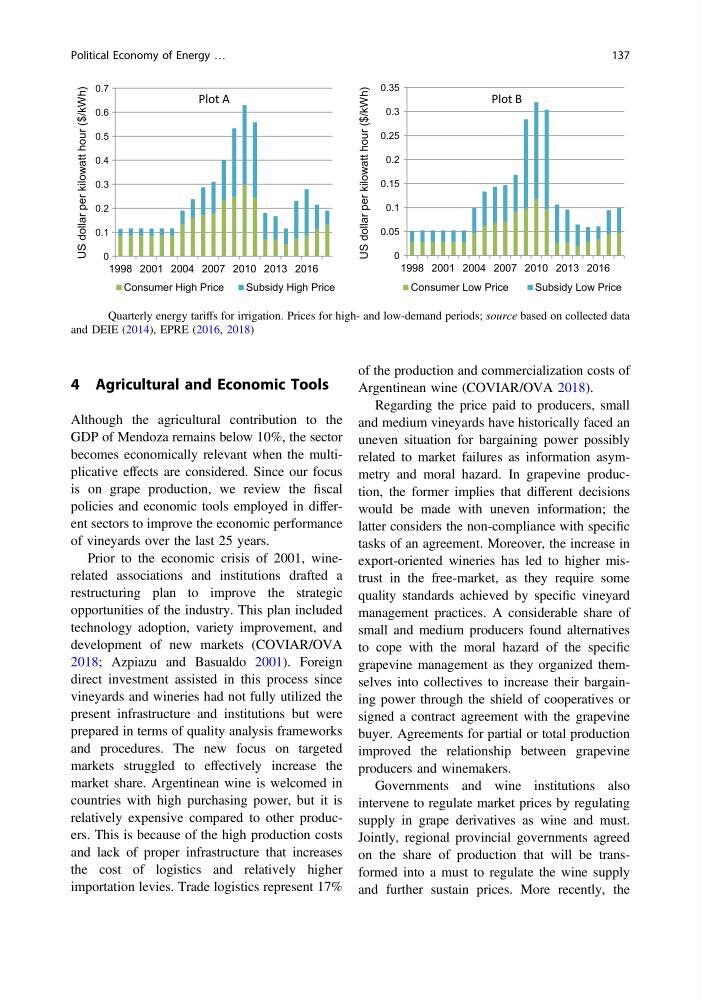
Fig. 5 Quarterly energy tariffs for irrigation. Prices for high- and low-demand periods; source based on collected data
and DEIE (2014), EPRE (2016, 2018)
Political Economy of Energy …
137
Although the agricultural contribution to the
GDP of Mendoza remains below 10%, the sector
becomes economically relevant when the multiplicative effects are considered. Since our focus
is on grape production, we review the fiscal
policies and economic tools employed in different sectors to improve the economic performance
of vineyards over the last 25 years.
Prior to the economic crisis of 2001, winerelated associations and institutions drafted a
restructuring plan to improve the strategic
opportunities of the industry. This plan included
technology adoption, variety improvement, and
development of new markets (COVIAR/OVA
2018; Azpiazu and Basualdo 2001). Foreign
direct investment assisted in this process since
vineyards and wineries had not fully utilized the
present infrastructure and institutions but were
prepared in terms of quality analysis frameworks
and procedures. The new focus on targeted
markets struggled to effectively increase the
market share. Argentinean wine is welcomed in
countries with high purchasing power, but it is
relatively expensive compared to other producers. This is because of the high production costs
and lack of proper infrastructure that increases
the cost of logistics and relatively higher
importation levies. Trade logistics represent 17%
of the production and commercialization costs of
Argentinean wine (COVIAR/OVA 2018).
Regarding the price paid to producers, small
and medium vineyards have historically faced an
uneven situation for bargaining power possibly
related to market failures as information asymmetry and moral hazard. In grapevine production, the former implies that different decisions
would be made with uneven information; the
latter considers the non-compliance with specific
tasks of an agreement. Moreover, the increase in
export-oriented wineries has led to higher mistrust in the free-market, as they require some
quality standards achieved by specific vineyard
management practices. A considerable share of
small and medium producers found alternatives
to cope with the moral hazard of the specific
grapevine management as they organized themselves into collectives to increase their bargaining power through the shield of cooperatives or
signed a contract agreement with the grapevine
buyer. Agreements for partial or total production
improved the relationship between grapevine
producers and winemakers.
Governments and wine institutions also
intervene to regulate market prices by regulating
supply in grape derivatives as wine and must.
Jointly, regional provincial governments agreed
on the share of production that will be transformed into a must to regulate the wine supply
and further sustain prices. More recently, the
0
0.1
0.2
0.3
0.4
0.5
0.6
0.7
1998 2001 2004 2007 2010 2013 2016
US dollar per kilowatt hour ($/kWh)
Consumer High Price
Subsidy High Price
Plot A
0
0.05
0.1
0.15
0.2
0.25
0.3
0.35
1998 2001 2004 2007 2010 2013 2016
US dollar per kilowatt hour ($/kWh)
Consumer Low Price
Subsidy Low Price
Plot B
Fig. 5 Quarterly energy tariffs for irrigation. Prices for high- and low-demand periods; source based on collected data
and DEIE (2014), EPRE (2016, 2018)
Political Economy of Energy …
137