

The location in the Andes Mountains allows
primary access to surface water in summer
through the largest irrigation system in the
country, which was originally designed by the
original towns (DGI 2015). Over the Carrizal
aquifer, the coexistence of agricultural activities
and oil refineries has evolved as a delicate matter
for water users and management institutions. The
extension of the aquifer is nearly 1,000 km
2 ,
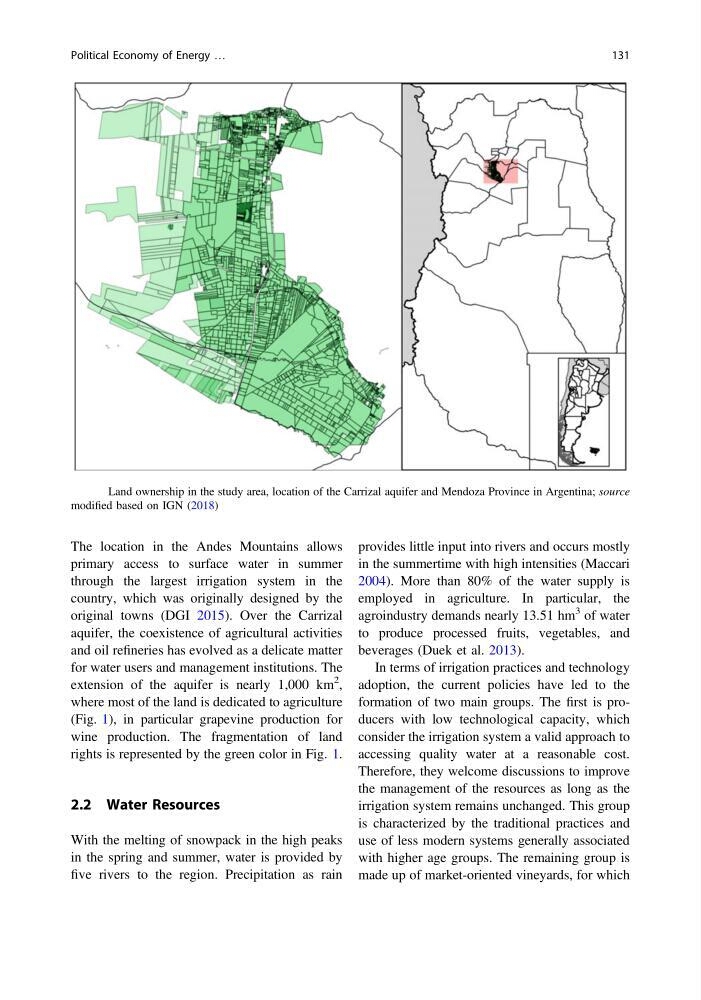
where most of the land is dedicated to agriculture
(Fig. 1), in particular grapevine production for
wine production. The fragmentation of land
rights is represented by the green color in Fig. 1.
2.2 Water Resources
With the melting of snowpack in the high peaks
in the spring and summer, water is provided by
five rivers to the region. Precipitation as rain
provides little input into rivers and occurs mostly
in the summertime with high intensities (Maccari
2004). More than 80% of the water supply is
employed in agriculture. In particular, the
agroindustry demands nearly 13.51 hm
3 of water
to produce processed fruits, vegetables, and
beverages (Duek et al. 2013).
In terms of irrigation practices and technology
adoption, the current policies have led to the
formation of two main groups. The first is producers with low technological capacity, which
consider the irrigation system a valid approach to
accessing quality water at a reasonable cost.
Therefore, they welcome discussions to improve
the management of the resources as long as the
irrigation system remains unchanged. This group
is characterized by the traditional practices and
use of less modern systems generally associated
with higher age groups. The remaining group is
made up of market-oriented vineyards, for which
Fig. 1 Land ownership in the study area, location of the Carrizal aquifer and Mendoza Province in Argentina; source
modified based on IGN (2018)
Political Economy of Energy …
131
primary access to surface water in summer
through the largest irrigation system in the
country, which was originally designed by the
original towns (DGI 2015). Over the Carrizal
aquifer, the coexistence of agricultural activities
and oil refineries has evolved as a delicate matter
for water users and management institutions. The
extension of the aquifer is nearly 1,000 km
2 ,
where most of the land is dedicated to agriculture
(Fig. 1), in particular grapevine production for
wine production. The fragmentation of land
rights is represented by the green color in Fig. 1.
2.2 Water Resources
With the melting of snowpack in the high peaks
in the spring and summer, water is provided by
five rivers to the region. Precipitation as rain
provides little input into rivers and occurs mostly
in the summertime with high intensities (Maccari
2004). More than 80% of the water supply is
employed in agriculture. In particular, the
agroindustry demands nearly 13.51 hm
3 of water
to produce processed fruits, vegetables, and
beverages (Duek et al. 2013).
In terms of irrigation practices and technology
adoption, the current policies have led to the
formation of two main groups. The first is producers with low technological capacity, which
consider the irrigation system a valid approach to
accessing quality water at a reasonable cost.
Therefore, they welcome discussions to improve
the management of the resources as long as the
irrigation system remains unchanged. This group
is characterized by the traditional practices and
use of less modern systems generally associated
with higher age groups. The remaining group is
made up of market-oriented vineyards, for which
Fig. 1 Land ownership in the study area, location of the Carrizal aquifer and Mendoza Province in Argentina; source
modified based on IGN (2018)
Political Economy of Energy …
131