

parsimonious, and it is not possible to release
water to empty the lake of its sediments. The
tidal range, which is the annual variation of the
lake level, is, in an average year, only 3.50 m,
and it is the logical consequence of the area
occupied by the lake. The lake is thus inexorably
filled, and the power plant is condemned to close
in the near future, with consequences for the
economy of the country.
The rate of sedimentation of the lake:
According to the study commissioned by MEADEN (2005), the silting effect of the Lagdo tank
has the main effect of reducing the storage
capacity of this structure. In 2004, this reduction
was estimated at 23% of the total volume at the
present stage of sedimentation. The results
obtained from the various treatments carried out
reveal that in 20 years, 815.9 million cubic
meters of deposits, mostly of coarse sands, have
accumulated in the reservoir. If we consider
1984, the year of optimum filling of the reservoir
and the start-up of the Lagdo power station's
number one, as the basis for calculating the rate
of alluvial speed, the reservoir is being filled at
the rate of 40.80 million cubic meters per year.
This assessment could be verified by applying
the method described by Sang and Maina (2021).
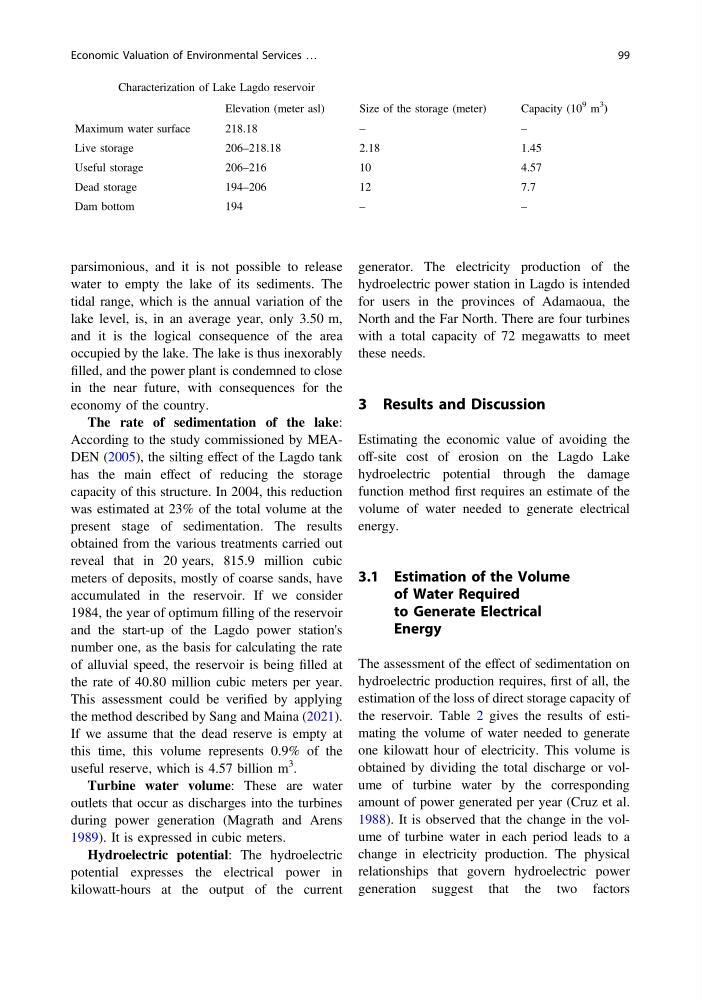
If we assume that the dead reserve is empty at
this time, this volume represents 0.9% of the
useful reserve, which is 4.57 billion m
3 .
Turbine water volume: These are water
outlets that occur as discharges into the turbines
during power generation (Magrath and Arens
1989). It is expressed in cubic meters.
Hydroelectric potential: The hydroelectric
potential expresses the electrical power in
kilowatt-hours at the output of the current
generator. The electricity production of the
hydroelectric power station in Lagdo is intended
for users in the provinces of Adamaoua, the
North and the Far North. There are four turbines
with a total capacity of 72 megawatts to meet
these needs.
3 Results and Discussion
Estimating the economic value of avoiding the
off-site cost of erosion on the Lagdo Lake
hydroelectric potential through the damage
function method first requires an estimate of the
volume of water needed to generate electrical
energy.
3.1 Estimation of the Volume
of Water Required
to Generate Electrical
Energy
The assessment of the effect of sedimentation on
hydroelectric production requires, first of all, the
estimation of the loss of direct storage capacity of
the reservoir. Table 2 gives the results of estimating the volume of water needed to generate
one kilowatt hour of electricity. This volume is
obtained by dividing the total discharge or volume of turbine water by the corresponding
amount of power generated per year (Cruz et al.
1988). It is observed that the change in the volume of turbine water in each period leads to a
change in electricity production. The physical
relationships that govern hydroelectric power
generation suggest that the two factors
Table 1 Characterization of Lake Lagdo reservoir
Elevation (meter asl)
Size of the storage (meter)
Capacity (10
9 m
3
)
Maximum water surface
218.18
–
–
Live storage
206–218.18
2.18
1.45
Useful storage
206–216
10
4.57
Dead storage
194–206
12
7.7
Dam bottom
194
–
–
Economic Valuation of Environmental Services …
99
water to empty the lake of its sediments. The
tidal range, which is the annual variation of the
lake level, is, in an average year, only 3.50 m,
and it is the logical consequence of the area
occupied by the lake. The lake is thus inexorably
filled, and the power plant is condemned to close
in the near future, with consequences for the
economy of the country.
The rate of sedimentation of the lake:
According to the study commissioned by MEADEN (2005), the silting effect of the Lagdo tank
has the main effect of reducing the storage
capacity of this structure. In 2004, this reduction
was estimated at 23% of the total volume at the
present stage of sedimentation. The results
obtained from the various treatments carried out
reveal that in 20 years, 815.9 million cubic
meters of deposits, mostly of coarse sands, have
accumulated in the reservoir. If we consider
1984, the year of optimum filling of the reservoir
and the start-up of the Lagdo power station's
number one, as the basis for calculating the rate
of alluvial speed, the reservoir is being filled at
the rate of 40.80 million cubic meters per year.
This assessment could be verified by applying
the method described by Sang and Maina (2021).
If we assume that the dead reserve is empty at
this time, this volume represents 0.9% of the
useful reserve, which is 4.57 billion m
3 .
Turbine water volume: These are water
outlets that occur as discharges into the turbines
during power generation (Magrath and Arens
1989). It is expressed in cubic meters.
Hydroelectric potential: The hydroelectric
potential expresses the electrical power in
kilowatt-hours at the output of the current
generator. The electricity production of the
hydroelectric power station in Lagdo is intended
for users in the provinces of Adamaoua, the
North and the Far North. There are four turbines
with a total capacity of 72 megawatts to meet
these needs.
3 Results and Discussion
Estimating the economic value of avoiding the
off-site cost of erosion on the Lagdo Lake
hydroelectric potential through the damage
function method first requires an estimate of the
volume of water needed to generate electrical
energy.
3.1 Estimation of the Volume
of Water Required
to Generate Electrical
Energy
The assessment of the effect of sedimentation on
hydroelectric production requires, first of all, the
estimation of the loss of direct storage capacity of
the reservoir. Table 2 gives the results of estimating the volume of water needed to generate
one kilowatt hour of electricity. This volume is
obtained by dividing the total discharge or volume of turbine water by the corresponding
amount of power generated per year (Cruz et al.
1988). It is observed that the change in the volume of turbine water in each period leads to a
change in electricity production. The physical
relationships that govern hydroelectric power
generation suggest that the two factors
Table 1 Characterization of Lake Lagdo reservoir
Elevation (meter asl)
Size of the storage (meter)
Capacity (10
9 m
3
)
Maximum water surface
218.18
–
–
Live storage
206–218.18
2.18
1.45
Useful storage
206–216
10
4.57
Dead storage
194–206
12
7.7
Dam bottom
194
–
–
Economic Valuation of Environmental Services …
99