

84
4.4 India
The Uranium Corporation of India Ltd. (UCIL) working under the Department of
Atomic Energy (DAE) Commission has the central responsibility for the uranium
mining in India. As per the DAE report (2011), 171,672 tons of uranium (as U 3 O 8 )
is present in ten states of India (namely, Andhra Pradesh, Chhattisgarh, Himachal
Pradesh, Jharkhand, Karnataka, Maharashtra, Meghalaya, Rajasthan, Uttar Pradesh,
Uttarakhand). These reserves have the capability to produce 0.848 tons uranium for
each ton of the processed U 3 O 8 , albeit the ore grade is only 0.04–0.06% uranium
(NTI 2003). Jaduguda, near Jamshedpur city, located in the state of Bihar (when it
started operation in 1967) is the first uranium mine in India. Now it is under the state
of Jharkhand and is the deepest mining activity (at 905 m) of India that alone fuelling to ~25% nuclear reactors of India (DNA 2014). There are seven uranium mines
in Jaduguda and adjacent areas; Narwapahar is the most modern mines in India,
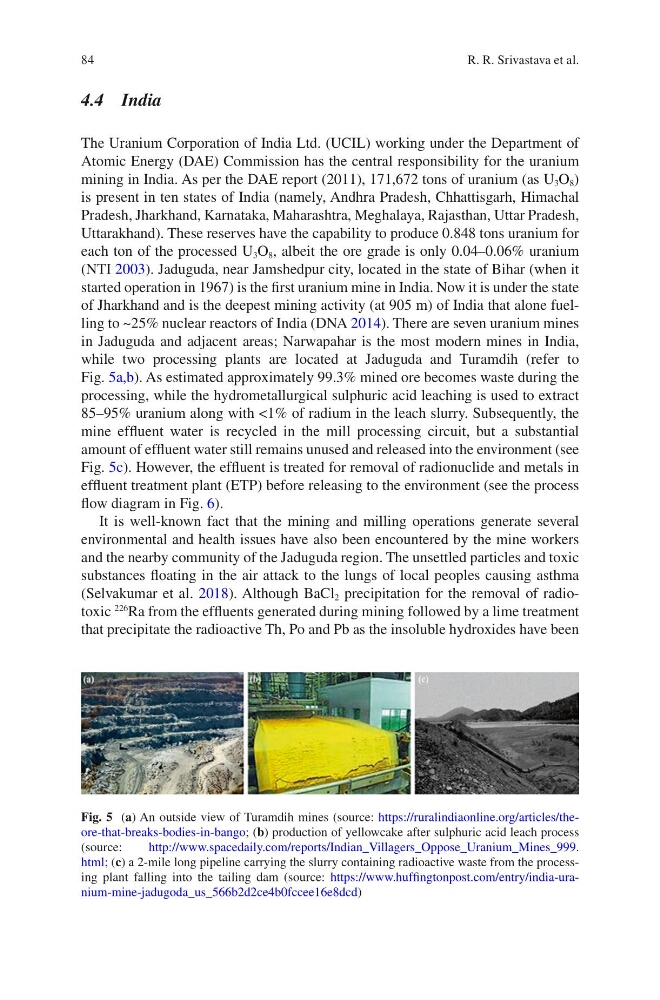
while two processing plants are located at Jaduguda and Turamdih (refer to
Fig. 5a,b). As estimated approximately 99.3% mined ore becomes waste during the
processing, while the hydrometallurgical sulphuric acid leaching is used to extract
85–95% uranium along with <1% of radium in the leach slurry. Subsequently, the
mine effluent water is recycled in the mill processing circuit, but a substantial
amount of effluent water still remains unused and released into the environment (see
Fig. 5c). However, the effluent is treated for removal of radionuclide and metals in
effluent treatment plant (ETP) before releasing to the environment (see the process
flow diagram in Fig. 6).
It is well-known fact that the mining and milling operations generate several
environmental and health issues have also been encountered by the mine workers
and the nearby community of the Jaduguda region. The unsettled particles and toxic
substances floating in the air attack to the lungs of local peoples causing asthma
(Selvakumar et al. 2018). Although BaCl 2 precipitation for the removal of radiotoxic
226
Ra from the effluents generated during mining followed by a lime treatment
that precipitate the radioactive Th, Po and Pb as the insoluble hydroxides have been
Fig. 5 (a) An outside view of Turamdih mines (source: https://ruralindiaonline.org/articles/theore-that-breaks-bodies-in-bango; (b) production of yellowcake after sulphuric acid leach process
(source:
http://www.spacedaily.com/reports/Indian_Villagers_Oppose_Uranium_Mines_999.
html; (c) a 2-mile long pipeline carrying the slurry containing radioactive waste from the processing plant falling into the tailing dam (source: https://www.huffingtonpost.com/entry/india-uranium-mine-jadugoda_us_566b2d2ce4b0fccee16e8dcd)
R. R. Srivastava et al.
4.4 India
The Uranium Corporation of India Ltd. (UCIL) working under the Department of
Atomic Energy (DAE) Commission has the central responsibility for the uranium
mining in India. As per the DAE report (2011), 171,672 tons of uranium (as U 3 O 8 )
is present in ten states of India (namely, Andhra Pradesh, Chhattisgarh, Himachal
Pradesh, Jharkhand, Karnataka, Maharashtra, Meghalaya, Rajasthan, Uttar Pradesh,
Uttarakhand). These reserves have the capability to produce 0.848 tons uranium for
each ton of the processed U 3 O 8 , albeit the ore grade is only 0.04–0.06% uranium
(NTI 2003). Jaduguda, near Jamshedpur city, located in the state of Bihar (when it
started operation in 1967) is the first uranium mine in India. Now it is under the state
of Jharkhand and is the deepest mining activity (at 905 m) of India that alone fuelling to ~25% nuclear reactors of India (DNA 2014). There are seven uranium mines
in Jaduguda and adjacent areas; Narwapahar is the most modern mines in India,
while two processing plants are located at Jaduguda and Turamdih (refer to
Fig. 5a,b). As estimated approximately 99.3% mined ore becomes waste during the
processing, while the hydrometallurgical sulphuric acid leaching is used to extract
85–95% uranium along with <1% of radium in the leach slurry. Subsequently, the
mine effluent water is recycled in the mill processing circuit, but a substantial
amount of effluent water still remains unused and released into the environment (see
Fig. 5c). However, the effluent is treated for removal of radionuclide and metals in
effluent treatment plant (ETP) before releasing to the environment (see the process
flow diagram in Fig. 6).
It is well-known fact that the mining and milling operations generate several
environmental and health issues have also been encountered by the mine workers
and the nearby community of the Jaduguda region. The unsettled particles and toxic
substances floating in the air attack to the lungs of local peoples causing asthma
(Selvakumar et al. 2018). Although BaCl 2 precipitation for the removal of radiotoxic
226
Ra from the effluents generated during mining followed by a lime treatment
that precipitate the radioactive Th, Po and Pb as the insoluble hydroxides have been
Fig. 5 (a) An outside view of Turamdih mines (source: https://ruralindiaonline.org/articles/theore-that-breaks-bodies-in-bango; (b) production of yellowcake after sulphuric acid leach process
(source:
http://www.spacedaily.com/reports/Indian_Villagers_Oppose_Uranium_Mines_999.
html; (c) a 2-mile long pipeline carrying the slurry containing radioactive waste from the processing plant falling into the tailing dam (source: https://www.huffingtonpost.com/entry/india-uranium-mine-jadugoda_us_566b2d2ce4b0fccee16e8dcd)
R. R. Srivastava et al.