

74
2.3 In Situ Leach (ISL) Mining
The ISL mining is a combined technology for mining and extraction process. A
mixture of chemical regents or say lixiviant is injected into the earth of mining area
via a number of patterned holes. The lixiviant leaches out the uranium along with
some impurities from the surrounding rock bodies, and the slurry is collected for the
subsequent processing of uranium separation. However, it diminished the surface
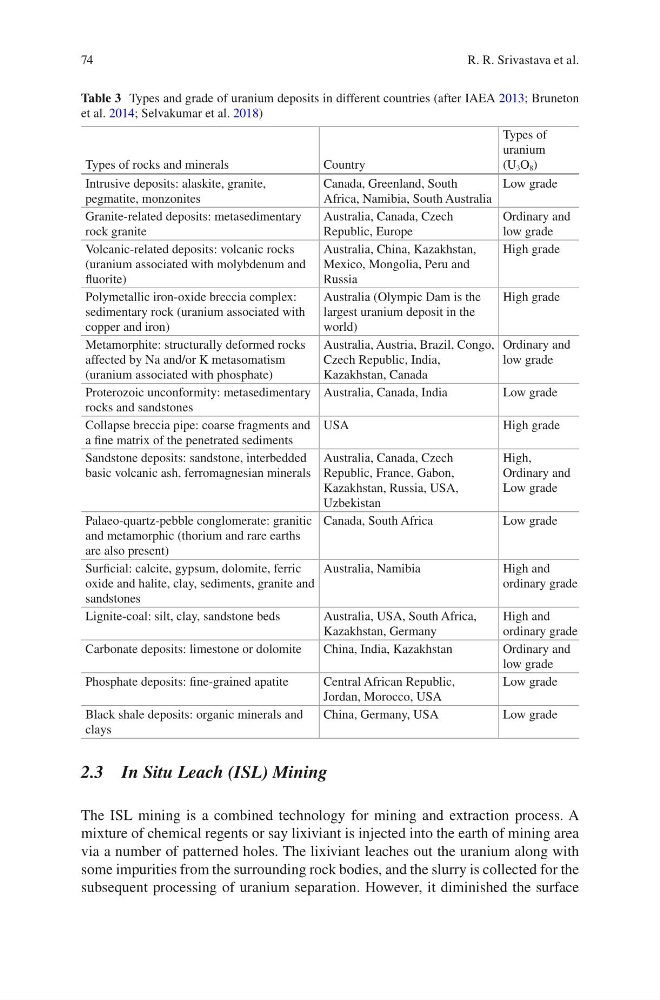
Table 3 Types and grade of uranium deposits in different countries (after IAEA 2013; Bruneton
et al. 2014; Selvakumar et al. 2018)
Types of rocks and minerals
Country
Types of
uranium
(U 3 O 8 )
Intrusive deposits: alaskite, granite,
pegmatite, monzonites
Canada, Greenland, South
Africa, Namibia, South Australia
Low grade
Granite-related deposits: metasedimentary
rock granite
Australia, Canada, Czech
Republic, Europe
Ordinary and
low grade
Volcanic-related deposits: volcanic rocks
(uranium associated with molybdenum and
fluorite)
Australia, China, Kazakhstan,
Mexico, Mongolia, Peru and
Russia
High grade
Polymetallic iron-oxide breccia complex:
sedimentary rock (uranium associated with
copper and iron)
Australia (Olympic Dam is the
largest uranium deposit in the
world)
High grade
Metamorphite: structurally deformed rocks
affected by Na and/or K metasomatism
(uranium associated with phosphate)
Australia, Austria, Brazil, Congo,
Czech Republic, India,
Kazakhstan, Canada
Ordinary and
low grade
Proterozoic unconformity: metasedimentary
rocks and sandstones
Australia, Canada, India
Low grade
Collapse breccia pipe: coarse fragments and
a fine matrix of the penetrated sediments
USA
High grade
Sandstone deposits: sandstone, interbedded
basic volcanic ash, ferromagnesian minerals
Australia, Canada, Czech
Republic, France, Gabon,
Kazakhstan, Russia, USA,
Uzbekistan
High,
Ordinary and
Low grade
Palaeo-quartz-pebble conglomerate: granitic
and metamorphic (thorium and rare earths
are also present)
Canada, South Africa
Low grade
Surficial: calcite, gypsum, dolomite, ferric
oxide and halite, clay, sediments, granite and
sandstones
Australia, Namibia
High and
ordinary grade
Lignite-coal: silt, clay, sandstone beds
Australia, USA, South Africa,
Kazakhstan, Germany
High and
ordinary grade
Carbonate deposits: limestone or dolomite
China, India, Kazakhstan
Ordinary and
low grade
Phosphate deposits: fine-grained apatite
Central African Republic,
Jordan, Morocco, USA
Low grade
Black shale deposits: organic minerals and
clays
China, Germany, USA
Low grade
R. R. Srivastava et al.
2.3 In Situ Leach (ISL) Mining
The ISL mining is a combined technology for mining and extraction process. A
mixture of chemical regents or say lixiviant is injected into the earth of mining area
via a number of patterned holes. The lixiviant leaches out the uranium along with
some impurities from the surrounding rock bodies, and the slurry is collected for the
subsequent processing of uranium separation. However, it diminished the surface
Table 3 Types and grade of uranium deposits in different countries (after IAEA 2013; Bruneton
et al. 2014; Selvakumar et al. 2018)
Types of rocks and minerals
Country
Types of
uranium
(U 3 O 8 )
Intrusive deposits: alaskite, granite,
pegmatite, monzonites
Canada, Greenland, South
Africa, Namibia, South Australia
Low grade
Granite-related deposits: metasedimentary
rock granite
Australia, Canada, Czech
Republic, Europe
Ordinary and
low grade
Volcanic-related deposits: volcanic rocks
(uranium associated with molybdenum and
fluorite)
Australia, China, Kazakhstan,
Mexico, Mongolia, Peru and
Russia
High grade
Polymetallic iron-oxide breccia complex:
sedimentary rock (uranium associated with
copper and iron)
Australia (Olympic Dam is the
largest uranium deposit in the
world)
High grade
Metamorphite: structurally deformed rocks
affected by Na and/or K metasomatism
(uranium associated with phosphate)
Australia, Austria, Brazil, Congo,
Czech Republic, India,
Kazakhstan, Canada
Ordinary and
low grade
Proterozoic unconformity: metasedimentary
rocks and sandstones
Australia, Canada, India
Low grade
Collapse breccia pipe: coarse fragments and
a fine matrix of the penetrated sediments
USA
High grade
Sandstone deposits: sandstone, interbedded
basic volcanic ash, ferromagnesian minerals
Australia, Canada, Czech
Republic, France, Gabon,
Kazakhstan, Russia, USA,
Uzbekistan
High,
Ordinary and
Low grade
Palaeo-quartz-pebble conglomerate: granitic
and metamorphic (thorium and rare earths
are also present)
Canada, South Africa
Low grade
Surficial: calcite, gypsum, dolomite, ferric
oxide and halite, clay, sediments, granite and
sandstones
Australia, Namibia
High and
ordinary grade
Lignite-coal: silt, clay, sandstone beds
Australia, USA, South Africa,
Kazakhstan, Germany
High and
ordinary grade
Carbonate deposits: limestone or dolomite
China, India, Kazakhstan
Ordinary and
low grade
Phosphate deposits: fine-grained apatite
Central African Republic,
Jordan, Morocco, USA
Low grade
Black shale deposits: organic minerals and
clays
China, Germany, USA
Low grade
R. R. Srivastava et al.