

62
7 Effect of Humidity on Uranium Mobile Species in the Soil
The object of study was sod-podzolic soil, containing uranium mainly of natural
origin. Soils of this type are widespread in the territory of Belarus. The soil was
sampled in the summer of 2016 near the settlement Anusino, Minsk region. It was
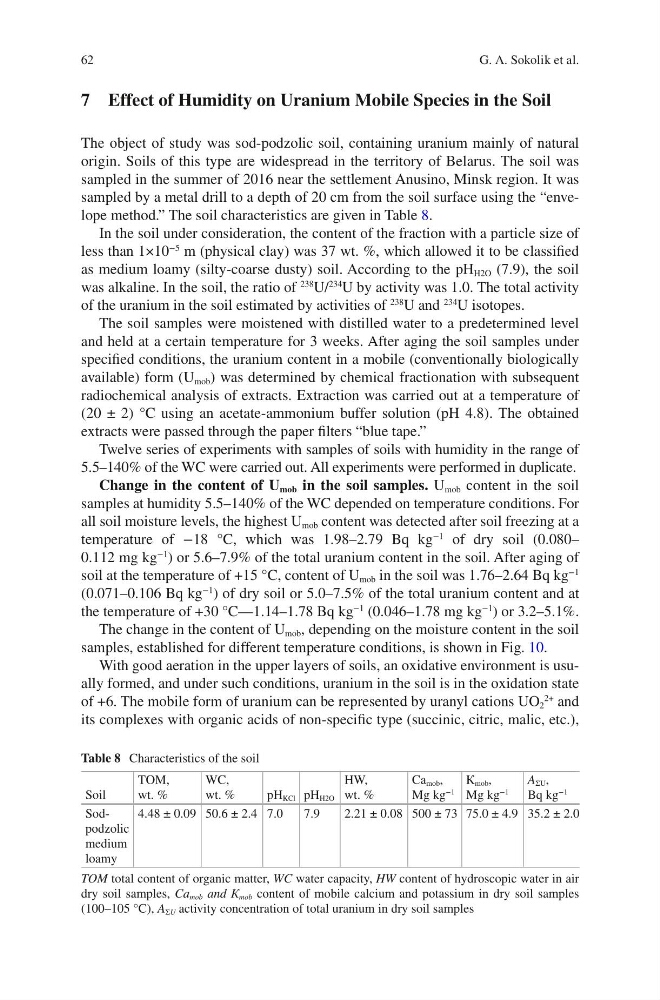
sampled by a metal drill to a depth of 20 cm from the soil surface using the “envelope method.” The soil characteristics are given in Table 8.
In the soil under consideration, the content of the fraction with a particle size of
less than 1×10
−5
m (physical clay) was 37 wt. %, which allowed it to be classified
as medium loamy (silty-coarse dusty) soil. According to the pH H2O (7.9), the soil
was alkaline. In the soil, the ratio of
238
U/
234
U by activity was 1.0. The total activity
of the uranium in the soil estimated by activities of
238
U and
234
U isotopes.
The soil samples were moistened with distilled water to a predetermined level
and held at a certain temperature for 3 weeks. After aging the soil samples under
specified conditions, the uranium content in a mobile (conventionally biologically
available) form (U mob ) was determined by chemical fractionation with subsequent
radiochemical analysis of extracts. Extraction was carried out at a temperature of
(20 ± 2) °C using an acetate-ammonium buffer solution (pH 4.8). The obtained
extracts were passed through the paper filters “blue tape.”
Twelve series of experiments with samples of soils with humidity in the range of
5.5–140% of the WC were carried out. All experiments were performed in duplicate.
Change in the content of U mob in the soil samples. U mob content in the soil
samples at humidity 5.5–140% of the WC depended on temperature conditions. For
all soil moisture levels, the highest U mob content was detected after soil freezing at a
temperature of −18 °C, which was 1.98–2.79 Bq kg
−1
of dry soil (0.080–
0.112 mg kg
−1
) or 5.6–7.9% of the total uranium content in the soil. After aging of
soil at the temperature of +15 °C, content of U mob in the soil was 1.76–2.64 Bq kg
−1
(0.071–0.106 Bq kg
−1
) of dry soil or 5.0–7.5% of the total uranium content and at
the temperature of +30 °C—1.14–1.78 Bq kg
−1
(0.046–1.78 mg kg
−1
) or 3.2–5.1%.
The change in the content of U mob , depending on the moisture content in the soil
samples, established for different temperature conditions, is shown in Fig. 10.
With good aeration in the upper layers of soils, an oxidative environment is usually formed, and under such conditions, uranium in the soil is in the oxidation state
of +6. The mobile form of uranium can be represented by uranyl cations UO 2
2+
and
its complexes with organic acids of non-specific type (succinic, citric, malic, etc.),
Table 8 Characteristics of the soil
Soil
TОM,
wt. %
WC,
wt. %
pH KCl pН H2О
HW,
wt. %
Ca mob ,
Mg kg
−1
К mob ,
Mg kg
−1
A ΣU ,
Bq kg
−1
Sodpodzolic
medium
loamy
4.48 ± 0.09 50.6 ± 2.4 7.0
7.9
2.21 ± 0.08 500 ± 73 75.0 ± 4.9 35.2 ± 2.0
TOM total content of organic matter, WC water capacity, HW content of hydroscopic water in air
dry soil samples, Ca mob and К mob content of mobile calcium and potassium in dry soil samples
(100–105 °C), A ΣU activity concentration of total uranium in dry soil samples
G. A. Sokolik et al.
7 Effect of Humidity on Uranium Mobile Species in the Soil
The object of study was sod-podzolic soil, containing uranium mainly of natural
origin. Soils of this type are widespread in the territory of Belarus. The soil was
sampled in the summer of 2016 near the settlement Anusino, Minsk region. It was
sampled by a metal drill to a depth of 20 cm from the soil surface using the “envelope method.” The soil characteristics are given in Table 8.
In the soil under consideration, the content of the fraction with a particle size of
less than 1×10
−5
m (physical clay) was 37 wt. %, which allowed it to be classified
as medium loamy (silty-coarse dusty) soil. According to the pH H2O (7.9), the soil
was alkaline. In the soil, the ratio of
238
U/
234
U by activity was 1.0. The total activity
of the uranium in the soil estimated by activities of
238
U and
234
U isotopes.
The soil samples were moistened with distilled water to a predetermined level
and held at a certain temperature for 3 weeks. After aging the soil samples under
specified conditions, the uranium content in a mobile (conventionally biologically
available) form (U mob ) was determined by chemical fractionation with subsequent
radiochemical analysis of extracts. Extraction was carried out at a temperature of
(20 ± 2) °C using an acetate-ammonium buffer solution (pH 4.8). The obtained
extracts were passed through the paper filters “blue tape.”
Twelve series of experiments with samples of soils with humidity in the range of
5.5–140% of the WC were carried out. All experiments were performed in duplicate.
Change in the content of U mob in the soil samples. U mob content in the soil
samples at humidity 5.5–140% of the WC depended on temperature conditions. For
all soil moisture levels, the highest U mob content was detected after soil freezing at a
temperature of −18 °C, which was 1.98–2.79 Bq kg
−1
of dry soil (0.080–
0.112 mg kg
−1
) or 5.6–7.9% of the total uranium content in the soil. After aging of
soil at the temperature of +15 °C, content of U mob in the soil was 1.76–2.64 Bq kg
−1
(0.071–0.106 Bq kg
−1
) of dry soil or 5.0–7.5% of the total uranium content and at
the temperature of +30 °C—1.14–1.78 Bq kg
−1
(0.046–1.78 mg kg
−1
) or 3.2–5.1%.
The change in the content of U mob , depending on the moisture content in the soil
samples, established for different temperature conditions, is shown in Fig. 10.
With good aeration in the upper layers of soils, an oxidative environment is usually formed, and under such conditions, uranium in the soil is in the oxidation state
of +6. The mobile form of uranium can be represented by uranyl cations UO 2
2+
and
its complexes with organic acids of non-specific type (succinic, citric, malic, etc.),
Table 8 Characteristics of the soil
Soil
TОM,
wt. %
WC,
wt. %
pH KCl pН H2О
HW,
wt. %
Ca mob ,
Mg kg
−1
К mob ,
Mg kg
−1
A ΣU ,
Bq kg
−1
Sodpodzolic
medium
loamy
4.48 ± 0.09 50.6 ± 2.4 7.0
7.9
2.21 ± 0.08 500 ± 73 75.0 ± 4.9 35.2 ± 2.0
TOM total content of organic matter, WC water capacity, HW content of hydroscopic water in air
dry soil samples, Ca mob and К mob content of mobile calcium and potassium in dry soil samples
(100–105 °C), A ΣU activity concentration of total uranium in dry soil samples
G. A. Sokolik et al.