

61
decrease in U mob content with increasing temperature in conditions of water saturation of soils (Hanson ed. 1985; Titayeva 2005; Vodyanitskiy 2011). Another possible
reason for the decrease in the content of U mob in the soils could be associated with an
increase in the degree of hydrolysis of U (IV) compounds with an increase in temperature, which led to an increase in the sorption of uranium by the solid phase of
the soils.
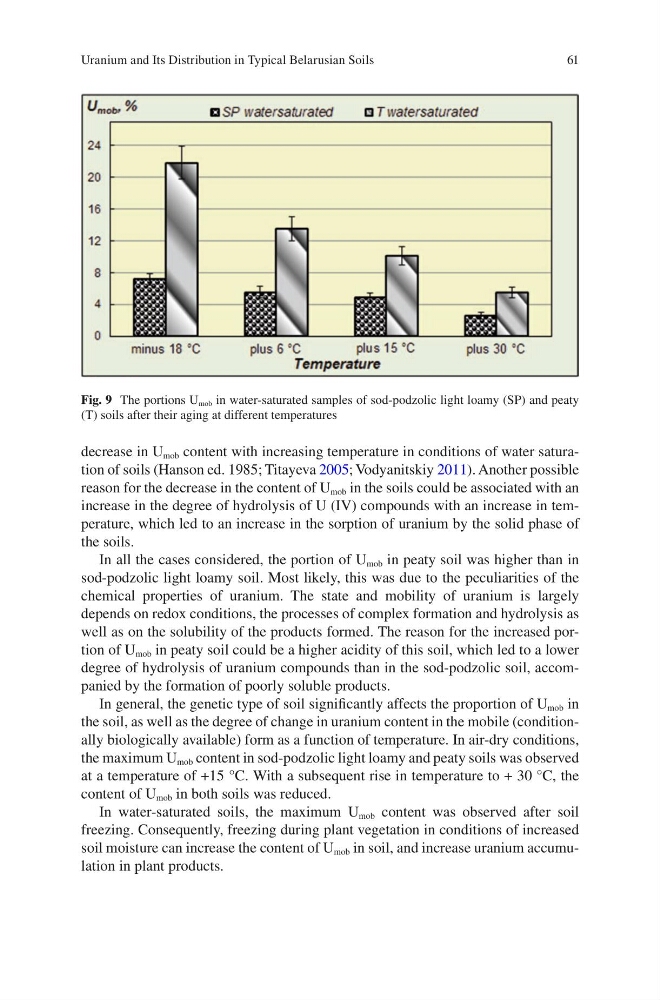
In all the cases considered, the portion of U mob in peaty soil was higher than in
sod-podzolic light loamy soil. Most likely, this was due to the peculiarities of the
chemical properties of uranium. The state and mobility of uranium is largely
depends on redox conditions, the processes of complex formation and hydrolysis as
well as on the solubility of the products formed. The reason for the increased portion of U mob in peaty soil could be a higher acidity of this soil, which led to a lower
degree of hydrolysis of uranium compounds than in the sod-podzolic soil, accompanied by the formation of poorly soluble products.
In general, the genetic type of soil significantly affects the proportion of U mob in
the soil, as well as the degree of change in uranium content in the mobile (conditionally biologically available) form as a function of temperature. In air-dry conditions,
the maximum U mob content in sod-podzolic light loamy and peaty soils was observed
at a temperature of +15 °C. With a subsequent rise in temperature to + 30 °C, the
content of U mob in both soils was reduced.
In water-saturated soils, the maximum U mob content was observed after soil
freezing. Consequently, freezing during plant vegetation in conditions of increased
soil moisture can increase the content of U mob in soil, and increase uranium accumulation in plant products.
Fig. 9 The portions U mob in water-saturated samples of sod-podzolic light loamy (SP) and peaty
(T) soils after their aging at different temperatures
Uranium and Its Distribution in Typical Belarusian Soils
decrease in U mob content with increasing temperature in conditions of water saturation of soils (Hanson ed. 1985; Titayeva 2005; Vodyanitskiy 2011). Another possible
reason for the decrease in the content of U mob in the soils could be associated with an
increase in the degree of hydrolysis of U (IV) compounds with an increase in temperature, which led to an increase in the sorption of uranium by the solid phase of
the soils.
In all the cases considered, the portion of U mob in peaty soil was higher than in
sod-podzolic light loamy soil. Most likely, this was due to the peculiarities of the
chemical properties of uranium. The state and mobility of uranium is largely
depends on redox conditions, the processes of complex formation and hydrolysis as
well as on the solubility of the products formed. The reason for the increased portion of U mob in peaty soil could be a higher acidity of this soil, which led to a lower
degree of hydrolysis of uranium compounds than in the sod-podzolic soil, accompanied by the formation of poorly soluble products.
In general, the genetic type of soil significantly affects the proportion of U mob in
the soil, as well as the degree of change in uranium content in the mobile (conditionally biologically available) form as a function of temperature. In air-dry conditions,
the maximum U mob content in sod-podzolic light loamy and peaty soils was observed
at a temperature of +15 °C. With a subsequent rise in temperature to + 30 °C, the
content of U mob in both soils was reduced.
In water-saturated soils, the maximum U mob content was observed after soil
freezing. Consequently, freezing during plant vegetation in conditions of increased
soil moisture can increase the content of U mob in soil, and increase uranium accumulation in plant products.
Fig. 9 The portions U mob in water-saturated samples of sod-podzolic light loamy (SP) and peaty
(T) soils after their aging at different temperatures
Uranium and Its Distribution in Typical Belarusian Soils