

17
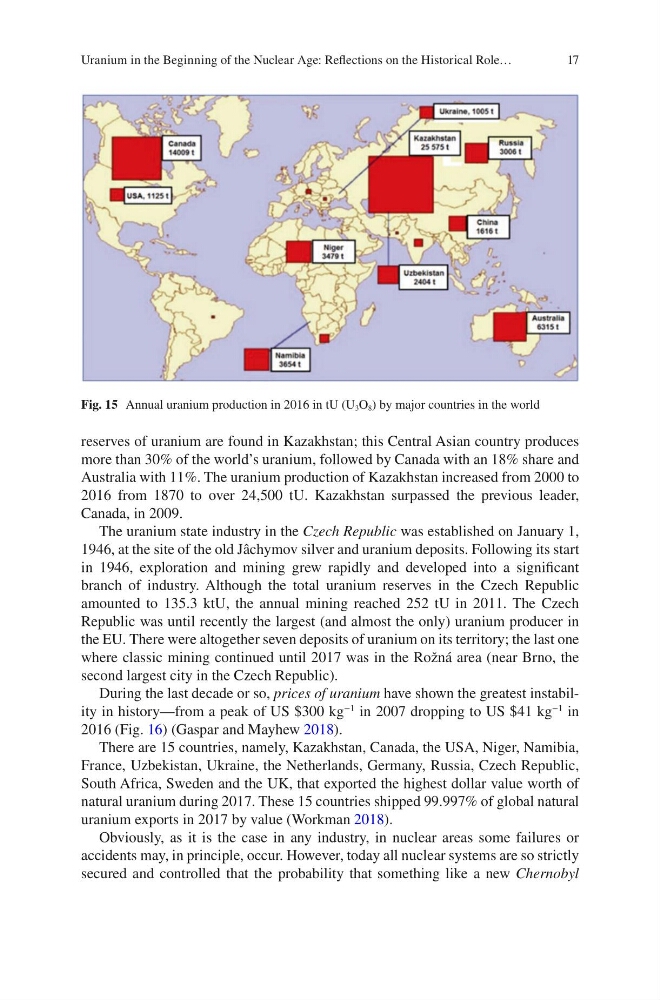
reserves of uranium are found in Kazakhstan; this Central Asian country produces
more than 30% of the world’s uranium, followed by Canada with an 18% share and
Australia with 11%. The uranium production of Kazakhstan increased from 2000 to
2016 from 1870 to over 24,500 tU. Kazakhstan surpassed the previous leader,
Canada, in 2009.
The uranium state industry in the Czech Republic was established on January 1,
1946, at the site of the old Jâchymov silver and uranium deposits. Following its start
in 1946, exploration and mining grew rapidly and developed into a significant
branch of industry. Although the total uranium reserves in the Czech Republic
amounted to 135.3 ktU, the annual mining reached 252 tU in 2011. The Czech
Republic was until recently the largest (and almost the only) uranium producer in
the EU. There were altogether seven deposits of uranium on its territory; the last one
where classic mining continued until 2017 was in the Rožná area (near Brno, the
second largest city in the Czech Republic).
During the last decade or so, prices of uranium have shown the greatest instability in history—from a peak of US $300 kg
−1
in 2007 dropping to US $41 kg
−1
in
2016 (Fig. 16) (Gaspar and Mayhew 2018).
There are 15 countries, namely, Kazakhstan, Canada, the USA, Niger, Namibia,
France, Uzbekistan, Ukraine, the Netherlands, Germany, Russia, Czech Republic,
South Africa, Sweden and the UK, that exported the highest dollar value worth of
natural uranium during 2017. These 15 countries shipped 99.997% of global natural
uranium exports in 2017 by value (Workman 2018).
Obviously, as it is the case in any industry, in nuclear areas some failures or
accidents may, in principle, occur. However, today all nuclear systems are so strictly
secured and controlled that the probability that something like a new Chernobyl
Fig. 15 Annual uranium production in 2016 in tU (U 3 O 8 ) by major countries in the world
Uranium in the Beginning of the Nuclear Age: Reflections on the Historical Role…
reserves of uranium are found in Kazakhstan; this Central Asian country produces
more than 30% of the world’s uranium, followed by Canada with an 18% share and
Australia with 11%. The uranium production of Kazakhstan increased from 2000 to
2016 from 1870 to over 24,500 tU. Kazakhstan surpassed the previous leader,
Canada, in 2009.
The uranium state industry in the Czech Republic was established on January 1,
1946, at the site of the old Jâchymov silver and uranium deposits. Following its start
in 1946, exploration and mining grew rapidly and developed into a significant
branch of industry. Although the total uranium reserves in the Czech Republic
amounted to 135.3 ktU, the annual mining reached 252 tU in 2011. The Czech
Republic was until recently the largest (and almost the only) uranium producer in
the EU. There were altogether seven deposits of uranium on its territory; the last one
where classic mining continued until 2017 was in the Rožná area (near Brno, the
second largest city in the Czech Republic).
During the last decade or so, prices of uranium have shown the greatest instability in history—from a peak of US $300 kg
−1
in 2007 dropping to US $41 kg
−1
in
2016 (Fig. 16) (Gaspar and Mayhew 2018).
There are 15 countries, namely, Kazakhstan, Canada, the USA, Niger, Namibia,
France, Uzbekistan, Ukraine, the Netherlands, Germany, Russia, Czech Republic,
South Africa, Sweden and the UK, that exported the highest dollar value worth of
natural uranium during 2017. These 15 countries shipped 99.997% of global natural
uranium exports in 2017 by value (Workman 2018).
Obviously, as it is the case in any industry, in nuclear areas some failures or
accidents may, in principle, occur. However, today all nuclear systems are so strictly
secured and controlled that the probability that something like a new Chernobyl
Fig. 15 Annual uranium production in 2016 in tU (U 3 O 8 ) by major countries in the world
Uranium in the Beginning of the Nuclear Age: Reflections on the Historical Role…