

15
2.4 Nuclear Age
While the start of World War I began to shake the golden age of radium in Jáchymov,
the beginning of World War II brought some new attraction to interest in the uranium business.
Towards the end of 1938, the Otto Hahn (1879–1968) together with Fritz
Strassmann (1902–1980) succeeded in splitting uranium atoms in two. For the first
time, it was confirmed that nuclear fission was taking place. This discovery laid the
basis for nuclear energy use but also for nuclear weapons. The small picturesque
town of Jáchymov in a deep forest valley came to be known as the “cradle of the
nuclear (atomic) age”.
Since the beginning of World War II, further atomic research was characterized
by the development of war-critical weapons. Some of the best scientists were hired
to participate in the development of the atomic bomb in the years following 1939.
As of the end of World War II, uranium mining was intensified, both in Jáchymov
and in other uranium mines in the former Czechoslovakia as well as on the German
side of the Ore Mountains (at that time the German Democratic Republic).
Conventionally, uranium had been mined from open pits or underground mines.
Later, alternate methods, such as in situ leach mining, based on injection of a specific solution into underground deposits to dissolve uranium, began to be common.
The simplified scheme of the whole fuel cycle is shown in Fig. 14 (Hecht 2006).
It was found long time ago that uranium mining presents serious health hazard
resulted in development of lung cancer due to inhaling uranium decay products
(IEER 2018). Uranium mill tailings contain radioactive materials, notably radium
and heavy metals, such as manganese and molybdenum, which can leach into
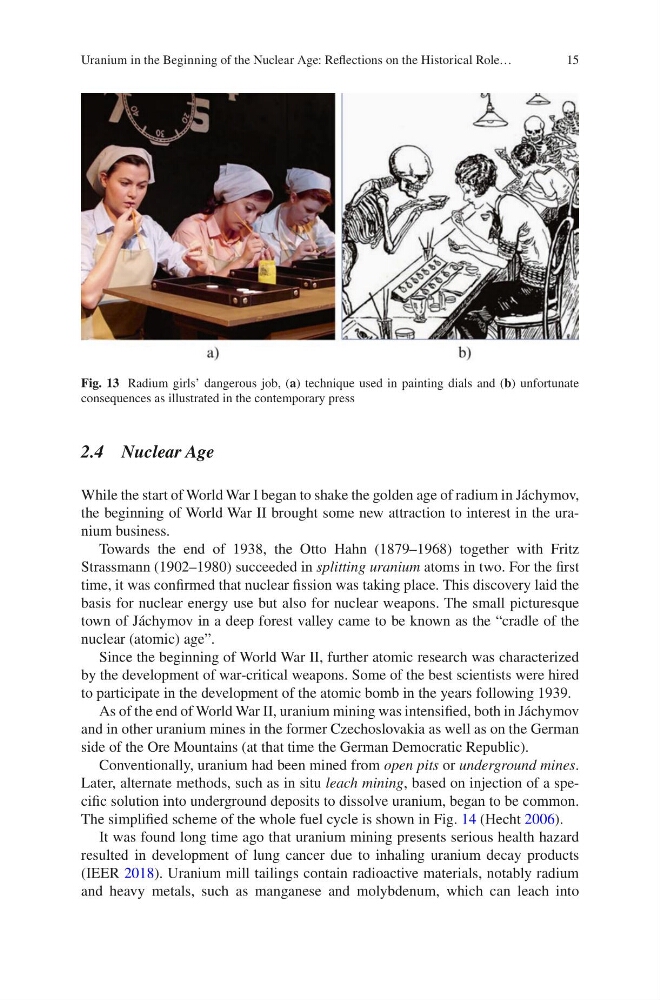
Fig. 13 Radium girls’ dangerous job, (a) technique used in painting dials and (b) unfortunate
consequences as illustrated in the contemporary press
Uranium in the Beginning of the Nuclear Age: Reflections on the Historical Role…
2.4 Nuclear Age
While the start of World War I began to shake the golden age of radium in Jáchymov,
the beginning of World War II brought some new attraction to interest in the uranium business.
Towards the end of 1938, the Otto Hahn (1879–1968) together with Fritz
Strassmann (1902–1980) succeeded in splitting uranium atoms in two. For the first
time, it was confirmed that nuclear fission was taking place. This discovery laid the
basis for nuclear energy use but also for nuclear weapons. The small picturesque
town of Jáchymov in a deep forest valley came to be known as the “cradle of the
nuclear (atomic) age”.
Since the beginning of World War II, further atomic research was characterized
by the development of war-critical weapons. Some of the best scientists were hired
to participate in the development of the atomic bomb in the years following 1939.
As of the end of World War II, uranium mining was intensified, both in Jáchymov
and in other uranium mines in the former Czechoslovakia as well as on the German
side of the Ore Mountains (at that time the German Democratic Republic).
Conventionally, uranium had been mined from open pits or underground mines.
Later, alternate methods, such as in situ leach mining, based on injection of a specific solution into underground deposits to dissolve uranium, began to be common.
The simplified scheme of the whole fuel cycle is shown in Fig. 14 (Hecht 2006).
It was found long time ago that uranium mining presents serious health hazard
resulted in development of lung cancer due to inhaling uranium decay products
(IEER 2018). Uranium mill tailings contain radioactive materials, notably radium
and heavy metals, such as manganese and molybdenum, which can leach into
Fig. 13 Radium girls’ dangerous job, (a) technique used in painting dials and (b) unfortunate
consequences as illustrated in the contemporary press
Uranium in the Beginning of the Nuclear Age: Reflections on the Historical Role…