

13
the well-known Czech scientist and educator, Professor František Běhounek (1898–
1973). F. Běhounek, who spent 2 years at M. Curie’s Institut du Radium in Paris
(1920–1922), and after returning home, studied radioactivity in the Jáchymov mines
and became a pioneer in the use of radium. He was the director of the National
Radiological Institute in Prague (1929–1946). In 1963 he founded the Department
of Dosimetry and Applications of Ionizing Radiation at the Faculty of Nuclear
Sciences of the Czech Technical University in Prague (by the way, the author of this
chapter was one of the first graduates from this department, which he also later
headed for some time). He also was the founder and the first director of the Institute
of Dosimetry of the Czech Academy of Sciences in Prague.
F. Běhounek continued his close contacts with his Paris mentor. He accompanied
M. Curie during her visit to Prague and Jáchymov in 1925 (Poledníček 2015).
During her visit, Marie Curie was also received by the president of the republic,
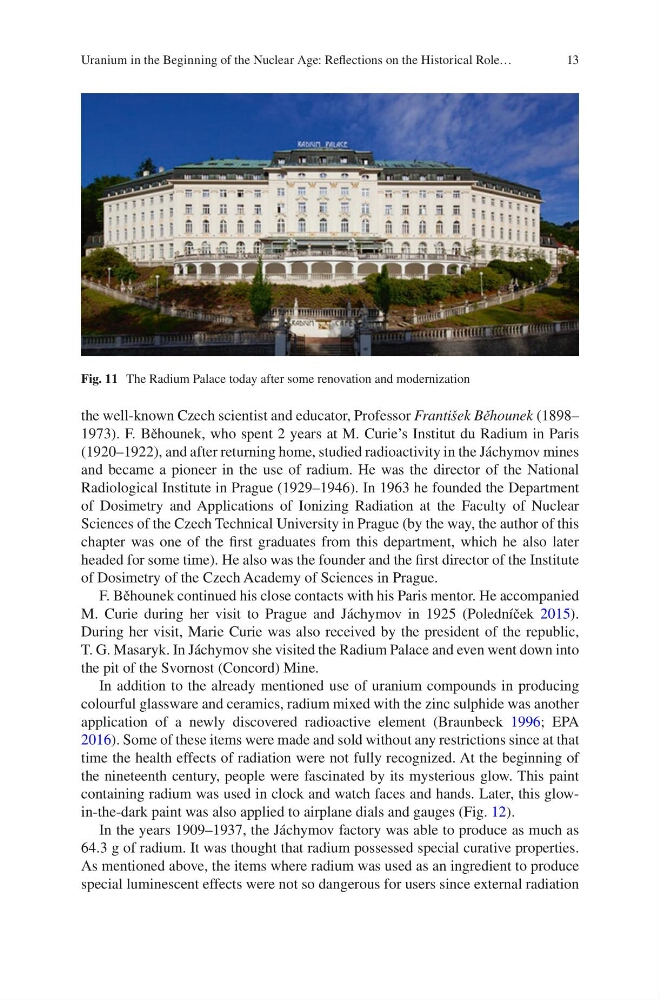
T. G. Masaryk. In Jáchymov she visited the Radium Palace and even went down into
the pit of the Svornost (Concord) Mine.
In addition to the already mentioned use of uranium compounds in producing
colourful glassware and ceramics, radium mixed with the zinc sulphide was another
application of a newly discovered radioactive element (Braunbeck 1996; EPA
2016). Some of these items were made and sold without any restrictions since at that
time the health effects of radiation were not fully recognized. At the beginning of
the nineteenth century, people were fascinated by its mysterious glow. This paint
containing radium was used in clock and watch faces and hands. Later, this glowin- the-dark paint was also applied to airplane dials and gauges (Fig. 12).
In the years 1909–1937, the Jáchymov factory was able to produce as much as
64.3 g of radium. It was thought that radium possessed special curative properties.
As mentioned above, the items where radium was used as an ingredient to produce
special luminescent effects were not so dangerous for users since external radiation
Fig. 11 The Radium Palace today after some renovation and modernization
Uranium in the Beginning of the Nuclear Age: Reflections on the Historical Role…
the well-known Czech scientist and educator, Professor František Běhounek (1898–
1973). F. Běhounek, who spent 2 years at M. Curie’s Institut du Radium in Paris
(1920–1922), and after returning home, studied radioactivity in the Jáchymov mines
and became a pioneer in the use of radium. He was the director of the National
Radiological Institute in Prague (1929–1946). In 1963 he founded the Department
of Dosimetry and Applications of Ionizing Radiation at the Faculty of Nuclear
Sciences of the Czech Technical University in Prague (by the way, the author of this
chapter was one of the first graduates from this department, which he also later
headed for some time). He also was the founder and the first director of the Institute
of Dosimetry of the Czech Academy of Sciences in Prague.
F. Běhounek continued his close contacts with his Paris mentor. He accompanied
M. Curie during her visit to Prague and Jáchymov in 1925 (Poledníček 2015).
During her visit, Marie Curie was also received by the president of the republic,
T. G. Masaryk. In Jáchymov she visited the Radium Palace and even went down into
the pit of the Svornost (Concord) Mine.
In addition to the already mentioned use of uranium compounds in producing
colourful glassware and ceramics, radium mixed with the zinc sulphide was another
application of a newly discovered radioactive element (Braunbeck 1996; EPA
2016). Some of these items were made and sold without any restrictions since at that
time the health effects of radiation were not fully recognized. At the beginning of
the nineteenth century, people were fascinated by its mysterious glow. This paint
containing radium was used in clock and watch faces and hands. Later, this glowin- the-dark paint was also applied to airplane dials and gauges (Fig. 12).
In the years 1909–1937, the Jáchymov factory was able to produce as much as
64.3 g of radium. It was thought that radium possessed special curative properties.
As mentioned above, the items where radium was used as an ingredient to produce
special luminescent effects were not so dangerous for users since external radiation
Fig. 11 The Radium Palace today after some renovation and modernization
Uranium in the Beginning of the Nuclear Age: Reflections on the Historical Role…