

209
3.3 Radiological Toxicity to Biota
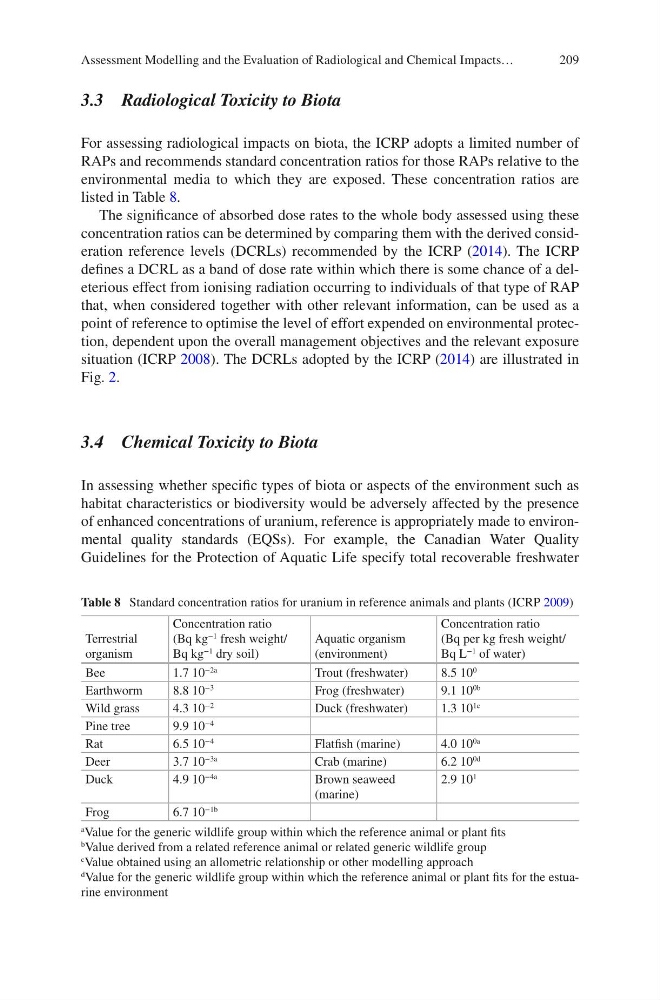
For assessing radiological impacts on biota, the ICRP adopts a limited number of
RAPs and recommends standard concentration ratios for those RAPs relative to the
environmental media to which they are exposed. These concentration ratios are
listed in Table 8.
The significance of absorbed dose rates to the whole body assessed using these
concentration ratios can be determined by comparing them with the derived consideration reference levels (DCRLs) recommended by the ICRP (2014). The ICRP
defines a DCRL as a band of dose rate within which there is some chance of a deleterious effect from ionising radiation occurring to individuals of that type of RAP
that, when considered together with other relevant information, can be used as a
point of reference to optimise the level of effort expended on environmental protection, dependent upon the overall management objectives and the relevant exposure
situation (ICRP 2008). The DCRLs adopted by the ICRP (2014) are illustrated in
Fig. 2.
3.4 Chemical Toxicity to Biota
In assessing whether specific types of biota or aspects of the environment such as
habitat characteristics or biodiversity would be adversely affected by the presence
of enhanced concentrations of uranium, reference is appropriately made to environmental quality standards (EQSs). For example, the Canadian Water Quality
Guidelines for the Protection of Aquatic Life specify total recoverable freshwater
Table 8 Standard concentration ratios for uranium in reference animals and plants (ICRP 2009)
Terrestrial
organism
Concentration ratio
(Bq kg
−1 fresh weight/
Bq kg
−1 dry soil)
Aquatic organism
(environment)
Concentration ratio
(Bq per kg fresh weight/
Bq L
−1 of water)
Bee
1.7 10
−2a
Trout (freshwater)
8.5 10
0
Earthworm
8.8 10
−3
Frog (freshwater)
9.1 10
0b
Wild grass
4.3 10
−2
Duck (freshwater)
1.3 10
1c
Pine tree
9.9 10
−4
Rat
6.5 10
−4
Flatfish (marine)
4.0 10
0a
Deer
3.7 10
−3a
Crab (marine)
6.2 10
0d
Duck
4.9 10
−4a
Brown seaweed
(marine)
2.9 10
1
Frog
6.7 10
−1b
a
Value for the generic wildlife group within which the reference animal or plant fits
b
Value derived from a related reference animal or related generic wildlife group
c
Value obtained using an allometric relationship or other modelling approach
d
Value for the generic wildlife group within which the reference animal or plant fits for the estuarine environment
Assessment Modelling and the Evaluation of Radiological and Chemical Impacts…
3.3 Radiological Toxicity to Biota
For assessing radiological impacts on biota, the ICRP adopts a limited number of
RAPs and recommends standard concentration ratios for those RAPs relative to the
environmental media to which they are exposed. These concentration ratios are
listed in Table 8.
The significance of absorbed dose rates to the whole body assessed using these
concentration ratios can be determined by comparing them with the derived consideration reference levels (DCRLs) recommended by the ICRP (2014). The ICRP
defines a DCRL as a band of dose rate within which there is some chance of a deleterious effect from ionising radiation occurring to individuals of that type of RAP
that, when considered together with other relevant information, can be used as a
point of reference to optimise the level of effort expended on environmental protection, dependent upon the overall management objectives and the relevant exposure
situation (ICRP 2008). The DCRLs adopted by the ICRP (2014) are illustrated in
Fig. 2.
3.4 Chemical Toxicity to Biota
In assessing whether specific types of biota or aspects of the environment such as
habitat characteristics or biodiversity would be adversely affected by the presence
of enhanced concentrations of uranium, reference is appropriately made to environmental quality standards (EQSs). For example, the Canadian Water Quality
Guidelines for the Protection of Aquatic Life specify total recoverable freshwater
Table 8 Standard concentration ratios for uranium in reference animals and plants (ICRP 2009)
Terrestrial
organism
Concentration ratio
(Bq kg
−1 fresh weight/
Bq kg
−1 dry soil)
Aquatic organism
(environment)
Concentration ratio
(Bq per kg fresh weight/
Bq L
−1 of water)
Bee
1.7 10
−2a
Trout (freshwater)
8.5 10
0
Earthworm
8.8 10
−3
Frog (freshwater)
9.1 10
0b
Wild grass
4.3 10
−2
Duck (freshwater)
1.3 10
1c
Pine tree
9.9 10
−4
Rat
6.5 10
−4
Flatfish (marine)
4.0 10
0a
Deer
3.7 10
−3a
Crab (marine)
6.2 10
0d
Duck
4.9 10
−4a
Brown seaweed
(marine)
2.9 10
1
Frog
6.7 10
−1b
a
Value for the generic wildlife group within which the reference animal or plant fits
b
Value derived from a related reference animal or related generic wildlife group
c
Value obtained using an allometric relationship or other modelling approach
d
Value for the generic wildlife group within which the reference animal or plant fits for the estuarine environment
Assessment Modelling and the Evaluation of Radiological and Chemical Impacts…