

187
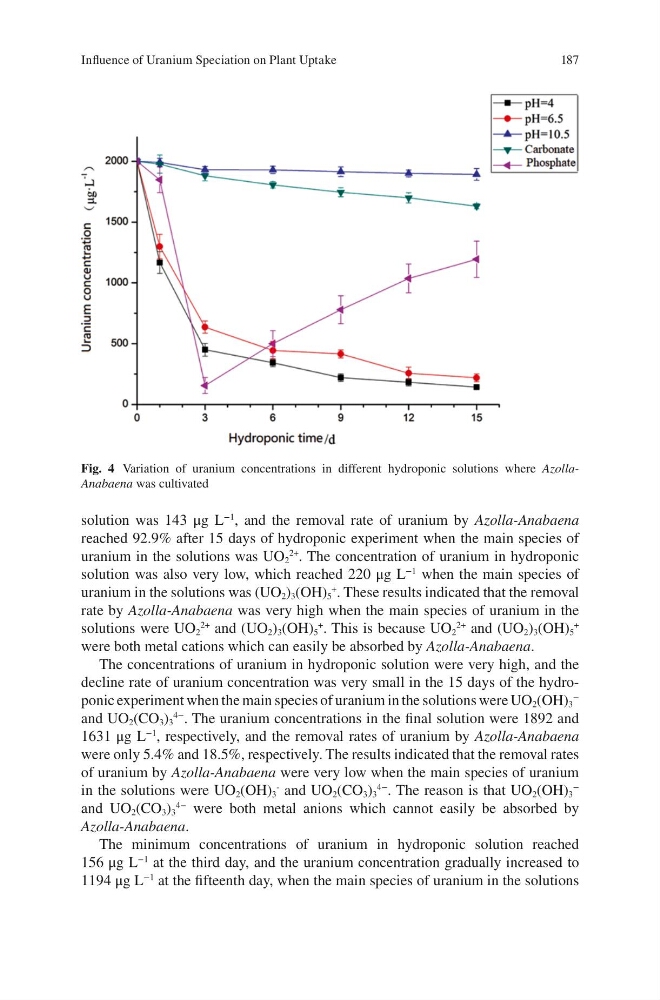
solution was 143 μg L
−1
, and the removal rate of uranium by Azolla-Anabaena
reached 92.9% after 15 days of hydroponic experiment when the main species of
uranium in the solutions was UO 2
2+
. The concentration of uranium in hydroponic
solution was also very low, which reached 220 μg L
−1
when the main species of
uranium in the solutions was (UO 2 ) 3 (OH) 5
+
. These results indicated that the removal
rate by Azolla-Anabaena was very high when the main species of uranium in the
solutions were UO 2
2+
and (UO 2 ) 3 (OH) 5
+
. This is because UO 2
2+
and (UO 2 ) 3 (OH) 5
+
were both metal cations which can easily be absorbed by Azolla-Anabaena.
The concentrations of uranium in hydroponic solution were very high, and the
decline rate of uranium concentration was very small in the 15 days of the hydroponic experiment when the main species of uranium in the solutions were UO 2 (OH) 3
−
and UO 2 (CO 3 ) 3
4−
. The uranium concentrations in the final solution were 1892 and
1631 μg L
−1
, respectively, and the removal rates of uranium by Azolla-Anabaena
were only 5.4% and 18.5%, respectively. The results indicated that the removal rates
of uranium by Azolla-Anabaena were very low when the main species of uranium
in the solutions were UO 2 (OH) 3
-
and UO 2 (CO 3 ) 3
4−
. The reason is that UO 2 (OH) 3
−
and UO 2 (CO 3 ) 3
4−
were both metal anions which cannot easily be absorbed by
Azolla-Anabaena.
The minimum concentrations of uranium in hydroponic solution reached
156 μg L
−1
at the third day, and the uranium concentration gradually increased to
1194 μg L
−1
at the fifteenth day, when the main species of uranium in the solutions
Fig. 4 Variation of uranium concentrations in different hydroponic solutions where AzollaAnabaena was cultivated
Influence of Uranium Speciation on Plant Uptake
solution was 143 μg L
−1
, and the removal rate of uranium by Azolla-Anabaena
reached 92.9% after 15 days of hydroponic experiment when the main species of
uranium in the solutions was UO 2
2+
. The concentration of uranium in hydroponic
solution was also very low, which reached 220 μg L
−1
when the main species of
uranium in the solutions was (UO 2 ) 3 (OH) 5
+
. These results indicated that the removal
rate by Azolla-Anabaena was very high when the main species of uranium in the
solutions were UO 2
2+
and (UO 2 ) 3 (OH) 5
+
. This is because UO 2
2+
and (UO 2 ) 3 (OH) 5
+
were both metal cations which can easily be absorbed by Azolla-Anabaena.
The concentrations of uranium in hydroponic solution were very high, and the
decline rate of uranium concentration was very small in the 15 days of the hydroponic experiment when the main species of uranium in the solutions were UO 2 (OH) 3
−
and UO 2 (CO 3 ) 3
4−
. The uranium concentrations in the final solution were 1892 and
1631 μg L
−1
, respectively, and the removal rates of uranium by Azolla-Anabaena
were only 5.4% and 18.5%, respectively. The results indicated that the removal rates
of uranium by Azolla-Anabaena were very low when the main species of uranium
in the solutions were UO 2 (OH) 3
-
and UO 2 (CO 3 ) 3
4−
. The reason is that UO 2 (OH) 3
−
and UO 2 (CO 3 ) 3
4−
were both metal anions which cannot easily be absorbed by
Azolla-Anabaena.
The minimum concentrations of uranium in hydroponic solution reached
156 μg L
−1
at the third day, and the uranium concentration gradually increased to
1194 μg L
−1
at the fifteenth day, when the main species of uranium in the solutions
Fig. 4 Variation of uranium concentrations in different hydroponic solutions where AzollaAnabaena was cultivated
Influence of Uranium Speciation on Plant Uptake