

140
be considered as constant and linear. The validity of the linear approximation was
questioned recently (Tuovinen et al. 2011, Tuovinen et al. 2016a,b). It was proposed
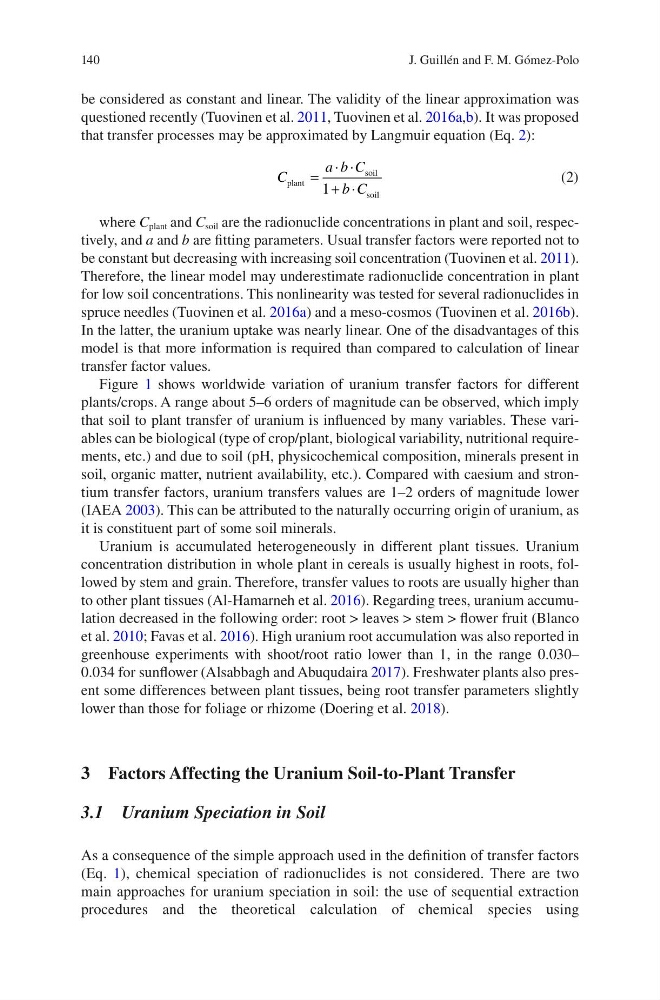
that transfer processes may be approximated by Langmuir equation (Eq. 2):
C
a b C
b C
plant
soil
soil
=
⋅ ⋅
+ ⋅
1
(2)
where C plant and C soil are the radionuclide concentrations in plant and soil, respectively, and a and b are fitting parameters. Usual transfer factors were reported not to
be constant but decreasing with increasing soil concentration (Tuovinen et al. 2011).
Therefore, the linear model may underestimate radionuclide concentration in plant
for low soil concentrations. This nonlinearity was tested for several radionuclides in
spruce needles (Tuovinen et al. 2016a) and a meso-cosmos (Tuovinen et al. 2016b).
In the latter, the uranium uptake was nearly linear. One of the disadvantages of this
model is that more information is required than compared to calculation of linear
transfer factor values.
Figure 1 shows worldwide variation of uranium transfer factors for different
plants/crops. A range about 5–6 orders of magnitude can be observed, which imply
that soil to plant transfer of uranium is influenced by many variables. These variables can be biological (type of crop/plant, biological variability, nutritional requirements, etc.) and due to soil (pH, physicochemical composition, minerals present in
soil, organic matter, nutrient availability, etc.). Compared with caesium and strontium transfer factors, uranium transfers values are 1–2 orders of magnitude lower
(IAEA 2003). This can be attributed to the naturally occurring origin of uranium, as
it is constituent part of some soil minerals.
Uranium is accumulated heterogeneously in different plant tissues. Uranium
concentration distribution in whole plant in cereals is usually highest in roots, followed by stem and grain. Therefore, transfer values to roots are usually higher than
to other plant tissues (Al-Hamarneh et al. 2016). Regarding trees, uranium accumulation decreased in the following order: root > leaves > stem > flower fruit (Blanco
et al. 2010; Favas et al. 2016). High uranium root accumulation was also reported in
greenhouse experiments with shoot/root ratio lower than 1, in the range 0.030–
0.034 for sunflower (Alsabbagh and Abuqudaira 2017). Freshwater plants also present some differences between plant tissues, being root transfer parameters slightly
lower than those for foliage or rhizome (Doering et al. 2018).
3 Factors Affecting the Uranium Soil-to-Plant Transfer
3.1 Uranium Speciation in Soil
As a consequence of the simple approach used in the definition of transfer factors
(Eq. 1), chemical speciation of radionuclides is not considered. There are two
main approaches for uranium speciation in soil: the use of sequential extraction
procedures and the theoretical calculation of chemical species using
J. Guillén and F. M. Gómez-Polo
be considered as constant and linear. The validity of the linear approximation was
questioned recently (Tuovinen et al. 2011, Tuovinen et al. 2016a,b). It was proposed
that transfer processes may be approximated by Langmuir equation (Eq. 2):
C
a b C
b C
plant
soil
soil
=
⋅ ⋅
+ ⋅
1
(2)
where C plant and C soil are the radionuclide concentrations in plant and soil, respectively, and a and b are fitting parameters. Usual transfer factors were reported not to
be constant but decreasing with increasing soil concentration (Tuovinen et al. 2011).
Therefore, the linear model may underestimate radionuclide concentration in plant
for low soil concentrations. This nonlinearity was tested for several radionuclides in
spruce needles (Tuovinen et al. 2016a) and a meso-cosmos (Tuovinen et al. 2016b).
In the latter, the uranium uptake was nearly linear. One of the disadvantages of this
model is that more information is required than compared to calculation of linear
transfer factor values.
Figure 1 shows worldwide variation of uranium transfer factors for different
plants/crops. A range about 5–6 orders of magnitude can be observed, which imply
that soil to plant transfer of uranium is influenced by many variables. These variables can be biological (type of crop/plant, biological variability, nutritional requirements, etc.) and due to soil (pH, physicochemical composition, minerals present in
soil, organic matter, nutrient availability, etc.). Compared with caesium and strontium transfer factors, uranium transfers values are 1–2 orders of magnitude lower
(IAEA 2003). This can be attributed to the naturally occurring origin of uranium, as
it is constituent part of some soil minerals.
Uranium is accumulated heterogeneously in different plant tissues. Uranium
concentration distribution in whole plant in cereals is usually highest in roots, followed by stem and grain. Therefore, transfer values to roots are usually higher than
to other plant tissues (Al-Hamarneh et al. 2016). Regarding trees, uranium accumulation decreased in the following order: root > leaves > stem > flower fruit (Blanco
et al. 2010; Favas et al. 2016). High uranium root accumulation was also reported in
greenhouse experiments with shoot/root ratio lower than 1, in the range 0.030–
0.034 for sunflower (Alsabbagh and Abuqudaira 2017). Freshwater plants also present some differences between plant tissues, being root transfer parameters slightly
lower than those for foliage or rhizome (Doering et al. 2018).
3 Factors Affecting the Uranium Soil-to-Plant Transfer
3.1 Uranium Speciation in Soil
As a consequence of the simple approach used in the definition of transfer factors
(Eq. 1), chemical speciation of radionuclides is not considered. There are two
main approaches for uranium speciation in soil: the use of sequential extraction
procedures and the theoretical calculation of chemical species using
J. Guillén and F. M. Gómez-Polo