

139
F v
Bq kgd w plant
Bq kgd w soil
=
/
. .
/
. .
(1)
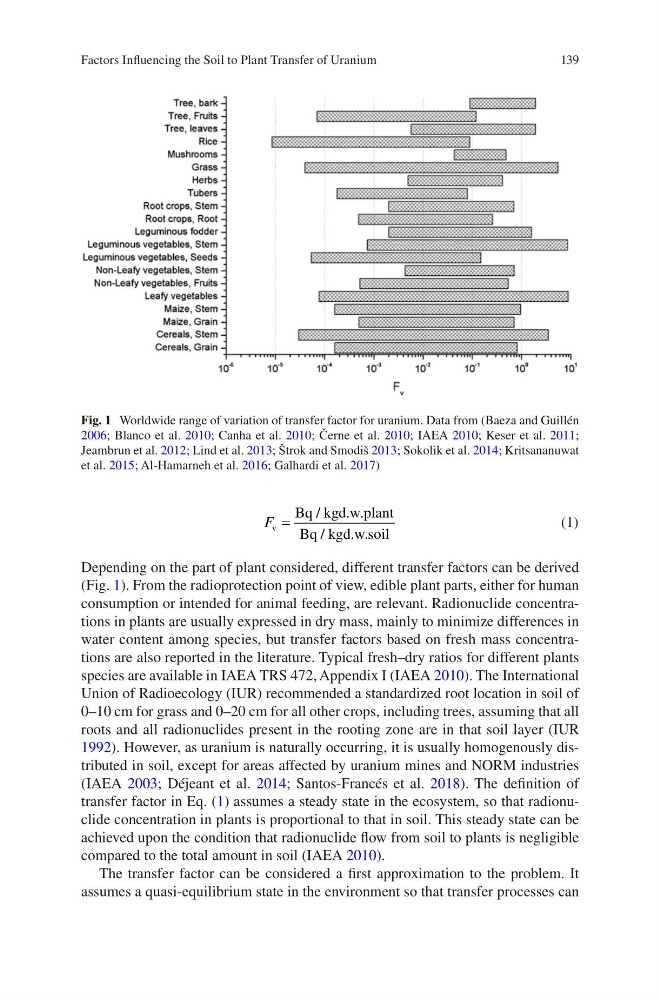
Depending on the part of plant considered, different transfer factors can be derived
(Fig. 1). From the radioprotection point of view, edible plant parts, either for human
consumption or intended for animal feeding, are relevant. Radionuclide concentrations in plants are usually expressed in dry mass, mainly to minimize differences in
water content among species, but transfer factors based on fresh mass concentrations are also reported in the literature. Typical fresh–dry ratios for different plants
species are available in IAEA TRS 472, Appendix I (IAEA 2010). The International
Union of Radioecology (IUR) recommended a standardized root location in soil of
0–10 cm for grass and 0–20 cm for all other crops, including trees, assuming that all
roots and all radionuclides present in the rooting zone are in that soil layer (IUR
1992). However, as uranium is naturally occurring, it is usually homogenously distributed in soil, except for areas affected by uranium mines and NORM industries
(IAEA 2003; Déjeant et al. 2014; Santos-Francés et al. 2018). The definition of
transfer factor in Eq. (1) assumes a steady state in the ecosystem, so that radionuclide concentration in plants is proportional to that in soil. This steady state can be
achieved upon the condition that radionuclide flow from soil to plants is negligible
compared to the total amount in soil (IAEA 2010).
The transfer factor can be considered a first approximation to the problem. It
assumes a quasi-equilibrium state in the environment so that transfer processes can
Fig. 1 Worldwide range of variation of transfer factor for uranium. Data from (Baeza and Guillén
2006; Blanco et al. 2010; Canha et al. 2010; Černe et al. 2010; IAEA 2010; Keser et al. 2011;
Jeambrun et al. 2012; Lind et al. 2013; Štrok and Smodiš 2013; Sokolik et al. 2014; Kritsananuwat
et al. 2015; Al-Hamarneh et al. 2016; Galhardi et al. 2017)
Factors Influencing the Soil to Plant Transfer of Uranium
F v
Bq kgd w plant
Bq kgd w soil
=
/
. .
/
. .
(1)
Depending on the part of plant considered, different transfer factors can be derived
(Fig. 1). From the radioprotection point of view, edible plant parts, either for human
consumption or intended for animal feeding, are relevant. Radionuclide concentrations in plants are usually expressed in dry mass, mainly to minimize differences in
water content among species, but transfer factors based on fresh mass concentrations are also reported in the literature. Typical fresh–dry ratios for different plants
species are available in IAEA TRS 472, Appendix I (IAEA 2010). The International
Union of Radioecology (IUR) recommended a standardized root location in soil of
0–10 cm for grass and 0–20 cm for all other crops, including trees, assuming that all
roots and all radionuclides present in the rooting zone are in that soil layer (IUR
1992). However, as uranium is naturally occurring, it is usually homogenously distributed in soil, except for areas affected by uranium mines and NORM industries
(IAEA 2003; Déjeant et al. 2014; Santos-Francés et al. 2018). The definition of
transfer factor in Eq. (1) assumes a steady state in the ecosystem, so that radionuclide concentration in plants is proportional to that in soil. This steady state can be
achieved upon the condition that radionuclide flow from soil to plants is negligible
compared to the total amount in soil (IAEA 2010).
The transfer factor can be considered a first approximation to the problem. It
assumes a quasi-equilibrium state in the environment so that transfer processes can
Fig. 1 Worldwide range of variation of transfer factor for uranium. Data from (Baeza and Guillén
2006; Blanco et al. 2010; Canha et al. 2010; Černe et al. 2010; IAEA 2010; Keser et al. 2011;
Jeambrun et al. 2012; Lind et al. 2013; Štrok and Smodiš 2013; Sokolik et al. 2014; Kritsananuwat
et al. 2015; Al-Hamarneh et al. 2016; Galhardi et al. 2017)
Factors Influencing the Soil to Plant Transfer of Uranium