

124
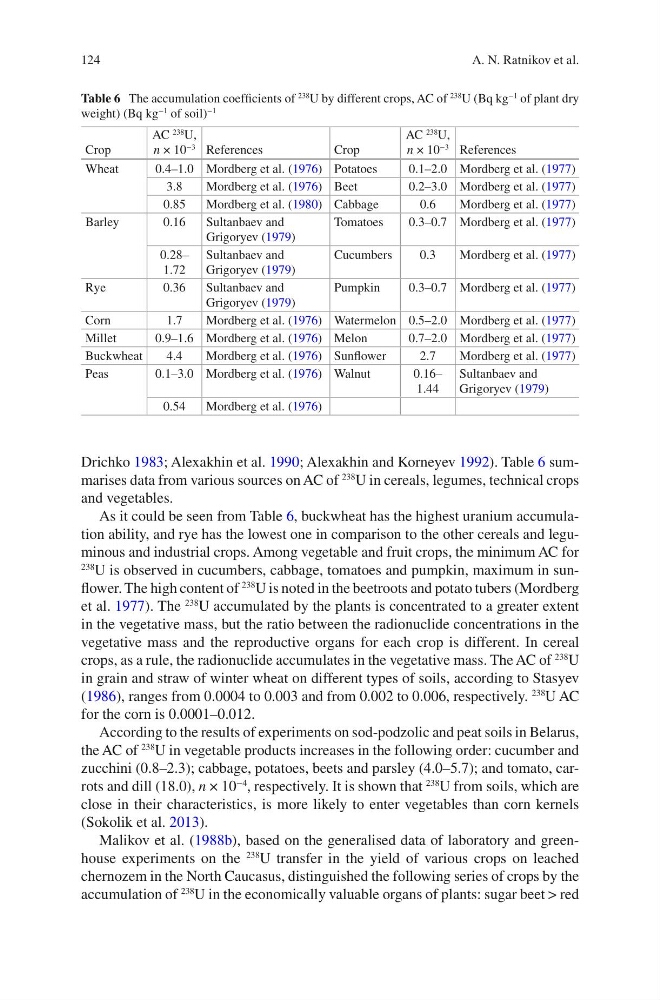
Drichko 1983; Alexakhin et al. 1990; Alexakhin and Korneyev 1992). Table 6 summarises data from various sources on AC of
238
U in cereals, legumes, technical crops
and vegetables.
As it could be seen from Table 6, buckwheat has the highest uranium accumulation ability, and rye has the lowest one in comparison to the other cereals and leguminous and industrial crops. Among vegetable and fruit crops, the minimum AC for
238
U is observed in cucumbers, cabbage, tomatoes and pumpkin, maximum in sunflower. The high content of
238
U is noted in the beetroots and potato tubers (Mordberg
et al. 1977). The
238
U accumulated by the plants is concentrated to a greater extent
in the vegetative mass, but the ratio between the radionuclide concentrations in the
vegetative mass and the reproductive organs for each crop is different. In cereal
crops, as a rule, the radionuclide accumulates in the vegetative mass. The AC of
238
U
in grain and straw of winter wheat on different types of soils, according to Stasyev
(1986), ranges from 0.0004 to 0.003 and from 0.002 to 0.006, respectively.
238
U AC
for the corn is 0.0001–0.012.
According to the results of experiments on sod-podzolic and peat soils in Belarus,
the AC of
238
U in vegetable products increases in the following order: cucumber and
zucchini (0.8–2.3); cabbage, potatoes, beets and parsley (4.0–5.7); and tomato, carrots and dill (18.0), n × 10
−4
, respectively. It is shown that
238
U from soils, which are
close in their characteristics, is more likely to enter vegetables than corn kernels
(Sokolik et al. 2013).
Malikov et al. (1988b), based on the generalised data of laboratory and greenhouse experiments on the
238
U transfer in the yield of various crops on leached
chernozem in the North Caucasus, distinguished the following series of crops by the
accumulation of
238
U in the economically valuable organs of plants: sugar beet > red
Table 6 The accumulation coefficients of
238
U by different crops, AC of
238
U (Bq kg
−1 of plant dry
weight) (Bq kg
−1 of soil)
−1
Crop
AC
238 U,
n × 10
−3 References
Crop
AC
238
U,
n × 10
−3 References
Wheat
0.4–1.0 Mordberg et al. (1976) Potatoes
0.1–2.0 Mordberg et al. (1977)
3.8
Mordberg et al. (1976) Beet
0.2–3.0 Mordberg et al. (1977)
0.85
Mordberg et al. (1980) Cabbage
0.6
Mordberg et al. (1977)
Barley
0.16
Sultanbaev and
Grigoryev (1979)
Tomatoes
0.3–0.7 Mordberg et al. (1977)
0.28–
1.72
Sultanbaev and
Grigoryev (1979)
Cucumbers
0.3
Mordberg et al. (1977)
Rye
0.36
Sultanbaev and
Grigoryev (1979)
Pumpkin
0.3–0.7 Mordberg et al. (1977)
Corn
1.7
Mordberg et al. (1976) Watermelon 0.5–2.0 Mordberg et al. (1977)
Millet
0.9–1.6 Mordberg et al. (1976) Melon
0.7–2.0 Mordberg et al. (1977)
Buckwheat
4.4
Mordberg et al. (1976) Sunflower
2.7
Mordberg et al. (1977)
Peas
0.1–3.0 Mordberg et al. (1976) Walnut
0.16–
1.44
Sultanbaev and
Grigoryev (1979)
0.54
Mordberg et al. (1976)
A. N. Ratnikov et al.
Drichko 1983; Alexakhin et al. 1990; Alexakhin and Korneyev 1992). Table 6 summarises data from various sources on AC of
238
U in cereals, legumes, technical crops
and vegetables.
As it could be seen from Table 6, buckwheat has the highest uranium accumulation ability, and rye has the lowest one in comparison to the other cereals and leguminous and industrial crops. Among vegetable and fruit crops, the minimum AC for
238
U is observed in cucumbers, cabbage, tomatoes and pumpkin, maximum in sunflower. The high content of
238
U is noted in the beetroots and potato tubers (Mordberg
et al. 1977). The
238
U accumulated by the plants is concentrated to a greater extent
in the vegetative mass, but the ratio between the radionuclide concentrations in the
vegetative mass and the reproductive organs for each crop is different. In cereal
crops, as a rule, the radionuclide accumulates in the vegetative mass. The AC of
238
U
in grain and straw of winter wheat on different types of soils, according to Stasyev
(1986), ranges from 0.0004 to 0.003 and from 0.002 to 0.006, respectively.
238
U AC
for the corn is 0.0001–0.012.
According to the results of experiments on sod-podzolic and peat soils in Belarus,
the AC of
238
U in vegetable products increases in the following order: cucumber and
zucchini (0.8–2.3); cabbage, potatoes, beets and parsley (4.0–5.7); and tomato, carrots and dill (18.0), n × 10
−4
, respectively. It is shown that
238
U from soils, which are
close in their characteristics, is more likely to enter vegetables than corn kernels
(Sokolik et al. 2013).
Malikov et al. (1988b), based on the generalised data of laboratory and greenhouse experiments on the
238
U transfer in the yield of various crops on leached
chernozem in the North Caucasus, distinguished the following series of crops by the
accumulation of
238
U in the economically valuable organs of plants: sugar beet > red
Table 6 The accumulation coefficients of
238
U by different crops, AC of
238
U (Bq kg
−1 of plant dry
weight) (Bq kg
−1 of soil)
−1
Crop
AC
238 U,
n × 10
−3 References
Crop
AC
238
U,
n × 10
−3 References
Wheat
0.4–1.0 Mordberg et al. (1976) Potatoes
0.1–2.0 Mordberg et al. (1977)
3.8
Mordberg et al. (1976) Beet
0.2–3.0 Mordberg et al. (1977)
0.85
Mordberg et al. (1980) Cabbage
0.6
Mordberg et al. (1977)
Barley
0.16
Sultanbaev and
Grigoryev (1979)
Tomatoes
0.3–0.7 Mordberg et al. (1977)
0.28–
1.72
Sultanbaev and
Grigoryev (1979)
Cucumbers
0.3
Mordberg et al. (1977)
Rye
0.36
Sultanbaev and
Grigoryev (1979)
Pumpkin
0.3–0.7 Mordberg et al. (1977)
Corn
1.7
Mordberg et al. (1976) Watermelon 0.5–2.0 Mordberg et al. (1977)
Millet
0.9–1.6 Mordberg et al. (1976) Melon
0.7–2.0 Mordberg et al. (1977)
Buckwheat
4.4
Mordberg et al. (1976) Sunflower
2.7
Mordberg et al. (1977)
Peas
0.1–3.0 Mordberg et al. (1976) Walnut
0.16–
1.44
Sultanbaev and
Grigoryev (1979)
0.54
Mordberg et al. (1976)
A. N. Ratnikov et al.