

123
chemical form for another 2 years after radioactive contamination of the meadow
sod surface. The bioavailability of
238
U, which entered the soil in the form of ammonium diuranate, uranyl chloride, uranium (VI) oxide, uranium (IV, VI) oxide, uranyl
sulphate, sodium uranate and uranium (IV) oxide, consistently decreases. For the
third year after the contamination, these differences become even (Ivanov and
Yudintseva 1987).
Peculiarities of mineral nutrition, different duration of the growing season, the
character of the distribution of root systems in the soil, differences in productivity
and other biological features of plants affect the accumulation of radionuclides by
different species and varieties of crops. Accumulation of
238
U in plants varies from
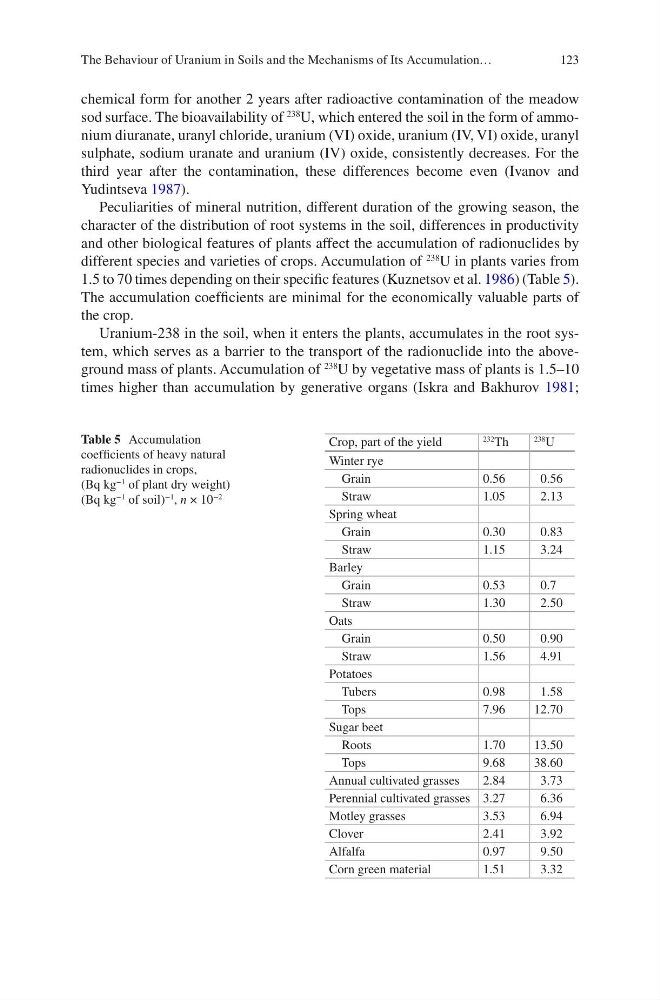
1.5 to 70 times depending on their specific features (Kuznetsov et al. 1986) (Table 5).
The accumulation coefficients are minimal for the economically valuable parts of
the crop.
Uranium-238 in the soil, when it enters the plants, accumulates in the root system, which serves as a barrier to the transport of the radionuclide into the aboveground mass of plants. Accumulation of
238
U by vegetative mass of plants is 1.5–10
times higher than accumulation by generative organs (Iskra and Bakhurov 1981;
Table 5 Accumulation
coefficients of heavy natural
radionuclides in crops,
(Bq kg
−1 of plant dry weight)
(Bq kg
−1 of soil)
−1
, n × 10
−2
Crop, part of the yield
232 Th
238 U
Winter rye
Grain
0.56
0.56
Straw
1.05
2.13
Spring wheat
Grain
0.30
0.83
Straw
1.15
3.24
Barley
Grain
0.53
0.7
Straw
1.30
2.50
Oats
Grain
0.50
0.90
Straw
1.56
4.91
Potatoes
Tubers
0.98
1.58
Tops
7.96
12.70
Sugar beet
Roots
1.70
13.50
Tops
9.68
38.60
Annual cultivated grasses
2.84
3.73
Perennial cultivated grasses 3.27
6.36
Motley grasses
3.53
6.94
Clover
2.41
3.92
Alfalfa
0.97
9.50
Corn green material
1.51
3.32
The Behaviour of Uranium in Soils and the Mechanisms of Its Accumulation…
chemical form for another 2 years after radioactive contamination of the meadow
sod surface. The bioavailability of
238
U, which entered the soil in the form of ammonium diuranate, uranyl chloride, uranium (VI) oxide, uranium (IV, VI) oxide, uranyl
sulphate, sodium uranate and uranium (IV) oxide, consistently decreases. For the
third year after the contamination, these differences become even (Ivanov and
Yudintseva 1987).
Peculiarities of mineral nutrition, different duration of the growing season, the
character of the distribution of root systems in the soil, differences in productivity
and other biological features of plants affect the accumulation of radionuclides by
different species and varieties of crops. Accumulation of
238
U in plants varies from
1.5 to 70 times depending on their specific features (Kuznetsov et al. 1986) (Table 5).
The accumulation coefficients are minimal for the economically valuable parts of
the crop.
Uranium-238 in the soil, when it enters the plants, accumulates in the root system, which serves as a barrier to the transport of the radionuclide into the aboveground mass of plants. Accumulation of
238
U by vegetative mass of plants is 1.5–10
times higher than accumulation by generative organs (Iskra and Bakhurov 1981;
Table 5 Accumulation
coefficients of heavy natural
radionuclides in crops,
(Bq kg
−1 of plant dry weight)
(Bq kg
−1 of soil)
−1
, n × 10
−2
Crop, part of the yield
232 Th
238 U
Winter rye
Grain
0.56
0.56
Straw
1.05
2.13
Spring wheat
Grain
0.30
0.83
Straw
1.15
3.24
Barley
Grain
0.53
0.7
Straw
1.30
2.50
Oats
Grain
0.50
0.90
Straw
1.56
4.91
Potatoes
Tubers
0.98
1.58
Tops
7.96
12.70
Sugar beet
Roots
1.70
13.50
Tops
9.68
38.60
Annual cultivated grasses
2.84
3.73
Perennial cultivated grasses 3.27
6.36
Motley grasses
3.53
6.94
Clover
2.41
3.92
Alfalfa
0.97
9.50
Corn green material
1.51
3.32
The Behaviour of Uranium in Soils and the Mechanisms of Its Accumulation…