

calcium and magnesium oxides with CO 2 to form stable
mineral carbonates. CO 2 can react with divalent metal oxides
or metal silicates to form the corresponding carbonate.
Accelerated carbonation is an exothermic reaction, where the
amount of heat released depends on the reactive metal and
on the material containing this metal oxide (El-Naas et al.
2015). In the case of alkaline solid wastes, residues with a
native pH value of greater than 10 typically contain portlandite (Ca(OH) 2 ), which controls the solubility of calcium
ions and the pH of solution (Olajire 2013) Portlandite can be
carbonated with CO 2 . The theoretical CO 2 fixation capacity
of alkaline solid wastes can be estimated based on the
chemical compositions of the wastes (Mohamed and El
Gamal 2011, 2014).
The aim of this study is to investigate and evaluate the
efficiency of the alkaline solid wastes on CCS, using different industrial waste residues from various industrial sectors in UAE such as steel, cement and acetylene factories as
feedstock material for mineral carbonation. The effect of
reaction variables on the sequestration potential is studied.
The degree of carbonation and carbonation efficiency as a
function of various process variables are investigated.
2 Experimental Work
2.1 Raw Materials, Types and Characterization
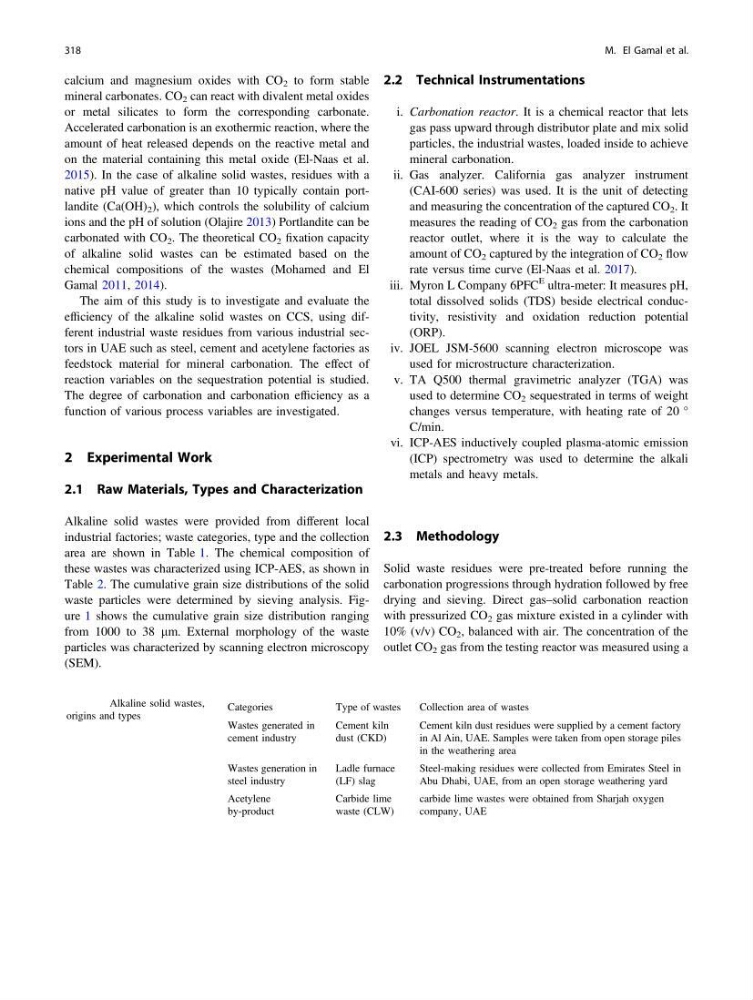
Alkaline solid wastes were provided from different local
industrial factories; waste categories, type and the collection
area are shown in Table 1. The chemical composition of
these wastes was characterized using ICP-AES, as shown in
Table 2. The cumulative grain size distributions of the solid
waste particles were determined by sieving analysis. Figure 1 shows the cumulative grain size distribution ranging
from 1000 to 38 lm. External morphology of the waste
particles was characterized by scanning electron microscopy
(SEM).
2.2 Technical Instrumentations
i. Carbonation reactor. It is a chemical reactor that lets
gas pass upward through distributor plate and mix solid
particles, the industrial wastes, loaded inside to achieve
mineral carbonation.
ii. Gas analyzer. California gas analyzer instrument
(CAI-600 series) was used. It is the unit of detecting
and measuring the concentration of the captured CO 2 . It
measures the reading of CO 2 gas from the carbonation
reactor outlet, where it is the way to calculate the
amount of CO 2 captured by the integration of CO 2 flow
rate versus time curve (El-Naas et al. 2017).
iii. Myron L Company 6PFC
E ultra-meter: It measures pH,
total dissolved solids (TDS) beside electrical conductivity, resistivity and oxidation reduction potential
(ORP).
iv. JOEL JSM-5600 scanning electron microscope was
used for microstructure characterization.
v. TA Q500 thermal gravimetric analyzer (TGA) was
used to determine CO 2 sequestrated in terms of weight
changes versus temperature, with heating rate of 20 °
C/min.
vi. ICP-AES inductively coupled plasma-atomic emission
(ICP) spectrometry was used to determine the alkali
metals and heavy metals.
2.3 Methodology
Solid waste residues were pre-treated before running the
carbonation progressions through hydration followed by free
drying and sieving. Direct gas–solid carbonation reaction
with pressurized CO 2 gas mixture existed in a cylinder with
10% (v/v) CO 2 , balanced with air. The concentration of the
outlet CO 2 gas from the testing reactor was measured using a
Table 1 Alkaline solid wastes,
origins and types
Categories
Type of wastes
Collection area of wastes
Wastes generated in
cement industry
Cement kiln
dust (CKD)
Cement kiln dust residues were supplied by a cement factory
in Al Ain, UAE. Samples were taken from open storage piles
in the weathering area
Wastes generation in
steel industry
Ladle furnace
(LF) slag
Steel-making residues were collected from Emirates Steel in
Abu Dhabi, UAE, from an open storage weathering yard
Acetylene
by-product
Carbide lime
waste (CLW)
carbide lime wastes were obtained from Sharjah oxygen
company, UAE
318
M. El Gamal et al.
mineral carbonates. CO 2 can react with divalent metal oxides
or metal silicates to form the corresponding carbonate.
Accelerated carbonation is an exothermic reaction, where the
amount of heat released depends on the reactive metal and
on the material containing this metal oxide (El-Naas et al.
2015). In the case of alkaline solid wastes, residues with a
native pH value of greater than 10 typically contain portlandite (Ca(OH) 2 ), which controls the solubility of calcium
ions and the pH of solution (Olajire 2013) Portlandite can be
carbonated with CO 2 . The theoretical CO 2 fixation capacity
of alkaline solid wastes can be estimated based on the
chemical compositions of the wastes (Mohamed and El
Gamal 2011, 2014).
The aim of this study is to investigate and evaluate the
efficiency of the alkaline solid wastes on CCS, using different industrial waste residues from various industrial sectors in UAE such as steel, cement and acetylene factories as
feedstock material for mineral carbonation. The effect of
reaction variables on the sequestration potential is studied.
The degree of carbonation and carbonation efficiency as a
function of various process variables are investigated.
2 Experimental Work
2.1 Raw Materials, Types and Characterization
Alkaline solid wastes were provided from different local
industrial factories; waste categories, type and the collection
area are shown in Table 1. The chemical composition of
these wastes was characterized using ICP-AES, as shown in
Table 2. The cumulative grain size distributions of the solid
waste particles were determined by sieving analysis. Figure 1 shows the cumulative grain size distribution ranging
from 1000 to 38 lm. External morphology of the waste
particles was characterized by scanning electron microscopy
(SEM).
2.2 Technical Instrumentations
i. Carbonation reactor. It is a chemical reactor that lets
gas pass upward through distributor plate and mix solid
particles, the industrial wastes, loaded inside to achieve
mineral carbonation.
ii. Gas analyzer. California gas analyzer instrument
(CAI-600 series) was used. It is the unit of detecting
and measuring the concentration of the captured CO 2 . It
measures the reading of CO 2 gas from the carbonation
reactor outlet, where it is the way to calculate the
amount of CO 2 captured by the integration of CO 2 flow
rate versus time curve (El-Naas et al. 2017).
iii. Myron L Company 6PFC
E ultra-meter: It measures pH,
total dissolved solids (TDS) beside electrical conductivity, resistivity and oxidation reduction potential
(ORP).
iv. JOEL JSM-5600 scanning electron microscope was
used for microstructure characterization.
v. TA Q500 thermal gravimetric analyzer (TGA) was
used to determine CO 2 sequestrated in terms of weight
changes versus temperature, with heating rate of 20 °
C/min.
vi. ICP-AES inductively coupled plasma-atomic emission
(ICP) spectrometry was used to determine the alkali
metals and heavy metals.
2.3 Methodology
Solid waste residues were pre-treated before running the
carbonation progressions through hydration followed by free
drying and sieving. Direct gas–solid carbonation reaction
with pressurized CO 2 gas mixture existed in a cylinder with
10% (v/v) CO 2 , balanced with air. The concentration of the
outlet CO 2 gas from the testing reactor was measured using a
Table 1 Alkaline solid wastes,
origins and types
Categories
Type of wastes
Collection area of wastes
Wastes generated in
cement industry
Cement kiln
dust (CKD)
Cement kiln dust residues were supplied by a cement factory
in Al Ain, UAE. Samples were taken from open storage piles
in the weathering area
Wastes generation in
steel industry
Ladle furnace
(LF) slag
Steel-making residues were collected from Emirates Steel in
Abu Dhabi, UAE, from an open storage weathering yard
Acetylene
by-product
Carbide lime
waste (CLW)
carbide lime wastes were obtained from Sharjah oxygen
company, UAE
318
M. El Gamal et al.