

Avoidance of Oversimplifications. From the proposed
design charts, it is obvious that it is not appropriate to
oversimplify the process of sizing the windows for daylighting by mentioning that window area should equal
approximately 20% of a room’s floor area, to provide
enough light, even during overcast days (Keeler and Vaidya
2016). This is not a very precise method to be used as a rule
of thumb due to the fluctuating variables that affect the area
of glazing required for providing an adequate amount of
daylight, e.g., (s), (R), and (h). Additionally, if it is required
to simplify the process of sizing the windows for daylighting, the use of the proposed design charts might be the
answer.
4 Discussion and Conclusions
It is possible to use the proposed design charts as a rule of
thumb to determine the sizing of vertical windows needed
for providing adequate amount of daylight needed for most
basic applications. The amount of daylight entering a given
room is a function of a number of variables concerning the
properties of the window, the room, and the surrounding
environment. And the proposed design charts use graphs
signifying most of those different variables, which in turn
make it possible to be used as a quick tool, especially within
the preliminary stages of design. Those design charts could
not only be used for design by finding the window area (W),
but also could be used for analysis by finding the daylight
factor (DF) caused by an existing window.
In future researches, those design charts could be
upgraded to include more variables such as orientation, sky
conditions, external reflected component (ERC), etc. The
same methodology could be used for finding the dimensions
of other daylight media such as skylights, etc., or other
architectural elements such as self-shading masses, climatic
envelopes, etc. (Saifelnasr 2003). Other researches might
involve studying the integration between daylighting and
other building systems, e.g., solar heat gain (Szokolay
2008), ventilation, etc., that might affect the sizing of such
windows that are used for more than one function. In
addition, future researches might involve studying the
cost-effectiveness, efficiency, or energy savings that might
result from the use of such windows in the different climates.
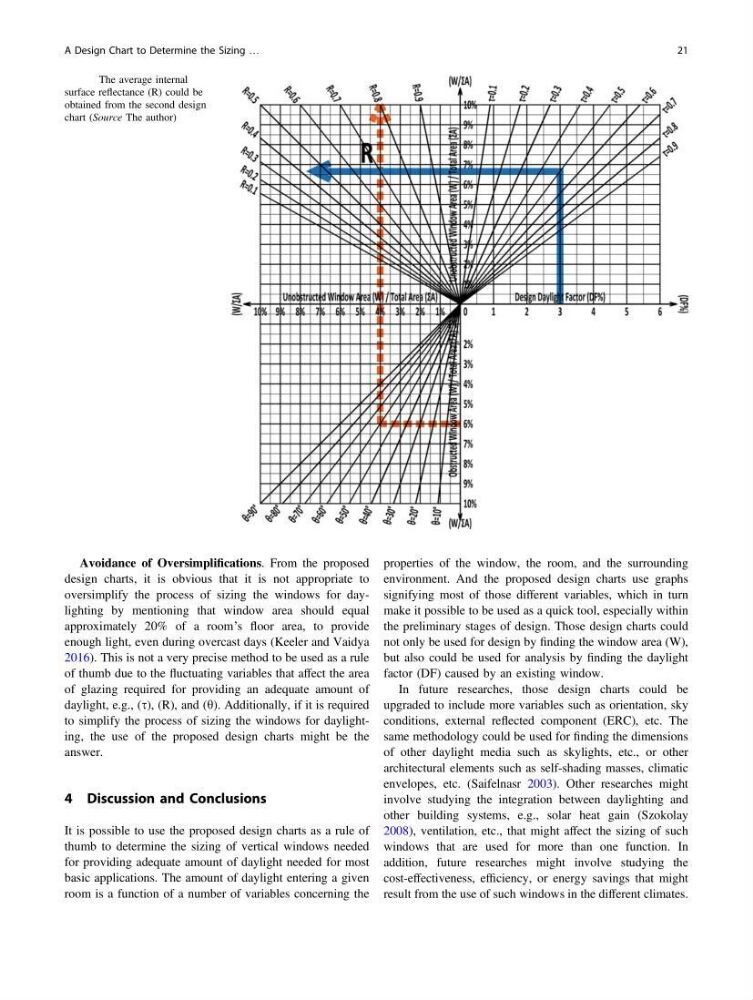
Fig. 8 The average internal
surface reflectance (R) could be
obtained from the second design
chart (Source The author)
A Design Chart to Determine the Sizing …
21
design charts, it is obvious that it is not appropriate to
oversimplify the process of sizing the windows for daylighting by mentioning that window area should equal
approximately 20% of a room’s floor area, to provide
enough light, even during overcast days (Keeler and Vaidya
2016). This is not a very precise method to be used as a rule
of thumb due to the fluctuating variables that affect the area
of glazing required for providing an adequate amount of
daylight, e.g., (s), (R), and (h). Additionally, if it is required
to simplify the process of sizing the windows for daylighting, the use of the proposed design charts might be the
answer.
4 Discussion and Conclusions
It is possible to use the proposed design charts as a rule of
thumb to determine the sizing of vertical windows needed
for providing adequate amount of daylight needed for most
basic applications. The amount of daylight entering a given
room is a function of a number of variables concerning the
properties of the window, the room, and the surrounding
environment. And the proposed design charts use graphs
signifying most of those different variables, which in turn
make it possible to be used as a quick tool, especially within
the preliminary stages of design. Those design charts could
not only be used for design by finding the window area (W),
but also could be used for analysis by finding the daylight
factor (DF) caused by an existing window.
In future researches, those design charts could be
upgraded to include more variables such as orientation, sky
conditions, external reflected component (ERC), etc. The
same methodology could be used for finding the dimensions
of other daylight media such as skylights, etc., or other
architectural elements such as self-shading masses, climatic
envelopes, etc. (Saifelnasr 2003). Other researches might
involve studying the integration between daylighting and
other building systems, e.g., solar heat gain (Szokolay
2008), ventilation, etc., that might affect the sizing of such
windows that are used for more than one function. In
addition, future researches might involve studying the
cost-effectiveness, efficiency, or energy savings that might
result from the use of such windows in the different climates.
Fig. 8 The average internal
surface reflectance (R) could be
obtained from the second design
chart (Source The author)
A Design Chart to Determine the Sizing …
21