

into superior performance. The development of this model is
explained in the following sections.
10 The Adopted Model from the Literature
by Peteraf
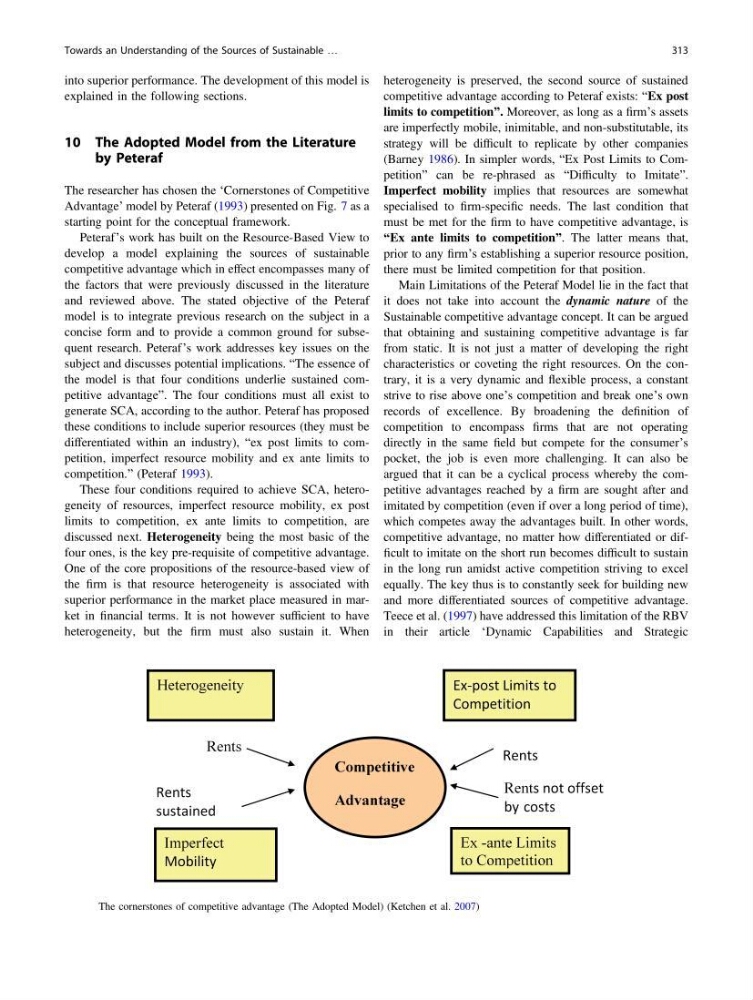
The researcher has chosen the ‘Cornerstones of Competitive
Advantage’ model by Peteraf (1993) presented on Fig. 7 as a
starting point for the conceptual framework.
Peteraf’s work has built on the Resource-Based View to
develop a model explaining the sources of sustainable
competitive advantage which in effect encompasses many of
the factors that were previously discussed in the literature
and reviewed above. The stated objective of the Peteraf
model is to integrate previous research on the subject in a
concise form and to provide a common ground for subsequent research. Peteraf’s work addresses key issues on the
subject and discusses potential implications. “The essence of
the model is that four conditions underlie sustained competitive advantage”. The four conditions must all exist to
generate SCA, according to the author. Peteraf has proposed
these conditions to include superior resources (they must be
differentiated within an industry), “ex post limits to competition, imperfect resource mobility and ex ante limits to
competition.” (Peteraf 1993).
These four conditions required to achieve SCA, heterogeneity of resources, imperfect resource mobility, ex post
limits to competition, ex ante limits to competition, are
discussed next. Heterogeneity being the most basic of the
four ones, is the key pre-requisite of competitive advantage.
One of the core propositions of the resource-based view of
the firm is that resource heterogeneity is associated with
superior performance in the market place measured in market in financial terms. It is not however sufficient to have
heterogeneity, but the firm must also sustain it. When
heterogeneity is preserved, the second source of sustained
competitive advantage according to Peteraf exists: “Ex post
limits to competition”. Moreover, as long as a firm’s assets
are imperfectly mobile, inimitable, and non-substitutable, its
strategy will be difficult to replicate by other companies
(Barney 1986). In simpler words, “Ex Post Limits to Competition” can be re-phrased as “Difficulty to Imitate”.
Imperfect mobility implies that resources are somewhat
specialised to firm-specific needs. The last condition that
must be met for the firm to have competitive advantage, is
“Ex ante limits to competition”. The latter means that,
prior to any firm’s establishing a superior resource position,
there must be limited competition for that position.
Main Limitations of the Peteraf Model lie in the fact that
it does not take into account the dynamic nature of the
Sustainable competitive advantage concept. It can be argued
that obtaining and sustaining competitive advantage is far
from static. It is not just a matter of developing the right
characteristics or coveting the right resources. On the contrary, it is a very dynamic and flexible process, a constant
strive to rise above one’s competition and break one’s own
records of excellence. By broadening the definition of
competition to encompass firms that are not operating
directly in the same field but compete for the consumer’s
pocket, the job is even more challenging. It can also be
argued that it can be a cyclical process whereby the competitive advantages reached by a firm are sought after and
imitated by competition (even if over a long period of time),
which competes away the advantages built. In other words,
competitive advantage, no matter how differentiated or difficult to imitate on the short run becomes difficult to sustain
in the long run amidst active competition striving to excel
equally. The key thus is to constantly seek for building new
and more differentiated sources of competitive advantage.
Teece et al. (1997) have addressed this limitation of the RBV
in their article ‘Dynamic Capabilities and Strategic
Fig. 7 The cornerstones of competitive advantage (The Adopted Model) (Ketchen et al. 2007)
Towards an Understanding of the Sources of Sustainable …
313
explained in the following sections.
10 The Adopted Model from the Literature
by Peteraf
The researcher has chosen the ‘Cornerstones of Competitive
Advantage’ model by Peteraf (1993) presented on Fig. 7 as a
starting point for the conceptual framework.
Peteraf’s work has built on the Resource-Based View to
develop a model explaining the sources of sustainable
competitive advantage which in effect encompasses many of
the factors that were previously discussed in the literature
and reviewed above. The stated objective of the Peteraf
model is to integrate previous research on the subject in a
concise form and to provide a common ground for subsequent research. Peteraf’s work addresses key issues on the
subject and discusses potential implications. “The essence of
the model is that four conditions underlie sustained competitive advantage”. The four conditions must all exist to
generate SCA, according to the author. Peteraf has proposed
these conditions to include superior resources (they must be
differentiated within an industry), “ex post limits to competition, imperfect resource mobility and ex ante limits to
competition.” (Peteraf 1993).
These four conditions required to achieve SCA, heterogeneity of resources, imperfect resource mobility, ex post
limits to competition, ex ante limits to competition, are
discussed next. Heterogeneity being the most basic of the
four ones, is the key pre-requisite of competitive advantage.
One of the core propositions of the resource-based view of
the firm is that resource heterogeneity is associated with
superior performance in the market place measured in market in financial terms. It is not however sufficient to have
heterogeneity, but the firm must also sustain it. When
heterogeneity is preserved, the second source of sustained
competitive advantage according to Peteraf exists: “Ex post
limits to competition”. Moreover, as long as a firm’s assets
are imperfectly mobile, inimitable, and non-substitutable, its
strategy will be difficult to replicate by other companies
(Barney 1986). In simpler words, “Ex Post Limits to Competition” can be re-phrased as “Difficulty to Imitate”.
Imperfect mobility implies that resources are somewhat
specialised to firm-specific needs. The last condition that
must be met for the firm to have competitive advantage, is
“Ex ante limits to competition”. The latter means that,
prior to any firm’s establishing a superior resource position,
there must be limited competition for that position.
Main Limitations of the Peteraf Model lie in the fact that
it does not take into account the dynamic nature of the
Sustainable competitive advantage concept. It can be argued
that obtaining and sustaining competitive advantage is far
from static. It is not just a matter of developing the right
characteristics or coveting the right resources. On the contrary, it is a very dynamic and flexible process, a constant
strive to rise above one’s competition and break one’s own
records of excellence. By broadening the definition of
competition to encompass firms that are not operating
directly in the same field but compete for the consumer’s
pocket, the job is even more challenging. It can also be
argued that it can be a cyclical process whereby the competitive advantages reached by a firm are sought after and
imitated by competition (even if over a long period of time),
which competes away the advantages built. In other words,
competitive advantage, no matter how differentiated or difficult to imitate on the short run becomes difficult to sustain
in the long run amidst active competition striving to excel
equally. The key thus is to constantly seek for building new
and more differentiated sources of competitive advantage.
Teece et al. (1997) have addressed this limitation of the RBV
in their article ‘Dynamic Capabilities and Strategic
Fig. 7 The cornerstones of competitive advantage (The Adopted Model) (Ketchen et al. 2007)
Towards an Understanding of the Sources of Sustainable …
313