

Srivastava, Fahey and Christensen (2001) believe that the
attention given to the marketing role in the resource-based
theory is not commensurate with its potential importance. In
addition, the growing theoretical and conceptual work on
marketing research is not supported by empirical investigations (Milfelner et al. 2008). A large body of literature has
thus emerged, discussing Market Orientation as a source of
superior performance and Sustainable Competitive Advantage, at the other end of the continuum from the RBV as will
be demonstrated in the below sections.
6 Knowledge Management as a Source
of Sustainable Competitive Advantage
The VUCA (Volatile, Uncertain, Complex, Ambiguous)
environment that is the characteristic of today’s day and age
poses a number of new challenges for organisations, accelerated also by globalisation and digitisation, which impose
different ways of doing things than in the past. In this context, the rapid dissemination of knowledge and its widespread and rapid availability to consumers has generated
important discussions around the important role that
Knowledge Management and knowledge based resources (as
opposed to purely tangible ones) must now play in creating
and sustaining competitive advantage and superior performance (Nguyen et al. 2009).
Consequently, another important intangible asset often
quoted to be a source of competitive advantage is knowledge
management. Knowledge is the key competitive advantage
for an organisation according to Grant (1996).
The Resource-Based View is gradually placing more
emphasis on the importance of the firm’s knowledge as a
driver in maintaining a company’s competitive advantage
(Narasimha 2000). In the RBV concept (Wernerfelt, Barney,
Prahalad & Hamel, Peteraf, Conner), knowledge has the
ability to become a source of SCA for a firm, if adequately
managed (as cited in Halawi and Aronson 2005).
Knowledge is broadly defined as credible information
that is of potential value to the organisation (Hult 2003).
Knowledge can be dissected as inbound and outbound
knowledge. The inbound aspect of knowledge pertains to
generation of knowledge, which entails compilation and
sharing of information and coding this information into
widely agreed messages and conclusions, i.e. useful information that could guide decision making within the organisation (Ketchen et al. 2003). The outbound aspect of the
knowledge management process addresses the deployment
of knowledge to gain an edge in the market place, which is a
much more difficult task.
Hult (2003) defines knowledge management as the
structured and methodical manner in which knowledge is
accumulated and shared within an organisation and subsequently utilised it in a manner that builds competitive
advantage for the firm, by drawing on explicit as well as tacit
knowledge.
Despite widespread agreement by managers regarding the
strategic importance of knowledge, most face challenges in
extracting real benefits for their business from their knowledge management efforts. An important contributor to this
challenge is the fact that it is often assumed that merely
acquiring knowledge will automatically yield benefits
(Murray 2002). In fact, mere possession of the knowledge
will not inspire action if it is not adequately disseminated.
Murray advances four logical steps, described below, to
deliver tangible benefits from Knowledge Management
(KM) initiatives.
Step 1: KM as a demand-led business activity. Knowledge
Management can only generate positive business results if it
is capitalised on in such a way that serves business objectives, as driven by the management of the organisation. It
must be seen as only an enabler. In this context, KM must
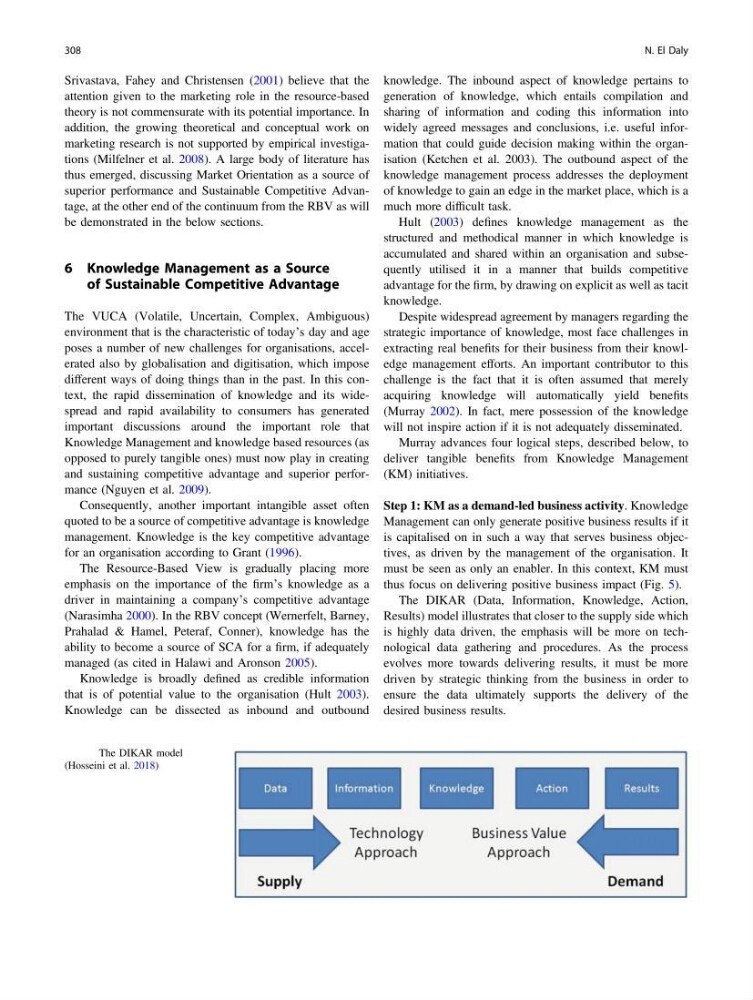
thus focus on delivering positive business impact (Fig. 5).
The DIKAR (Data, Information, Knowledge, Action,
Results) model illustrates that closer to the supply side which
is highly data driven, the emphasis will be more on technological data gathering and procedures. As the process
evolves more towards delivering results, it must be more
driven by strategic thinking from the business in order to
ensure the data ultimately supports the delivery of the
desired business results.
Fig. 5 The DIKAR model
(Hosseini et al. 2018)
308
N. El Daly
attention given to the marketing role in the resource-based
theory is not commensurate with its potential importance. In
addition, the growing theoretical and conceptual work on
marketing research is not supported by empirical investigations (Milfelner et al. 2008). A large body of literature has
thus emerged, discussing Market Orientation as a source of
superior performance and Sustainable Competitive Advantage, at the other end of the continuum from the RBV as will
be demonstrated in the below sections.
6 Knowledge Management as a Source
of Sustainable Competitive Advantage
The VUCA (Volatile, Uncertain, Complex, Ambiguous)
environment that is the characteristic of today’s day and age
poses a number of new challenges for organisations, accelerated also by globalisation and digitisation, which impose
different ways of doing things than in the past. In this context, the rapid dissemination of knowledge and its widespread and rapid availability to consumers has generated
important discussions around the important role that
Knowledge Management and knowledge based resources (as
opposed to purely tangible ones) must now play in creating
and sustaining competitive advantage and superior performance (Nguyen et al. 2009).
Consequently, another important intangible asset often
quoted to be a source of competitive advantage is knowledge
management. Knowledge is the key competitive advantage
for an organisation according to Grant (1996).
The Resource-Based View is gradually placing more
emphasis on the importance of the firm’s knowledge as a
driver in maintaining a company’s competitive advantage
(Narasimha 2000). In the RBV concept (Wernerfelt, Barney,
Prahalad & Hamel, Peteraf, Conner), knowledge has the
ability to become a source of SCA for a firm, if adequately
managed (as cited in Halawi and Aronson 2005).
Knowledge is broadly defined as credible information
that is of potential value to the organisation (Hult 2003).
Knowledge can be dissected as inbound and outbound
knowledge. The inbound aspect of knowledge pertains to
generation of knowledge, which entails compilation and
sharing of information and coding this information into
widely agreed messages and conclusions, i.e. useful information that could guide decision making within the organisation (Ketchen et al. 2003). The outbound aspect of the
knowledge management process addresses the deployment
of knowledge to gain an edge in the market place, which is a
much more difficult task.
Hult (2003) defines knowledge management as the
structured and methodical manner in which knowledge is
accumulated and shared within an organisation and subsequently utilised it in a manner that builds competitive
advantage for the firm, by drawing on explicit as well as tacit
knowledge.
Despite widespread agreement by managers regarding the
strategic importance of knowledge, most face challenges in
extracting real benefits for their business from their knowledge management efforts. An important contributor to this
challenge is the fact that it is often assumed that merely
acquiring knowledge will automatically yield benefits
(Murray 2002). In fact, mere possession of the knowledge
will not inspire action if it is not adequately disseminated.
Murray advances four logical steps, described below, to
deliver tangible benefits from Knowledge Management
(KM) initiatives.
Step 1: KM as a demand-led business activity. Knowledge
Management can only generate positive business results if it
is capitalised on in such a way that serves business objectives, as driven by the management of the organisation. It
must be seen as only an enabler. In this context, KM must
thus focus on delivering positive business impact (Fig. 5).
The DIKAR (Data, Information, Knowledge, Action,
Results) model illustrates that closer to the supply side which
is highly data driven, the emphasis will be more on technological data gathering and procedures. As the process
evolves more towards delivering results, it must be more
driven by strategic thinking from the business in order to
ensure the data ultimately supports the delivery of the
desired business results.
Fig. 5 The DIKAR model
(Hosseini et al. 2018)
308
N. El Daly